


 How can we recover the colours Bach may have imagined at the organ? In his complete recording of Part III of the “Clavier-Übung”, Maurizio Croci draws on the registration indications left by Georg Friedrich Kauffmann, a contemporary of the Cantor. On the Treutmann organ at Grauhof, built in 1737, he offers a fresh reading of one of the great monuments of Bach’s organ music.
  By
By 


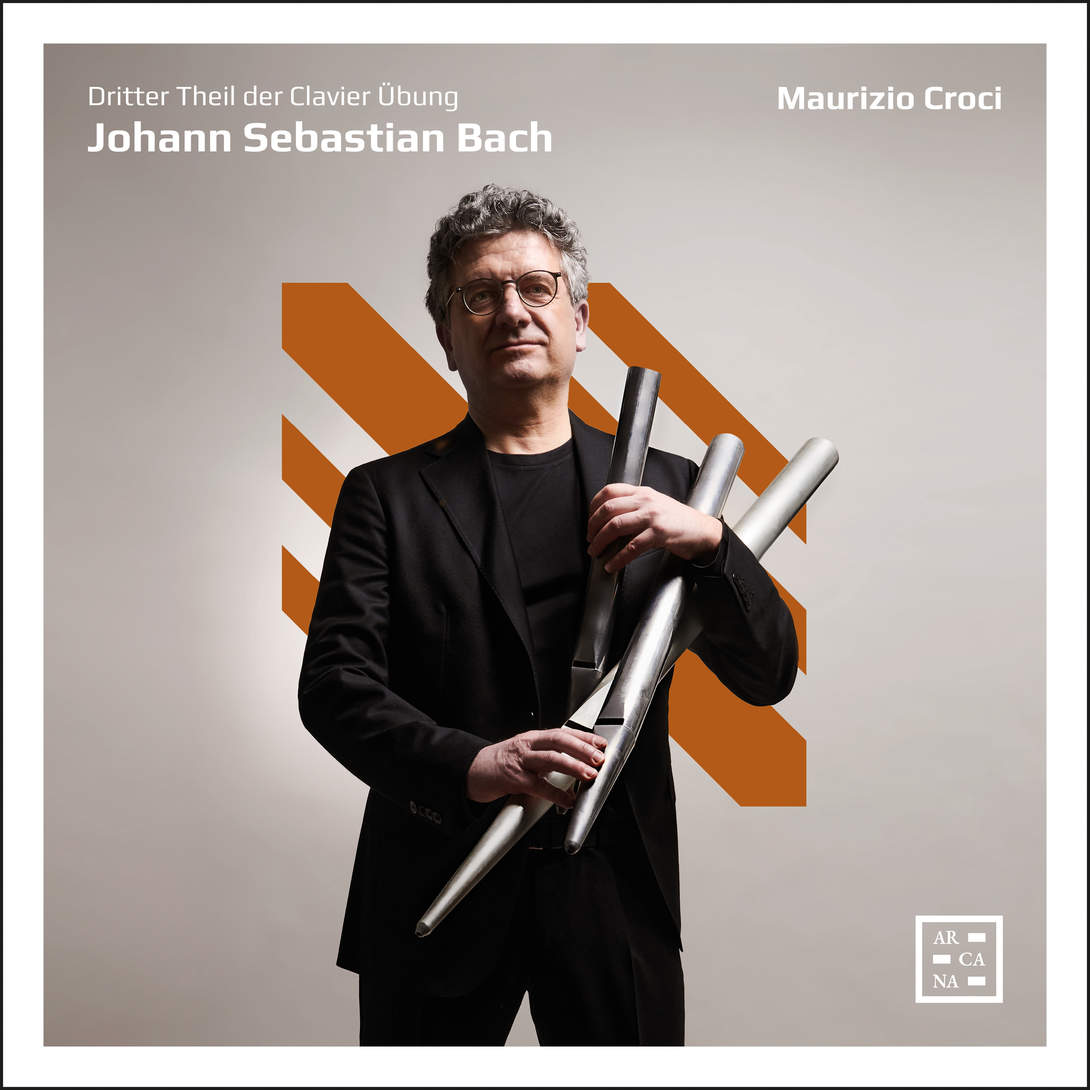
With this double album released by Arcana, Maurizio Croci returns to Part III of the Clavier-Übung, published by Johann Sebastian Bach in Leipzig in 1739. Twenty-one chorale preludes, four duets and the imposing Prelude and Fugue in E flat major, BWV 552, make up a vast collection conceived as a true compendium of organ writing. But the recording is built above all around one question: how can we recreate today the registrations – the choice and combination of organ stops – and the sound colours Bach may have had in mind? To answer it, Croci turns to another German organist of the period, Georg Friedrich Kauffmann.
When Part III of the Clavier-Übung appeared in 1739, Bach brought together an extraordinary range of styles within a single volume. The great Prelude and Fugue BWV 552 frames twenty-one chorales covering the principal elements of the Lutheran liturgy, alongside four duets in two-part counterpoint. Older forms sit alongside a more modern language: stile antico, fugue, canon and cantus firmus rub shoulders with rhythms and articulations already shaped by the galant style. According to Peter Wollny, director of the Bach-Archiv Leipzig and author of the first essay in the booklet, Bach thereby restored to the chorale prelude an artistic ambition extending far beyond its purely liturgical function.
In search of Bach’s colours
The originality of the recording lies above all in its choice of registrations. Direct evidence of how Bach combined organ stops is extremely scarce. His first biographer, Johann Nikolaus Forkel, nevertheless describes how his combinations of timbres could astonish the organists and organ builders of his day before winning them over through their effects.
Maurizio Croci finds a possible clue in Georg Friedrich Kauffmann (1679–1735), organist at Merseburg Cathedral and, like Bach, a candidate for the post of Thomaskantor in Leipzig in 1723. Between 1733 and 1736, Kauffmann published the ninety-seven chorale preludes of his Harmonische Seelenlust. The collection is a particularly valuable source, containing numerous indications on articulation, ornamentation, tempo and, above all, registration.
The two collections also share several points of contact. Both draw on melodies from the Lutheran liturgical repertoire and alternate pedaliter and manualiter pieces. They are closely related chronologically, and certain thematic similarities – notably between one of Kauffmann’s Fugella and Bach’s Fughetta BWV 677 – even suggest that Bach may have known his colleague’s work. Croci therefore does not seek to apply Kauffmann’s registrations mechanically to Bach’s music, but rather to use them as a key to exploring its sound world.
Kauffmann as a guide
Certain aspects of Kauffmann’s practice are of particular interest. In around half the pieces in the Harmonische Seelenlust, a 16-foot stop is required on the manuals, sometimes even in the upper voices. These choices give the sound a distinctive depth and encourage bold combinations of timbres, recalling precisely Forkel’s descriptions of Bach. For Kauffmann, registration is also closely linked to the Affekt of the chorale – its expressive and spiritual character.
Croci adapts these principles to Bach’s music according to the demands of the writing: treatment of bass lines, solo stops, contrasts of colour and the use of 16-foot stops in certain manualiter pieces. The recording forms part of the Kauffmann to Bach research project, led by Croci at HEMU – Haute école de musique and funded by HES-SO. Its aim is precisely to use Kauffmann’s indications as an interpretative tool for gaining a better understanding of the sound world of Bach’s organ music.
An almost contemporary organ
This approach finds a particularly suitable setting in the Christoph Treutmann organ at the Stiftskirche in Grauhof, Germany. Built in 1737, just two years before the publication of the Clavier-Übung III, it offers a wide range of principals, flutes, gambas, mixtures and reed stops, allowing Croci to explore the combinations of colour at the heart of his approach. The recording was made on the instrument from 9 to 11 June 2025.
Spread across two discs, the complete recording follows the architecture of the collection: the Prelude BWV 552 opens the journey before the twenty-one chorales; the four Duetti, BWV 802–805, follow, before the great five-part Fugue BWV 552 brings the cycle to a close. The sequence reveals the full range of Bach’s organ language, from the rigour of the stile antico to galant lightness, from monumental counterpoint to the most pared-back writing.
With this recording, Maurizio Croci makes no claim to recreate some hypothetical “authentic sound” of Bach. Instead, he offers a new way of approaching a much-recorded work through a contemporary source capable of shedding fresh light on its colours. Kauffmann is absent from the programme itself, yet his Harmonische Seelenlust remains present throughout the interpretation: a reminder that, at the organ, the score alone does not determine the sound, and that the choice of registrations is an integral part of interpretation.
You must be logged in to be able to post comments.
Sign in