


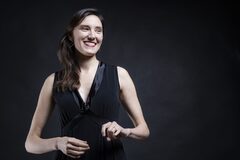
 Maayan Licht has made his mark on Europe’s Baroque scene with an ironclad technique, honed in particular at the Conservatorium van Amsterdam, and a raw emotional intensity that is gradually becoming his signature. The Israeli singer has just left his first agency, Parnassus, to strike out on his own and enter a new phase of his career. On November 27, he takes on the title role in Handel’s *Serse* in Oldenburg. Before then, on November 19, 21 and 24, he reunites with the Lithuanian Chamber Orchestra for *Sopranista Fireworks* in Kaunas, Vilnius and Klaipėda. The sopranist looks back on his remarkable journey, his artistic choices, his distinctive relationship with social media and the vulnerability he now embraces as a true hallmark of his artistry.
 By
 11 minutes



Maayan Licht is no ordinary sopranist. His journey, shaped by upheaval and resilience, has made him an artist unlike any other. Leaving behind the label of “protégé,” he is now embarking on an international career that he intends to manage from A to Z. Armed with impeccable technique, raw sensitivity, and a keen understanding of the digital world (1.5 million followers!), he is poised to conquer the world’s greatest stages, having already appeared at the legendary Bayreuth Baroque Festival. “For me, vulnerability is the key to every piece. When I’m angry, I’m really angry. When I’m sad, I cry,” he says. And what if his name, Licht (“light” in German), were no coincidence?
It is 6:00 p.m., and Maayan Licht’s voice rings out, clear, naturally musical, and often soothing. After brilliantly stepping in at the last minute for soprano Julia Lezhneva with the Kammerorchester Basel, and before flying to Bayreuth, the sopranist takes a break from an increasingly busy schedule to look back on a journey that, in less than ten years, has propelled him from the Amsterdam Conservatory to some of Europe’s greatest stages.
Identity and the journey from Israel to Europe
Looking at the current rise of sopranists and countertenors—Franco Fagioli, Bruno de Sá, Max Emanuel Cenčić, Dennis Orellana, Maximiliano Danta—many come from South America. As an Israeli, have you ever felt like an outsider in this very Latin landscape?
Maayan Licht: (laughs) You know, before I think about them, I think about myself. No, I’m joking. But it’s funny you should ask because, as it happens, my mother was born in Uruguay. So I do have a little Latin blood in me. After World War II, my grandfather fled to Montevideo to join the large Jewish community there. My mother was born there and, at 18, left for Israel to make Aliyah. So I’m a real melting pot: my mother is Uruguayan, my father is Polish, and I even have Turkish roots. So yes, I grew up in Israel, but really, I come from everywhere. If I took a DNA test, it would be very interesting.
Baroque music has not yet become part of the cultural norm in Israel. What did a young boy from Tel Aviv understand about Handel, Porpora, or Hasse before meeting your teacher, Vita Gurevich, who told you to stop singing pop and concentrate on opera? What did she hear in your voice that you had not yet recognized yourself?
M. L.: It’s true, Baroque music isn’t part of Israel’s cultural DNA. I was the village singer, the one who sang at ceremonies. I sang everything, from pop to Hebrew songs, with a fairly light voice. When I came to Vita, she immediately heard something different. She told me: “You have an instrument for opera, for Baroque music.” For me, it was a shock. I didn’t know this repertoire at all. But she had that intuition. She heard that colour, that ability to project, that particular timbre I hadn’t yet explored. She was the one who set me on this path, who told me: “You have potential, but you have to work on it, and not with just any method.” I was a little lost, but I trusted her.

Passionate about early music and want to read this subscriber-only article?
If you are not a subscriber, join the international Total Baroque community. Subscribe here from 5.00€.
I subscribe
If you are already a subscriber, sign in.
I sign in 


You must be logged in to be able to post comments.
Sign in