


Interview
-
-
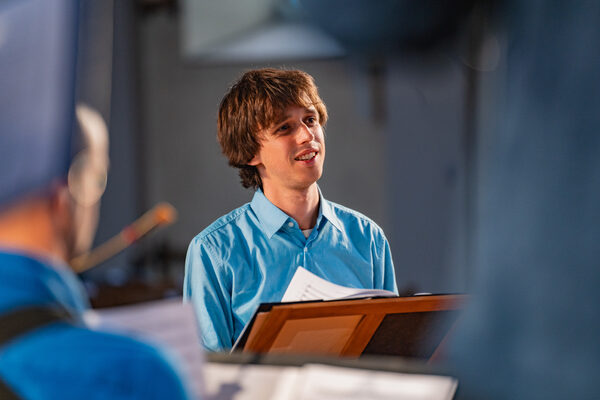 Young Talents
Beniamino Paganini: for the Glory of Music
Founder of Musica Gloria, a baroque ensemble born out of his early years of training, Belgian flutist and harpsichordist Beniamino Paganini, 31, has cultivated an intimate and devoted approach to music since discovering Monteverdi in Bruges at the age of 7.
-
 Young Talents
Ensemble Théodora: French Baroque Finds a Home in London
Four women, making every decision together, embracing a quartet that combines artistic freedom with uncompromising rigour. Founded in London around French music, Ensemble Théodora has made friendship, source materials, and long-term collaboration the foundations of a shared sound, refined with meticulous care. Lucie Chabard and Mariamielle Lamagat speak about the intimate process behind their collective.
-
 Young Talents
Olivier Bergeron: A Year in Charpentier’s Company
In love with the French language and with voices that inhabit the space in between, Olivier Bergeron finds in Charpentier an ideal terrain. At 29, the Quebec baritone has made the composer one of the central themes of his 2026 season. A laureate of Le Jardin des Voix, trained in Montreal and Paris, he will reunite this summer with Les Arts Florissants and William Christie for a North American tour, before singing his first Papageno in Montreal.
-
 From 2000 to the present day
Marcel Pérès and Ensemble Organum: Reinventing Cultural Initiatives (2/2)
What if the real revolution were to make music with human beings again? At a time when artificial intelligence is churning out fake sacred chants and culture is reduced to a consumable commodity, Marcel Pérès proposes an alternative path: human voices, passed-down gestures, unpredictable gatherings, and Old Roman chant restored to its ritual power. In Moissac, early music is once again becoming an experience.
-
 The years 1982 to 2000
Marcel Pérès and Ensemble Organum: restoring the voice of the Middle Ages (1/2)
Who in the world of early music is not yet familiar with the mark left by Marcel Pérès and his ensemble Organum? An archaeologist of sound, a pioneer of ethnomusicology applied to early music repertoires, and a thinker on sacred music, the French musicologist, singer, and conductor has established himself as one of the leading European figures in the revival of medieval music. On the eve of his 70th birthday, he recounts his life as if it were a novel.
-
 Freiburger Barockorchester
Hans Georg Kaiser: A Legacy Shared
Since 1989, Hans-Georg Kaiser has accompanied the Freiburger Barockorchester on its rise to international recognition. Today, at the age of 64, the orchestra’s manager and general director for the past 37 years has decided to step down on July 1 and entrust the ensemble’s continued development to a new leadership team: Selma Brauns, artistic director, and Paul Enke, commercial director. Together, they are tasked with shaping the future of an ensemble that is now counted among the world’s leading orchestras performing on historical instruments. Hans-Georg Kaiser reflects on his career and on the orchestra’s new prospects.
-
 Michael Maul & Bachfest 2026
In Leipzig, a hit parade of Bach’s cantatas!
In Leipzig, Bach is no longer simply celebrated: placed “Im Dialog” (“In Dialogue”), the theme chosen for 2026, he becomes a living, shared experience. From June 11 to 21, the Bachfest takes the form of a participatory festival, in which audiences from around the world contribute to the programming, beginning with a chart-topping countdown of Bach’s cantatas. Michael Maul, the festival’s director, speaks about this collective adventure, bringing together heritage, research, and leading performers.
-
 Musikfest ION & BR-KLASSIK – live and streamed
A Musical Night in Nuremberg to Open the ION Festival
With Nuremberg’s Grand Musical Night, the ION Festival and the radio and television broadcaster BR-KLASSIK aim to take early music beyond the traditional concert hall and bring it into public life. Thorsten Preuß, deputy head of music at BR/ARD’s Nuremberg studio, reflects on the event, what it represents, and his broadcaster’s commitment to early music.
-
 Baroque Masters
Constellation: John Eliot Gardiner’s Second Act
John Eliot Gardiner has just completed a European tour with his new ensemble, Constellation, featuring a Bach trilogy: two cantatas and the Easter Oratorio. A year and a half after his departure from the Monteverdi Choir and Orchestra (which he founded in 1964), he reflects on this new musical and human adventure. He will be performing at the Royal Chapel in Versailles on 11 and 12 June.
-

-

