


 Buxtehude on the lute? Yet the composer from Lübeck left no works for the instrument. On this album, Elias Conrad transposes preludes, suites and sacred works into the more intimate world of plucked strings. A change of scale that casts the richly textured writing of the North German master in a different light, between counterpoint, dance and meditation.
 By
 3 minutes


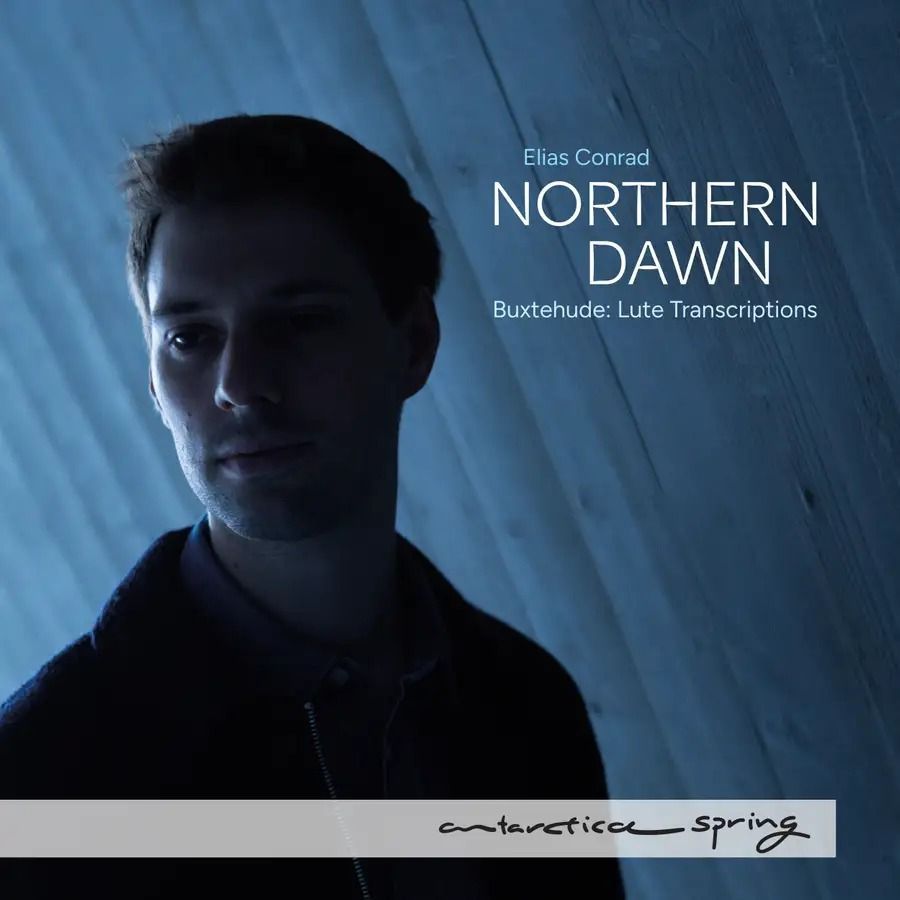
Released by Antarctica Records on 2 October, Northern Dawn – Buxtehude: Lute Transcriptions is German lutenist Elias Conrad’s first entirely solo album. Across twenty tracks devoted to Dieterich Buxtehude – with an Andante by Johann Sebastian Bach added as an epilogue – Conrad creates a repertoire that did not previously exist: since Buxtehude left no music for lute, keyboard preludes, suites and instrumental movements drawn from his vocal works here pass through the hands of Conrad as both transcriber and performer.
Buxtehude in a new light
The undertaking might seem bold, given how closely Buxtehude’s name remains associated with the organ. Yet the move to the lute is far from arbitrary. In seventeenth-century keyboard music, broken chords, ornamentation and the interplay of different voices already have close affinities with the practices of plucked-string instruments. Conrad explores this kinship without, of course, attempting to reproduce the power of an organ on a handful of strings.
The programme combines three Praeludia with Suites BuxWV 233 and 230 and the Aria BuxWV 249 with its variations. Alongside these instrumental works come fragments from another side of Buxtehude: the sinfonias from Wo soll ich fliehen hin and Jesu, meines Lebens Leben, the sonata from Gott hilf mir and even Ad Cor, the sixth part of Membra Jesu Nostri. Stripped of their voices and original forces, these works are condensed around their melodic and harmonic lines.
This is perhaps where the value of transcription becomes clearest. What the lute loses in breadth it gains in proximity: works conceived for church, keyboard or instrumental ensemble suddenly assume the proportions of chamber music for a single performer.
A cantata without voices
Conrad does not simply place one transcription after another. Northern Dawn is conceived as a five-stage journey – seeking, longing, pleading, hoping and, finally, trusting – whose organisation recalls that of a cantata. The title, “Northern Dawn”, refers to the light that the lutenist says he perceives in Buxtehude’s music, written in a seventeenth-century Europe marked by wars and upheaval.
There is no need to follow this spiritual programme to the letter for its underlying principle to give direction to a recital that might otherwise have been merely an anthology. Preludes sit alongside dances, variations follow pieces drawn from cantatas: the succession of forms gradually creates a more inward space, culminating in the brief sinfonia from Jesu, meines Lebens Leben.
A final detour then leads to Bach with the Andante from Organ Sonata No. 4 BWV 528, likewise transcribed for lute. The choice of epilogue is hardly incidental, given the young Bach’s admiration for his elder in Lübeck. Above all, it extends the album’s central idea: transferring music conceived for another instrument into the smaller, but remarkably malleable, world of the lute.
Intimacy rather than grandeur
The success of the undertaking naturally depends a great deal on Elias Conrad himself. The danger with such a programme would be to flatten works from very different contexts into a single colour. The young lutenist avoids this uniformity through playing attentive to articulation, changes of character and, above all, the different voices brought to the surface by the transcription.
The close, lightly reverberant recording contributes to this impression: it places the instrument almost within reach, allowing attacks, resonances and silences to be heard with striking clarity. Conrad can therefore favour subtle phrasing and lucid counterpoint without attempting artificially to compensate for the modest dimensions of his instrument.
The Suites, with their succession of dances, naturally offer familiar territory for the lute; more surprising are the borrowings from sacred music, where transcription lays bare lines previously embedded within a larger vocal or instrumental texture. Ad Cor, from Membra Jesu Nostri, acquires a particular intimacy beneath Conrad’s fingers and neatly encapsulates the album’s approach. In the closeness of plucked strings, the great organist of Lübeck loses something of his monumentality but gains a new fragility and transparency. A convincing way of rediscovering Buxtehude where one would least expect him.



You must be logged in to be able to post comments.
Sign in