


 How should Handel’s solo sonatas be brought to life when their publishing history, their sources and, at times, even their intended instrumentation remain fluid? Released in MDG’s Preziosa series, this double album by the Ganassi Consort with Anne Röhrig does not opt for uniformity: it entrusts the corpus to a whole range of period instruments, in order to recover, as closely as possible to historical practice, the diversity of a chamber Handel who is by turns lyrical, dance-like, theatrical and inventive.
  By
By 


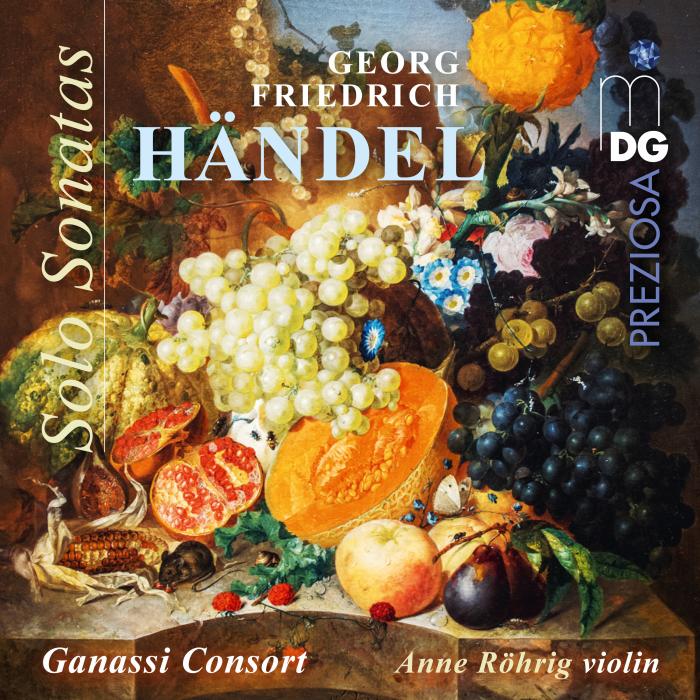
Handel’s solo sonatas occupy a singular place in his catalogue. Less immediately spectacular than the operas, oratorios or grand concertos, they nevertheless reveal an art of remarkable richness: the dialogue between an instrumental voice and basso continuo, between song and dance, between theatrical rhetoric and the freedom of chamber music. The repertoire is all the more fascinating because its publishing history remains complex: some sonatas were transmitted through unreliable editions, others changed instrument from one publication to another, while several attributions have long been debated. Behind the apparent simplicity of the genre lies shifting ground, where the performer must constantly question the sources, the practices and the instrumental colours.
This is precisely one of the strengths of this release from MDG / Dabringhaus und Grimm: it does not treat these pieces as a pleasant collection of drawing-room sonatas, but as a true Handelian laboratory. Recorder, transverse flute, oboe, violin, viola da gamba and harpsichord each define a distinct expressive profile, with their own diction, grain and breathing. Alongside Anne Röhrig, the Ganassi Consort brings out the diversity of a language that moves naturally from galant elegance to dramatic impulse, from vocal line to improvised ornament, from dancing grace to a more shadowed expressiveness. Far from being confined to a simple harmonic support, the continuo becomes an active partner: it comments, relaunches, colours and gives each movement its own rhetorical space.
This attention to timbre connects with a broader question: that of instrumental intention. Handel’s sonatas often circulated in versions adapted, recomposed or reassigned by eighteenth-century publishers, eager to meet the tastes and practices of their time. By returning to the sources, to the possibilities of period instruments and to historical practice, the Ganassi Consort seeks less to fix a definitive truth than to recover a musical logic: why a particular instrument speaks more convincingly here, how a given tessitura illuminates a phrase, and how the colour of an oboe, a flute or a violin alters our perception of the same writing.
The result is a more dynamic chamber Handel. We encounter the man of the theatre, but concentrated within the smaller space of the sonata; the master of the vocal line, but transposed into the breathing of instruments; and, finally, the European composer capable of absorbing styles, forms and idioms and turning them into a language instantly recognisable as his own. By bringing together musicological rigour, ornamental freedom and sonic imagination, Anne Röhrig and the Ganassi Consort remind us that Handel’s chamber music is no secondary field: it is one of the places where his genius reveals itself with the greatest naturalness, wit and vitality.

You must be logged in to be able to post comments.
Sign in