


 A viola da gamba, a theorbo and painted flowers: with “Baroque Flowers”, Maurizio Di Chio and Nicola Pignatiello bring Marais, Kapsberger, Boismortier and Forqueray into dialogue with Caravaggio, Zurbarán and the great masters of still-life painting. From dance to melancholy, from love to the passing of time, each piece finds its visual counterpart in a project that brings the affetti back to the fore – those passions that Baroque music sought to stir in the listener.
 By
 2 minutes


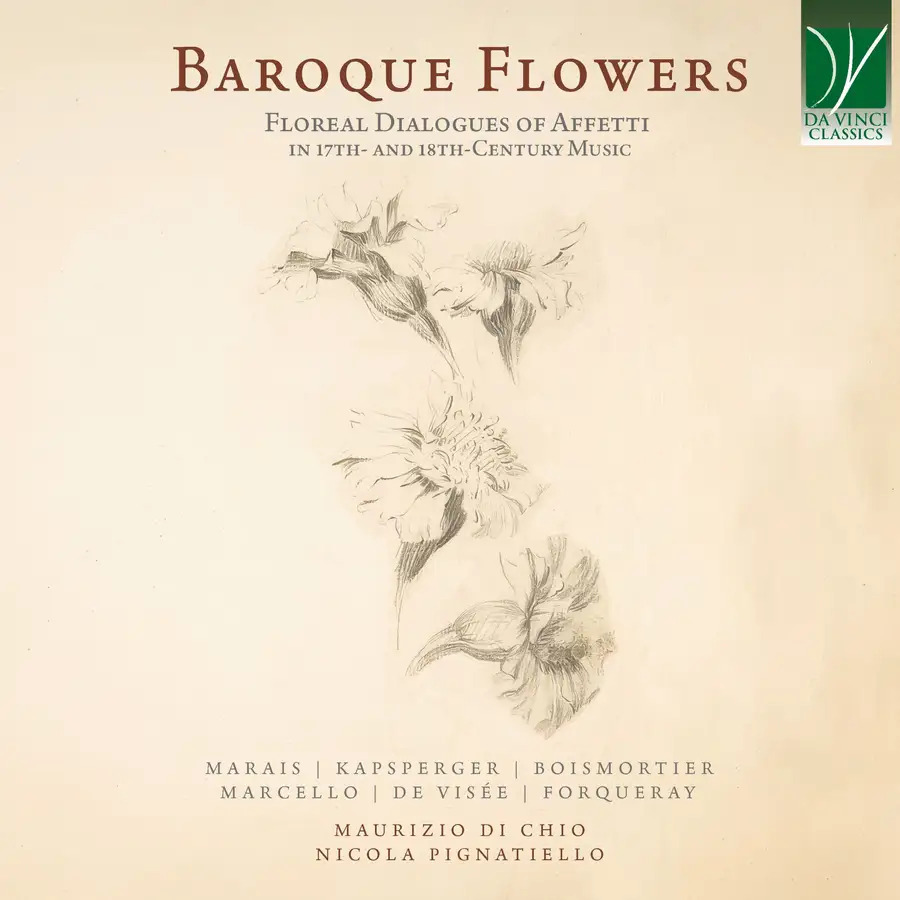
Recently released by Da Vinci Classics, Baroque Flowers – Floreal Dialogues of Affetti in 17th- and 18th-Century Music brings together viol player Maurizio Di Chio and theorbo player Nicola Pignatiello in twenty tracks featuring music by Marin Marais, Kapsberger, Boismortier, Benedetto Marcello, Robert de Visée and Antoine Forqueray, alongside an anonymous Ciaccona. Developed from a project already presented in concert, the album follows neither a single composer nor a national school: it associates each piece with a painted flower and the emotion it suggests, tracing a path through sounds, colours and symbols.
A floral anthology
The starting point is explicitly Baudelairean. Maurizio Di Chio places the project under the sign of Correspondances, where “perfumes, colours and sounds answer one another”. In Baroque Flowers, this intuition becomes a principle of programming: a piece of music, an emotion, then a flower borrowed from a painting that offers something like its silent echo.
The booklet thus calls upon Caravaggio, Francisco de Zurbarán, Mario Nuzzi – known as Mario de’ Fiori! –, Margherita Caffi and Rachel Ruysch. In the seventeenth century, moreover, the painted flower is never merely decorative. Its radiant beauty can evoke its own fragility, the passing of time or the nearness of disappearance; elsewhere, colours and forms become evocations of desire, delicacy or exuberance.
The musicians organise this play of reflections into five stages: time passing or sweeping everything away, the affetti of dance, delicate passions, the different forms of love, and finally the changing reflections of the heart. It is a deliberately suggestive framework: listeners remain free to recognise their own images rather than search for a systematic translation of each emotion.
From Marais to Kapsberger
This freedom also explains the eclecticism of the programme. France predominates with a Suite in C major by Marin Marais, followed later by a Suite in G by Joseph Bodin de Boismortier, Robert de Visée’s Entrée d’Apollon and two pieces by Antoine Forqueray, La Dubreuil and La Sainscy. Together, they reveal several facets of the French viol school: the elegance of dance, the inward character of the sarabande, a taste for character pieces and, with Forqueray, a sharper-edged virtuosity.
But Baroque Flowers regularly crosses the Alps. Two short toccatas by Giovanni Girolamo Kapsberger give the theorbo a more exposed role before an anonymous Ciaccona, while Benedetto Marcello’s Sonata VI in G major, originally written for cello, takes on a new colour on the viola da gamba.
Two instruments in conversation
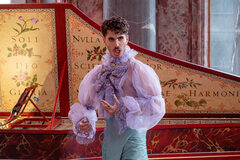
The set-up might seem austere: for some three quarters of an hour, just a viola da gamba and a theorbo. Yet this economy of means is precisely what gives the album its charm, thanks to Maurizio Di Chio and Nicola Pignatiello’s ability to keep renewing the listener’s attention. Supple phrasing, varied attacks, a keen sense of colour and dialogue: the two musicians draw enough variety from their tête-à-tête to dispel any sense of uniformity.
Indeed, this play of balance and response makes for particularly lively listening. From one piece to the next, the two musicians create enough contrast to bring out the diversity of characters without overloading the discourse. The project thus achieves its full coherence: viol and theorbo bring this journey through the affetti to life, extending in sound the interplay of colours, images and correspondences imagined around the flowers. A sensitive and convincing proposition that invites the listener to be guided from one sonic tableau to the next through this musical herbarium.


You must be logged in to be able to post comments.
Sign in