


 Over four centuries of performance, recording and reinterpretation, Monteverdi’s “Vespers” have accumulated traditions that have gradually transformed their character. With InAlto, Lambert Colson chooses to look back beyond that accumulated history: specific antiphons, reduced forces and a return to the pulse embedded in the score underpin a historically informed reconstruction of an Office for the Assumption within the context of 1610.
  By
By 


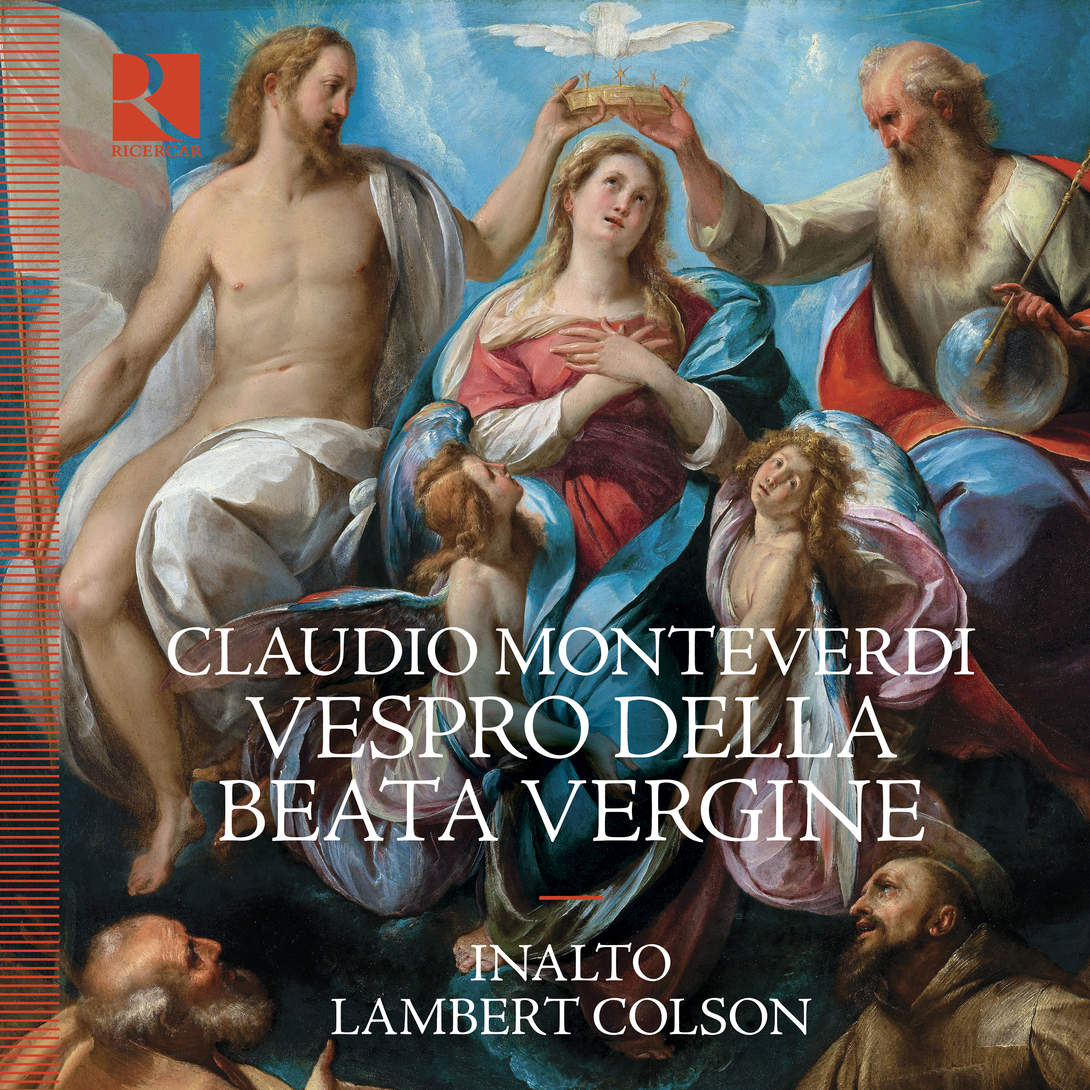
With this recording project, released in 2026 by Ricercar, Lambert Colson and InAlto offer a new reading of Monteverdi’s celebrated Vespers of the Blessed Virgin (1610). Recorded from 14 to 19 September 2025 in the Palatine Basilica of Santa Barbara in Mantua, the double album brings together InAlto’s singers and instrumentalists, joined by the Cappella di San Petronio of Bologna, directed by Michele Vannelli, for the plainchant. With one singer to a part, compact instrumental forces and the historic organ built by Graziadio Antegnati in 1565, Lambert Colson directs the ensemble from his cornett.
Returning to Mantua
The Vespers brought together in the collection Monteverdi had published in Venice in 1610 do not constitute a fully fixed concert programme in the modern sense. They include the principal pieces required for an office devoted to the Virgin – five psalms, a hymn and a Magnificat – alongside motets, but the Gregorian antiphons framing the psalms depended on the Marian feast being celebrated. In other words, to hear the Vespers within their liturgical logic, one must still decide which office is being reconstructed.
It is this process of working backwards that Lambert Colson places at the heart of his recording. He chooses the Assumption of the Virgin and draws the corresponding antiphons from a late-sixteenth-century antiphonary and breviary preserved in Mantua, the city where Monteverdi was working when the collection appeared. The cornettist then completes the office with a Toccata by Merulo, in accordance with a practice described by Banchieri, followed by a Canzon by Gabrieli and a Salve Regina by Palestrina.
Changing scale
This research also transforms the sound of the Vespers. Rather than the large forces with which the work has often been associated, InAlto adopts a much more compact ensemble, in keeping with Monteverdi’s indication that the music could suit chapels or princely chambers. The recording also returns to the Basilica of Santa Barbara and its 1565 Antegnati organ, restored to its historic pitch and temperament.
Colson also returns to the way musicians in Monteverdi’s time conceived pulse and proportional relationships between durations. This work on the tactus – the reference pulse that organises the music – preserves the relationships between the different sections rather than treating each change as an independent new tempo. Far from being a purely scholarly detail, this continuity gives the whole performance a very particular sense of breathing and architecture.
Closer, but no less spectacular
The reduced forces also bring the meaning of the texts into sharper focus. In Duo Seraphim, two voices representing the two seraphim become three when the Trinity enters the text; in Audi coelum, a second tenor answers the first like an echo from heaven. We can therefore hear more clearly how Monteverdi uses voices, instruments and space to turn the liturgy into genuine musical drama.
The strength of this version lies above all in transforming all this historical research into music that feels immediately alive. InAlto achieves remarkable transparency: the voices remain clearly individualised, the instruments retain their own colours and the ensemble breathes with great suppleness. The cornetts and trombones bring brilliance and relief without weighing down the texture, while the solo voices retain a strong presence, with an articulation and expressiveness that are never absorbed into the ensemble. A reading that is at once learned and vividly realised, in which the work’s recovered intimacy costs it none of its splendour.


You must be logged in to be able to post comments.
Sign in