


 What is there still to discover about Johann Sebastian Bach? At the Bach Archive in Leipzig, Peter Wollny has spent more than thirty years tracking down manuscripts, watermarks, copyists and all manner of musical clues. For the institution’s director, authenticating a score is a genuine investigation, in which doubt matters as much as intuition and the smallest detail can reopen a case thought to be closed. Just a few months ago, two further discoveries offered another reminder that, nearly three centuries after Bach’s death, his music and its transmission can still hold surprises.
  By
By 


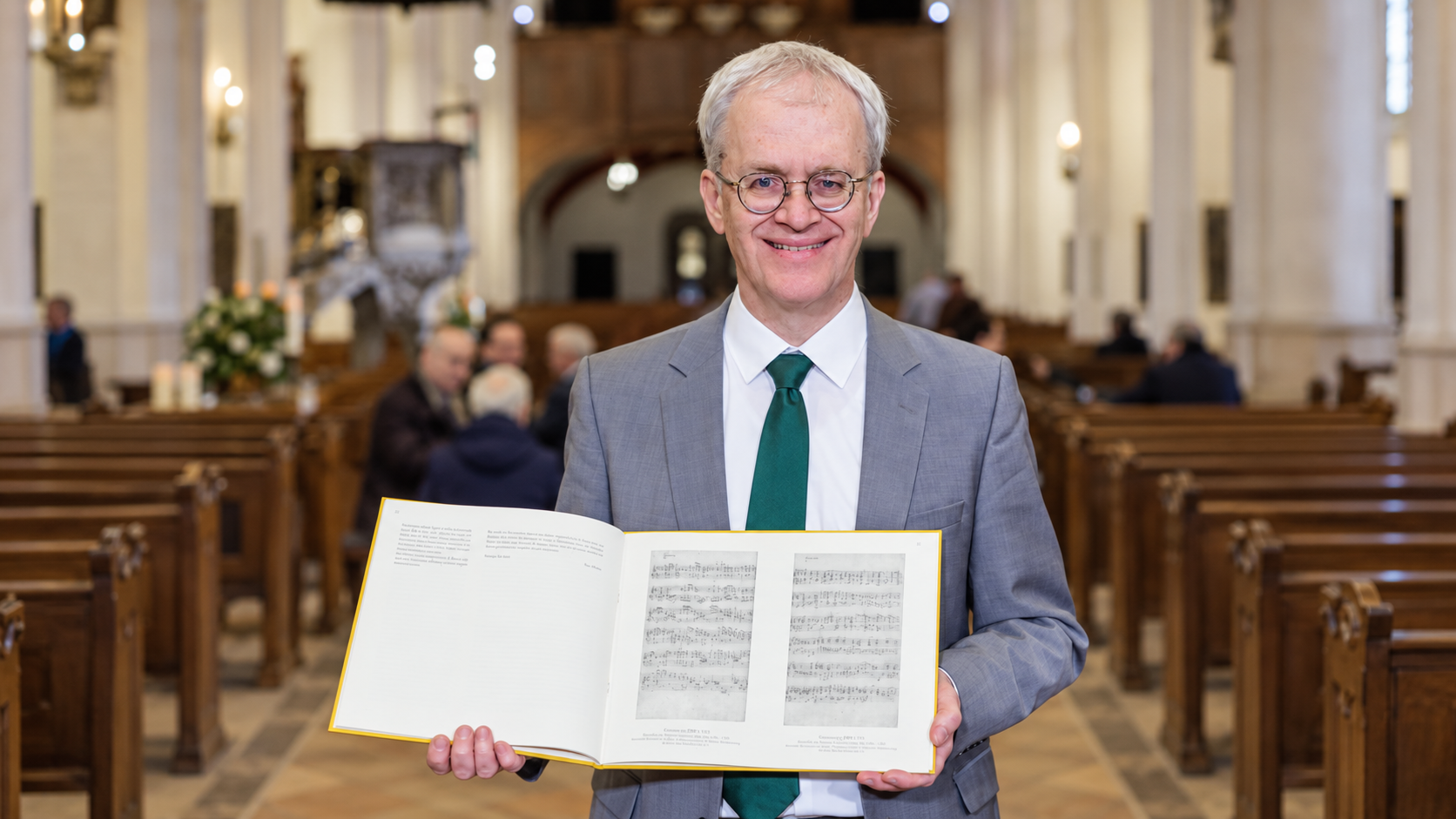
Peter Wollny knows Bach’s manuscripts the way others recognize familiar handwriting at a glance. Born in 1961, and educated in Cologne and at Harvard, the German musicologist joined the Leipzig Bach Archive in 1993, becoming its director in 2014. A specialist in the Bach family and in seventeenth- and eighteenth-century music, he has spent much of his career immersed in primary sources: autographs, copies, paper, watermarks, and handwriting. But simply finding a score isn’t enough: we still need to determine who wrote it, when, and where—and who composed it. In this age of digitization and artificial intelligence, he takes us behind the scenes of a research project in which Bach still holds many surprises.
We don’t find many new Bach scores anymore, unlike manuscripts or new musical works from the Renaissance, for example. But when you make a discovery in a manuscript believed to be by Bach, how do you go about verifying it?
Peter Wollny: It depends on the individual case. If a musical manuscript is in Bach’s own hand, that is already of great interest to us in itself, and the next question is: is it a composition by Bach, or is he simply copying a work by another composer?
And how do you first establish that the manuscript was indeed written by Bach and is not a forgery? That is something one might suspect today, after all, given the value of a Bach manuscript…
P. W.: I would put it this way: first of all, of course, you have to see the original object. And when you hold the original in your hands, you can see, for example, whether the paper is consistent with what you would expect, whether it is old paper, whether it is a type of paper Bach himself used rather than just any paper. You are of course right: fundamentally, these days, you always have to remain sceptical and ask whether something might perhaps be a forgery. But I would say that once you have the document in your hands, you are already in a position to recognize whether it could be authentic or not.
Do you also carry out physical and chemical analyses, as is done in the visual arts or with instruments, to examine the ink or determine the age of the paper, or do you remain on a purely musicological level? Perhaps it also depends on the work; but if, for example, a two-hour St. Luke Passion were suddenly to turn up, would scientific methods also be brought in?
P. W.: First of all, we do not use any method that might alter the object. That means, for example, that we would not take samples of ink or anything else, or cut off a fragment in order to analyse it. What we usually do is hold the paper up to the light to see what kind of watermark it bears. And in Bach research, there are extremely comprehensive catalogues that allow us to determine at what point in his life Bach bought paper from a particular paper mill. The form of the handwriting can also tell us approximately when in Bach’s life a manuscript was written, and we can then cross-check that information against the paper. For example, from the handwriting, you can determine whether a document was written in Weimar, Köthen, Leipzig, or even earlier. If the handwriting of a newly discovered document resembles that of Bach’s middle Leipzig period, for instance, and at the same time I find a watermark in the paper that I recognize from other sources from that same period—that is already a good sign. If a completely unknown watermark were to appear, one we had never heard of or seen before, then we would have to be sceptical. But if all these elements match, that is already a major step forward.
There is, of course, also provenance: we try to determine where a manuscript comes from. These manuscripts do not simply appear out of nowhere; we know quite precisely how Bach’s musical estate was divided up after his death. There are major lines of transmission, but also secondary ones, and we have to ask whether a manuscript can somehow fit into that picture. Of course, a manuscript can also turn up whose origin is completely unknown, whose transmission history is a mystery, which has never been described anywhere or mentioned in the literature—and which is suddenly just there. That happened to us a little over twenty years ago, when a Bach autograph was discovered in an envelope. To this day, we still do not know where it came from, and it had never even been mentioned in the nineteenth- or twentieth-century literature! Something like that is, of course, strange.
Passionate about early music and want to read this subscriber-only article?
If you are not a subscriber, join the international Total Baroque community. Subscribe here from 5.00€.
I subscribe
If you are already a subscriber, sign in.
I sign in 

You must be logged in to be able to post comments.
Sign in