


 Estampie, virelai, ballata, rondeau, lauda or bassadanza: for its 40th anniversary, laReverdie sets the Middle Ages dancing. With Venite alla danza!, the Italian ensemble journeys through three centuries of sacred and secular repertoire, from Montserrat to Machaut and Du Fay, reminding us that medieval dance belonged neither exclusively to secular entertainment nor, for that matter, to a purely instrumental repertoire.
 By
 3 minutes


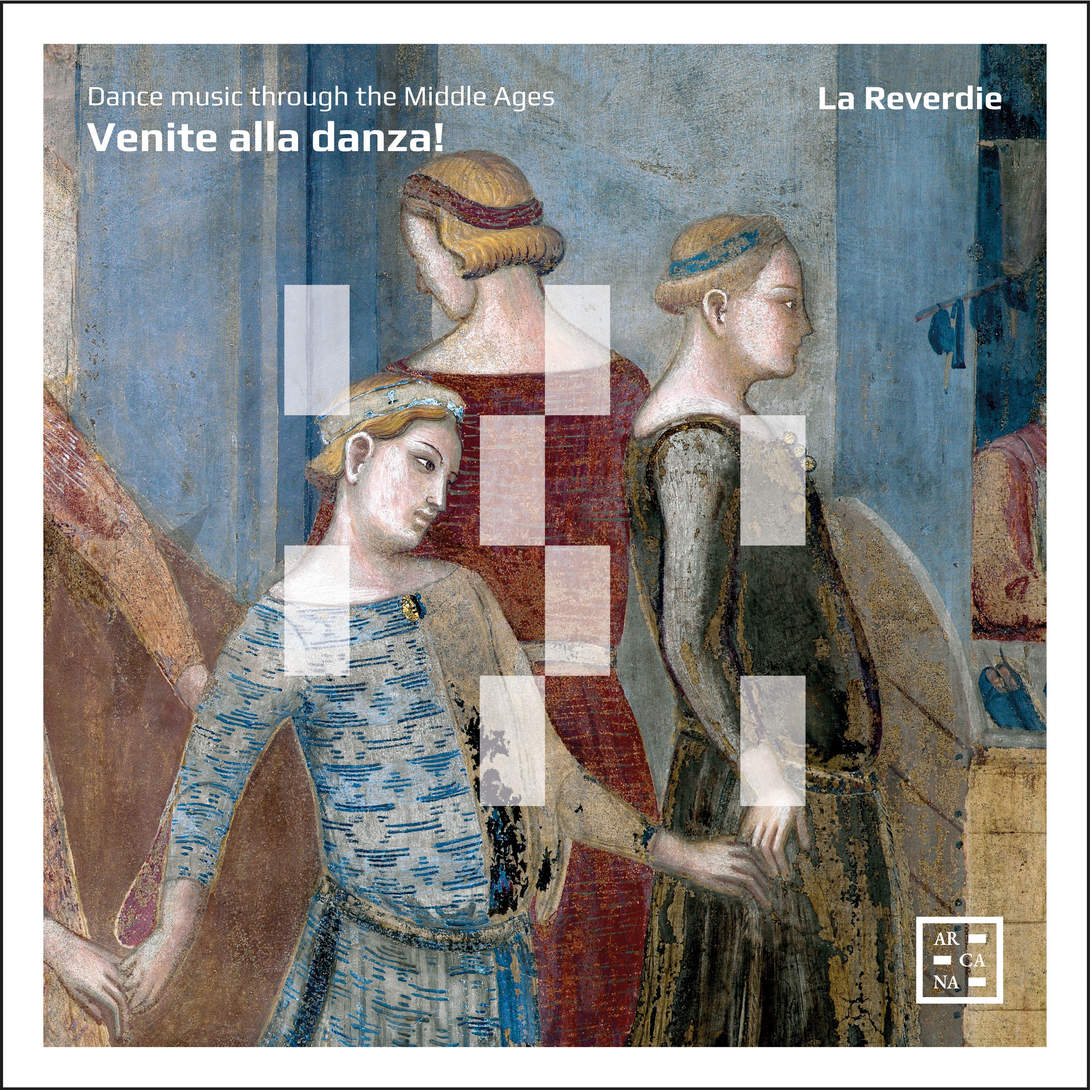
Released by Arcana as laReverdie celebrates its 40th anniversary, Venite alla danza! brings together fourteen works from the 13th to the 15th centuries, performed by an ensemble centred on Claudia and Livia Caffagni and Elisabetta de Mircovich. Inspired by the allegra brigata of Boccaccio’s Decameron – the group of ten young Florentines who leave Florence to escape the plague of 1348 and retreat to the countryside – the project draws on musical, literary, theoretical and iconographic sources to recover the many uses of dance in the Middle Ages, including within the religious sphere. Some works for which only the poetry had survived have even been newly set to music, bringing to life practices of circulation, adaptation and reinvention that were already part of medieval musical culture.
A dancing Middle Ages
In the Middle Ages, dance was not confined to secular entertainment. It also accompanied religious life, pilgrimages and certain devotional practices. This is the territory laReverdie sets out to explore, drawing on musical, literary, theoretical and iconographic sources spanning almost three centuries. Claudia Caffagni invokes figures such as Roger Bacon and Albertus Magnus, both of whom attributed aesthetic and social value to dance, as well as Ambrogio Lorenzetti’s famous fresco of the Good Government, in which music and dance become visible signs of a prosperous city.
The thread running through the album is less a particular form than a principle: movement, often associated with the refrain. Occitan dansas, ballades, rondeaux, virelais, ballate, laude and estampies follow one another in a broadly chronological sequence. Dante himself recalled in De vulgari eloquentia that ballate, unlike songs, ‘need dancers, for whom they were created’.
From Montserrat to the ballroom
LaReverdie begins its journey with De Patre principio, a monophonic rondeau setting a 13th-century Easter text, followed by the French Seste Estampie Royal and the Occitan desdansa Ben volgra. With Stella splendens, taken from Montserrat’s Llibre Vermell, dance enters directly into the world of pilgrimage: the virelai is described there as a cantilena ad trepudium rotundum, a song intended for a circular dance.
More striking still, Chi vuol ballare a righoletto describes a religious choreography almost step by step: the dancers move to the sound of the organetto, while the archangels Michael, Gabriel and Raphael play the harp, trumpet and lute respectively. Yet the piece’s original music has not survived. LaReverdie gives it a new voice through the practice of contrafactum – taking an existing song and pairing its melody with a new text – by borrowing a tune from the Laudario di Cortona. In Non ti fidare che oggi è sì pocha fé, the text is adapted to a ballata by Gherardello da Firenze. The album therefore does more than assemble sources: it recreates medieval practices of melodic circulation and reuse, one of the project’s most distinctive features.
A similar approach is taken with Franco Sacchetti’s Benedetta sia la state, a text whose music has not survived, to which Claudia Caffagni assigns a ballata by Francesco Landini with the same metre. The choice gains particular resonance from the 2025 discovery of a previously unknown two-voice version of another Landini ballad setting a text by Sacchetti.
Machaut, Du Fay and a pocket-sized orchestra
The journey also encounters more familiar names: Guillaume de Machaut with the virelai Moult sui de bonne heure nee, and Guillaume Du Fay with the rondeau Ce jour de l’an. Between them, the musicians perform the Italian istampitta Isabella and the anonymous three-voice French ballade Dame vailants / Amis, de tant que / Certainement puet. The journey ends with Falla con misuras, a bassadanza attributed to Guglielmo Ebreo da Pesaro and built on the famous tenor of Re di Spagna – here meaning the underlying melodic line that provides the structural framework for a composition.
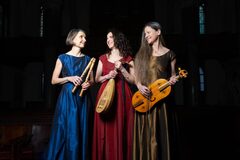
Founded in 1986 by two pairs of Italian sisters, laReverdie here returns to one of the qualities that has defined it for forty years: performers who are both singers and instrumentalists, and an exceptionally broad palette of timbres. Vielles, rebec, symphonia, harps, psalteries, lute and gittern sit alongside organetto, clavicymbalum, jaw harps, bells and percussion.
By the end, Venite alla danza! evokes a Middle Ages in which people dance to celebrate, pray or court as much as simply to amuse themselves. It is a repertoire in which the boundaries between sacred and secular, voice and instrument, text and gesture prove far more permeable than one might have imagined.


You must be logged in to be able to post comments.
Sign in