


 Between Les Ombres, the festivals run by the association Muses en Dialogue, the European Young Baroque Orchestra and his teaching work, Sylvain Sartre embodies a generation of versatile musicians bringing early music to life in the South of France. He is the artistic director of the Festival de Maguelone, which runs from 4 to 12 June.
  By
By 


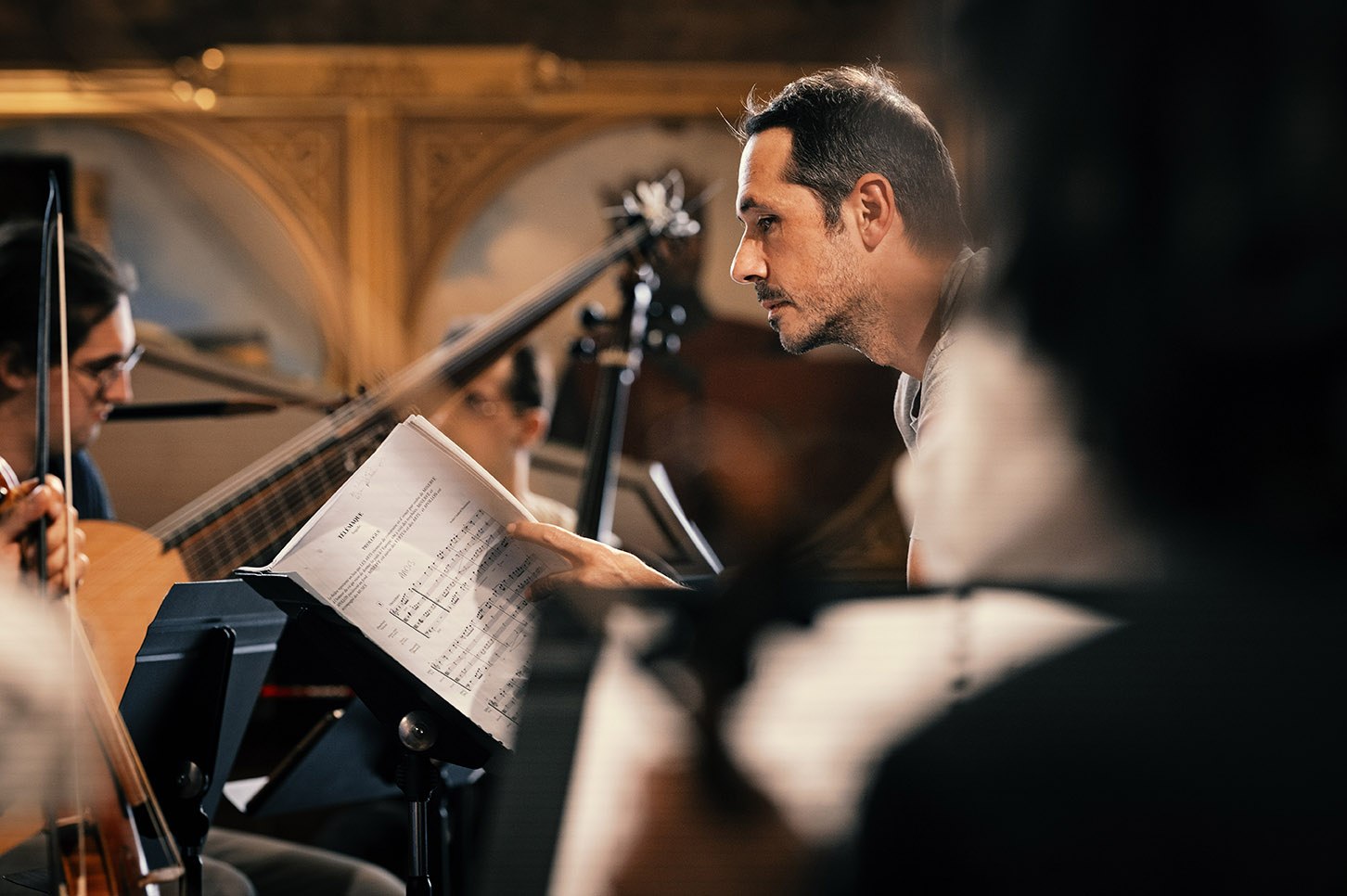
At a time when early music is both reinventing itself and becoming increasingly fragile, Sylvain Sartre is one of those artists who refuse to separate performance, transmission, dissemination and local cultural engagement. Founder and musical director of Les Ombres (The Shadows) alongside Margaux Blanchard, head of the Jeune Orchestre Baroque Européen (JOBE) or Young European Baroque Orchestra, teacher at the Conservatory of Perpignan, artistic director of the events organised by the association Les Muses en Dialogue in Occitanie, he has built across southern France a genuine musical ecosystem where young talents, established artists, regional projects and new forms of outreach intersect. In Maguelone, Uzès, Montpellier, Perpignan, and the Pic Saint-Loup region, he champions the same vision: making early music a living art form, open to exchanges between repertoires, generations and audiences. In an economic and political climate that is becoming increasingly tense for independent ensembles, he reflects here on his choices, his struggles, his hopes and his concerns, with the lucidity of someone who knows how much, today, creating also means enduring.
How would you define yourself today, between your various activities? Could one describe you as a “cultural entrepreneur”?
Sylvain Sartre: I would rather say: a musician of today. In 2026, being a musician is no longer just about performing. We are led to flourish in several different fields which, ultimately, all belong to the same profession. In my case, there is first of all teaching, since I am a professor at the Conservatory of Perpignan: transmission is fully part of my identity. There is obviously my career as a musician, as a flautist, as a conductor, with Les Ombres or within other ensembles depending on the projects. There is also the Jeune Orchestre Baroque Européen, which stands at a crossroads: it is both about transmission and a very direct extension of my work as a musical director. And then there is the festival side, within Muses en Dialogue, which is more about dissemination. In the end, all of this forms a loop. We are musicians, of course, but we also develop initiatives within the territory where we live. For me, that is Occitanie. Yes, it is a lot of different things, but they are activities that complement one another and make sense in relation to each other.
You often refer to the “region”. Between Montpellier, Perpignan, Maguelone, the Pic Saint-Loup region and Uzès, one senses a strong geographical coherence. Was that a deliberate choice?
S. S.: Yes, clearly. When we arrived in Montpellier with Les Ombres in 2013, it was already a coherent gesture. Margaux Blanchard and I had created the ensemble during our studies in Basel, then we benefited from an excellent three-year residency at the Saint-Étienne Opera. But for me, it was important that our work take root somewhere organically. I am originally from Occitanie, so I already had ties to the region. It was not a case of parachuting ourselves in. We chose Montpellier because it matched the cultural dynamism of a large student city. At the time, there was not really any structure established in the region defending our aesthetics. Then things developed fairly naturally. During our residency at the Montpellier Opera, we created many artistic and cultural education projects with Les Ombres, in Hérault, Gard and the Pyrénées-Orientales. Then I moved back to Perpignan six years ago, joined the conservatory, and the rest followed. The residency of the Jeune Orchestre Baroque Européen in Uzès came about quite naturally as a result of our local roots and this desire to initiate projects in our region. For the association Muses en Dialogue, there is a similar logic as well. Philippe Leclant, founder of the Maguelone Early Music Festival, had been thinking for some time about transmission, about succession, in order to prepare intelligently for the future. He wanted someone from the region, someone familiar with the local cultural and political issues. It was in that context that he approached me. Of course, this creates a vast area, and from Gard to Perpignan, it’s no small thing! But the activities of Muses en Dialogue are spread out across specific periods: late March for the European Early Music Days, early June for the Maguelone Early Music Festival, October for the Pic Saint-Loup Festival.

Passionate about early music and want to read this subscriber-only article?
If you are not a subscriber, join the international Total Baroque community. Subscribe here from 5.00€.
I subscribe
If you are already a subscriber, sign in.
I sign in 

You must be logged in to be able to post comments.
Sign in