


 Franco Fagioli revives Giovanni Battista Velluti and takes us on a sonic journey to the twilight of the castrati.
  By
By 


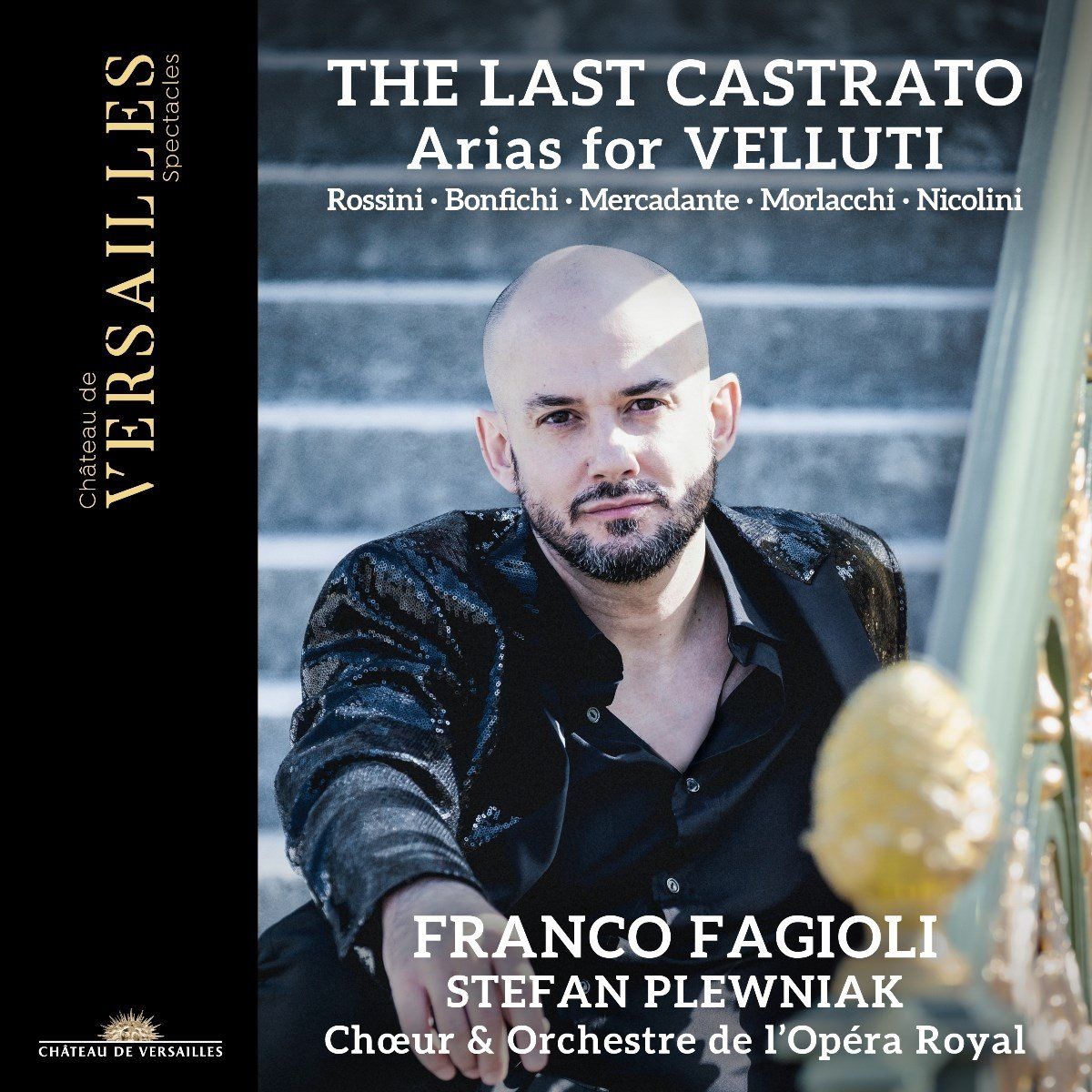
In his new album, countertenor Franco Fagioli, accompanied by the Orchestra and Choir of the Royal Opera of Versailles under the baton of Stefan Plewniak, pays tribute to Giovanni Battista Velluti (1780–1861), a leading figure of late bel canto. This album, the result of three years of research, unveils a rare repertoire—Bonfichi, Nicolini, Mercadante, Morlacchi, Rossini—and brings back to life the expressive virtuosity and vocal refinement that marked the dawn of the 19th century.
Your album highlights arias composed for Giovanni Battista Velluti, the last famous castrato, known for his virtuosity, his mastery of legato, expressive ornamentation, and stylistic refinement. Why did you choose to explore this twilight figure?
I chose to focus on the figure of Giovanni Battista Velluti because I have a deep love for Italian bel canto music. Even though today it is most often associated with composers like Bellini or Rossini, to me, bel canto refers to something broader—it goes back to the very origins of opera and is rooted in the Italian vocal tradition. Bel canto, Italian opera, and Italian singing are, in a way, inseparable concepts. My relationship to singing was shaped not only through baroque music but also through the 19th-century repertoire, in a fluid journey from Handel to Mozart and Rossini. In San Miguel de Tucumán, Argentina, my first teacher was a soprano, and I began by studying early arias, then Mozart, before diving—at the Art Institute of the Teatro Colón in Buenos Aires—into the Italian 19th-century repertoire (especially Rossini), while continuing to explore Handel and Mozart.
I remember one of my first teachers, a baritone, asking me to prepare Arsace’s aria in Semiramide by Rossini. That was a turning point: I began to discover the legacy of the castrati, especially through those male roles written for high voices. That’s how I came across Velluti—the last great castrato, for whom Rossini himself composed, like the role of Arsace in Aureliano in Palmira. Velluti embodies that pivotal moment when castrati gradually faded from the stage, while the aesthetic that had once celebrated them remained alive. After devoting albums to figures such as Caffarelli, Porpora, Vinci, and Mozart, I felt it was time to pay homage to Velluti—not only as a symbol of the end of an era, but also as a reflection of the emotional and artistic bond I have with this music. In fact, as I answer this interview, I am performing the role of Arsace in Semiramide at the Opéra de Rouen, and it feels like my whole path has naturally led me here!
Velluti represents a transitional figure between baroque castrato singing and the rise of romantic bel canto. What challenges did you encounter when approaching this singular repertoire, at the crossroads of two vocal traditions?
As you say, it’s a pivotal moment between two stylistic worlds. In studying the scores associated with Velluti, I discovered arias that still preserve elements of Mozartian language while already heralding Rossini’s style. A good example is the aria Ah se mi lasci, o cara that I sing on the album: in places it evokes Vitellia’s aria in La clemenza di Tito by Mozart. One of the greatest challenges was understanding the interpretative practices of that era. When you compare the original scores to the versions known to have been performed by Velluti, you quickly realize that the written score was only a starting point: the singer himself shaped the musical narrative, adding variations, poetic inflections, and expressive choices. This required me to take a very active role as a performer. It’s not enough to simply reproduce old ornaments—you have to craft a living, personal version, in dialogue with the codes of the time, but also with today’s sensibility.
Another crucial aspect was working on vocal colour. In the 19th century, high voices—like those of the castrati—were expected to have substance, richness of timbre, and even some amplitude in the lower register. These were not ethereal or angelic voices in the simplistic sense; they were broad, brilliant, powerful voices, capable of expressing both tenderness and heroism. This vocal ideal was a fascinating technical and expressive challenge. I love to share this revealing quote about how castrato voices were perceived at the time: De Brosses described them as follows — “Their tone is clear and high like that of children, but far more powerful; one doesn’t get the impression they’re singing an octave above the natural female voices. Their voice is almost always somewhat dry and harsh, very far from the youthful and sweet smoothness of women’s voices, but they are brilliant, light, full of brilliance, very strong and wide-ranging.”
Through this album—surprising as it is fascinating—what kind of experience do you hope to offer the audience? What drove you to record it?
Thank you for such kind words. What first drove me was the deep love I have for the Italian school of singing. It’s the foundation of my training, and the guiding thread of how I conceive music. With this album, I wanted to share that tradition, that timbre, that way of singing which I learned and continue to explore. I also wanted to bring attention back to the figure of Velluti, who continued to sing into the later 19th century, even as there were no castrati left on the stage. When he performed in London, it had been twenty-five years since anyone there had heard a voice like his. He was almost a living twilight—the last echo of an aesthetic still capable of moving audiences.
The album also invites reflection on the vocal taxonomy of opera. What does it mean to be a countertenor today? What do terms like soprano, mezzo-soprano, contralto, tenor, baritone, or bass really mean? Velluti, for example, was considered a soprano. As for me, I’m categorized as a countertenor, though my vocal register is that of a mezzo-soprano. Exploring how these labels emerged, from sacred polyphony to the modern operatic repertoire, helps us better understand not only our voice, but also the history it carries within it.
 Press review
His voice remains a thing of great beauty and tonal refinement [even if] he is less willing to venture into his highest register. However, let that not deter one from investigating this fascinating exploration of music, most of which is receiving a first recording.
Mike Parr, MusicWeb
This is a valuable disc, both for the singing of Fagioli and for the rare repertoire that has been rescued for posterity after two centuries of neglect.
Göran Forsling, MusicWeb
Franco Fagioli immerses himself in Velluti’s theatricality to recreate the full extent of his genius, delivering a remarkable interpretation of his most famous roles, accompanied by the Orchestra of the Royal Opera of Versailles.
PrestoMusic
With arias by Rossini, Mercadante, and Bonfichi, Fagioli continues to display excellent musicality and great expressiveness. Although his voice may now show some irregularities—perfectly natural after decades of career—his ability to meet the demands of this repertoire remains unmatched.
Albert Mena, ÓperaActual
Fagioli is extraordinarily virtuosic, interweaving pearly trills with runs, pointed notes, and breathtaking descents from the very top of his falsetto to low notes worthy of Marilyn Horne. His voice is astonishingly transparent and refined, not to mention dazzlingly agile.
Charles Sigel, ForumOpéra

You must be logged in to be able to post comments.
Sign in