


 On this debut album, the Théodora ensemble takes listeners on a journey through France and the German-speaking world, from Lully and Campra to the Krieger brothers, where styles intersect and transform. Carried by a distinctive vocal palette and a finely articulated continuo, the recording highlights the variety of compositional approaches and characters.
  By
By 


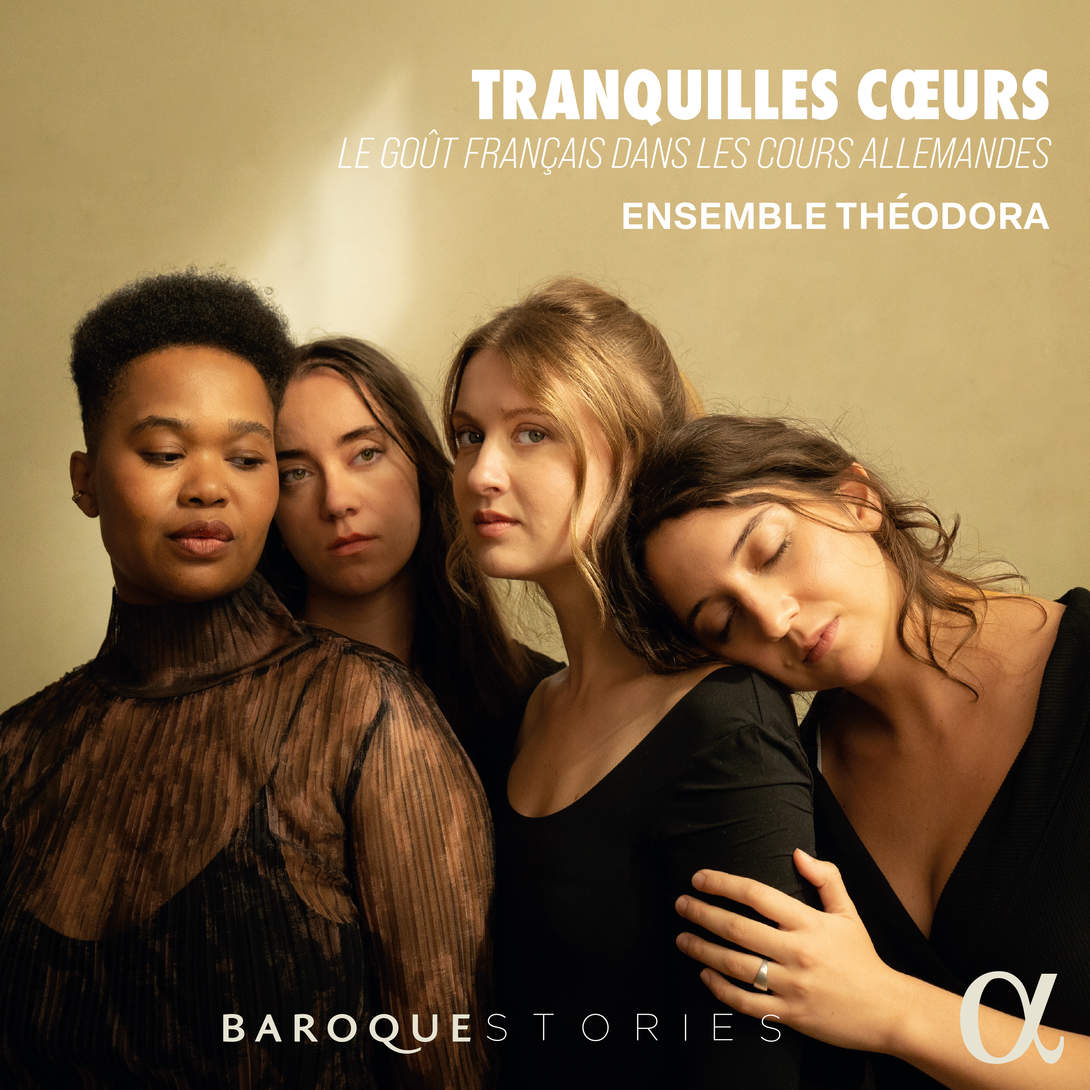
Around the ensemble Théodora, notably formed by Mariamielle Lamagat, Louise Ayrton, Alice Trocellier and Lucie Chabard, Adèle Charvet’s voice and Amandine Solano’s violin enrich a program devoted to the spread of the French style throughout the German-speaking world in the 17th and 18th centuries. From Lully and Campra to the Krieger brothers, the programme brings out contrasting idioms, supported by an interpretation that is rigorous, flexible and nuanced.
From the second half of the 17th century to the mid-18th century, European music was profoundly shaped by the works of French composers. Stage works such as comédies-ballets, tragédies-ballets, ballets interspersed with song and tragédies en musique, as well as the dance collections of Jean-Baptiste Lully, exerted a decisive influence on both the high and late Baroque. The programme of this recently released recording sheds light on how these French models were received in the regions of what is now northern and central Germany. The young Johann Sebastian Bach, for instance, took an interest in the organ works of Jacques Boyvin as well as in the pieces of François Couperin “le Grand” (1668–1733). The petits motets of André Campra seem to have found a favourable echo at the court of Saxony in Dresden, which was also the royal court of Poland. This is hardly surprising, given the Italianate sensuality with which they are sung here by Mariamielle Lamagat.
In his youth, Johann Fischer studied in Paris with Lully. He later became Kapellmeister in Mitau, now Jelgava in Latvia, and then in Schwerin and Schwedt an der Oder, remaining faithful to the French style throughout his life. At the court of the young Landgrave Charles of Hesse-Kassel (1654–1730), excerpts from Lully’s ballets were arranged for viola da gamba, perhaps to allow the sovereign himself, who played the instrument, to try his hand at them. It is precisely in this Kassel version, notated in tablature, that the musicians of the ensemble Théodora offer, with the air “Tranquilles cœurs” that gives the album its title, a particularly appealing opening. The various elements of the programme follow one another with great fluidity. At the harpsichord, Lucie Chabard performs two instrumental pieces drawn from Lully’s last complete lyric work, Armide (LWV 71, 1686), based on a collection of keyboard arrangements from the court of Mecklenburg. Only an anonymous “Sonata à 2” for violin, viola da gamba and basso continuo leaves the theorbist too far forward. By contrast, another guest musician, on the archlute, demonstrates all the finesse of an attentive continuo. As for Mariamielle Lamagat and Adèle Charvet, they would no doubt have delighted the ears of the Sun King himself, uniting with great vocal gentleness peace and felicity in a duet by Lully.
Finally, there is a minor inaccuracy in the booklet. On page 4, the spiritual cantata “Surgite cum gaudio” is attributed to Johann Philipp Krieger, while page 26 assigns it to his younger brother Johann Krieger (1651–1735). According to current knowledge, the work should indeed be credited to the elder brother. Johann Philipp Krieger was organist and Kapellmeister in Bayreuth and then in Weißenfels. Trained in Italy, he adopts in this cantata a style closer to the Italianate writing of Campra than to that of Lully. With “Surgite cum gaudio,” however, he already participates in the blended taste that would take hold in Germany, combining French forms such as the loure, the minuet or the passacaglia with a Latin text.
Overall, the ensemble Théodora, notably alongside Adèle Charvet, Amandine Solano and Sergio Bucheli, offers a rich and refined listening experience. These young musicians trained in London are already establishing themselves as striking representatives of their generation in the field of historically informed performance. Not to be missed!
Fact sheet
Works: Various.
Composers: Anonymous, Jean-Baptiste Lully (1632–1687), Johann Fischer (1646–1716/17), Jacques Boyvin (c. 1649–1706), Johann Philipp Krieger (1649–1725), André Campra (1660–1744), Georg Böhm (1661–1733), Johann Sebastian Bach (1685–1750)
Version: studio recording, Christuskirche (German Protestant church), Paris, December 2024
Ensemble: Théodora (on period instruments)
Performers:
- Mariamielle Lamagat, soprano
- Louise Ayrton, violin
- Alice Trocellier, viola da gamba
- Lucie Chabard, harpsichord and organ
Guests:
- Adèle Charvet, mezzo-soprano
- Amandine Solano, violin
- Sergio Bucheli, archlute
- Leon S. Jänicke, theorbo
Label: ALPHA (1197) / NAXOS (1 CD, total duration: 60 min 49 s)
You must be logged in to be able to post comments.
Sign in