


 Sumptuous polyphony, unexpected dissonances, choral virtuosity: Leonardo García-Alarcón unearths a forgotten gem of Italian Baroque and, by pairing it with Handel, restores its proper splendour.
  By
By 


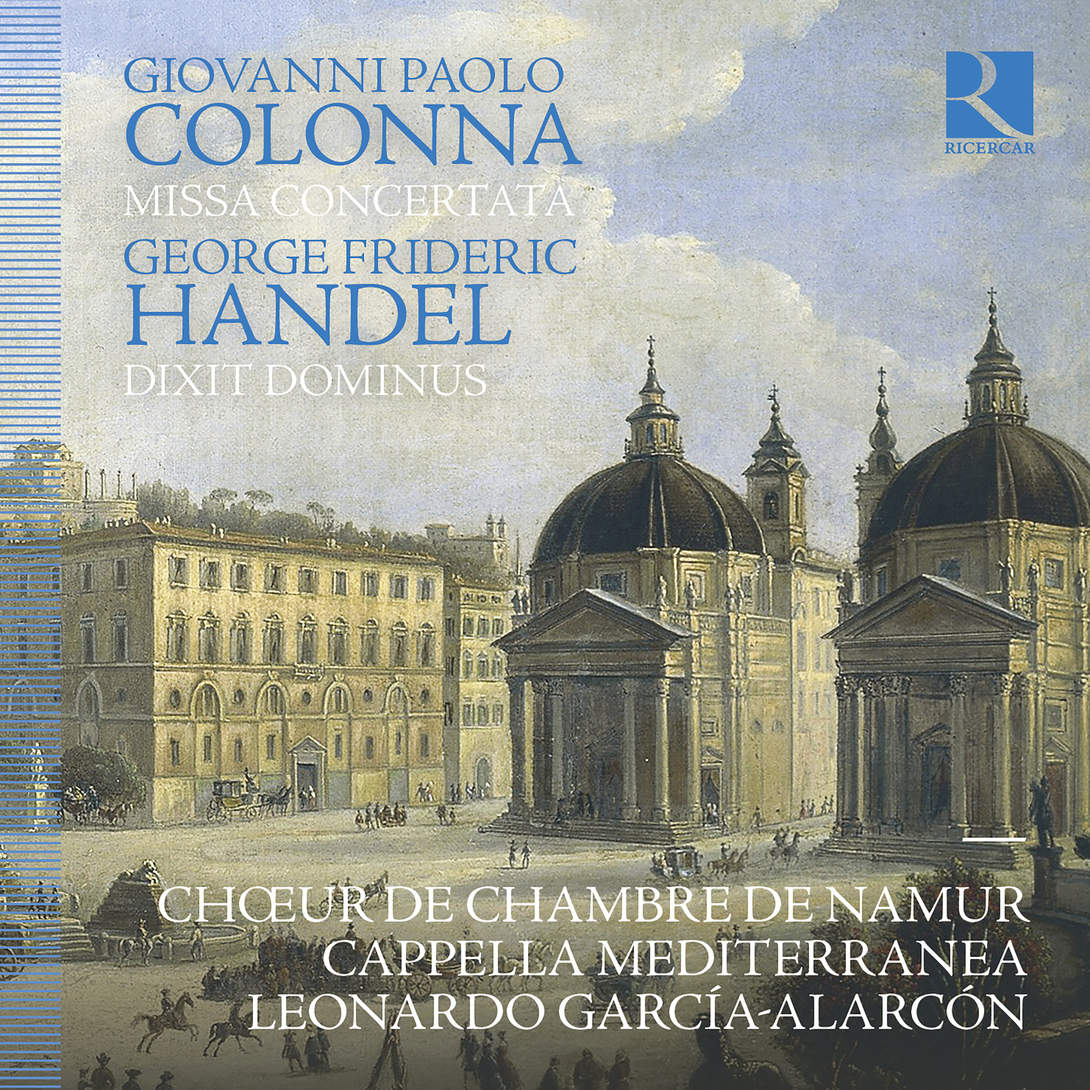
In his latest album, leading the Namur Chamber Choir and Cappella Mediterranea, Leonardo García-Alarcón juxtaposes Giovanni Paolo Colonna’s Missa Concertata, a forgotten treasure of Roman Baroque, with Handel’s renowned Dixit Dominus. In a brief interview, the Argentine conductor discusses the genesis of this programme, his admiration for Colonna—a little-known master with visionary counterpoint—and his consistently personal approach to great masterpieces.
Your recording draws a parallel between the Italian composer Giovanni Paolo Colonna and Handel. What stylistic or spiritual affinities led you to bring these two figures together in the same programme?
Leonardo García-Alarcón: It seems evident to me that when Handel arrived in Rome in 1707, admiration for Giovanni Paolo Colonna was still very much alive. Although Colonna had died a few years earlier, his music was considered as an example of sumptuous polyphonic music in the new style—that is, blending grand choirs with soloists—by the Vatican, the city of Rome, and all of Italy. This is indicated in the score, where the orchestral writing is separate. This is called a concertato, meaning a mass in which the instruments play an independent part from that of the choir, and it’s a significant innovation. Colonna sparked admiration from Emperor Leopold I of Austria, who invited him to perform his own music in Vienna. His works were also present in the library of Louis XIV in France, where he was known as the “master of masters.” All this suggests to me that the young 22-year-old musical genius Handel measured himself against Colonna, and that’s why I wanted to have these two “pillars” of music history on the same disc.
You discovered Colonna’s music at the Vienna library a few years ago while searching for the third act of Draghi’s Prometeo. What particularly struck you about this mass that made you want to introduce it to a modern audience? What are the challenges?
L. G.-A.: What struck me when I discovered the manuscript of this mass was the complexity of the counterpoint, where everything seems to flow from a single source. The refined harmonies and numerous dissonances immediately reminded me of much later music, like that of Handel or Bach. At first glance, I even thought it was a piece by one of these two composers! I had never encountered Italian music from the late 17th century of this type; I immediately realized it was by one of the greatest—if not the greatest—composers of that era. I felt a strong similarity with Bach’s Mass in B minor, just by the key: it’s rare to write a mass in a minor key. Actually, Caldara did it with his Mass in B minor, but only in 1736. Colonna did it as early as 1686, which was quite revolutionary for his time.
Rather than difficulties, we need to highlight the qualities of the score. For example, in the Quoniam tu solus sanctus or the Cum sancto spiritu, I have to bring out the four fugue themes and help the choirs and instrumentalists understand what’s happening so that everyone is aware. Because it’s not easy to face such virtuosic writing, one must react immediately to the composer’s propositions so that the audience can immediately perceive this texture, these complex harmonies. It all must feel them as something natural.
Conversely, Handel’s Dixit Dominus is frequently performed and has been recorded many times. How did you seek to distinguish your version from existing ones? What was your approach to the work?
L. G.-A.: I never think about being original when I approach a piece from the past. I care above all that the piece itself can speak to me with all its power, that it can touch me through parameters I can read and interpret. I believe that, ultimately, that’s what interpretation is: interpreting is reading, reading with one’s own eyes. I can never offer a version similar to that of another conductor because my interpretation will be different anyway. And that’s what justifies all the interpretations in the world. But the most important thing is not to want to be original; that would be a contradiction to all my research. It’s the piece itself that must tell me things, that offers itself to me as a gift so that I can share it with everyone.
 Press review
Musically, this production is strong. […] Both the orchestra and the Namur chamber choir […] make great music together. Overall, much to enjoy, especially so -if this is your introduction to Colonna!
Biberfan
A fascinating comparison between a first recording of a forgotten masterpiece and a new interpretation of one of the most brilliant works by the young Handel, dazzled as he was by his discovery of the Italian Baroque.
France Musique
All this is delivered here with dazzling brilliance, audacity, a taste for contrasts and the spectacular, a sonic indulgence and a kind of insolence that one imagines were those of the young Handel himself.
Charles Sigel, ForumOpéra

You must be logged in to be able to post comments.
Sign in