


 The music of Bach’s “Köthener Trauermusik”, composed for the funeral of Prince Leopold of Anhalt-Köthen in 1729, has been lost, but the libretto and many details of the ceremony survive. Solomon’s Knot presents a new reconstruction by Chad Kelly, drawing in particular on the “St Matthew Passion” and the “Trauerode BWV 198”.
  By
By 


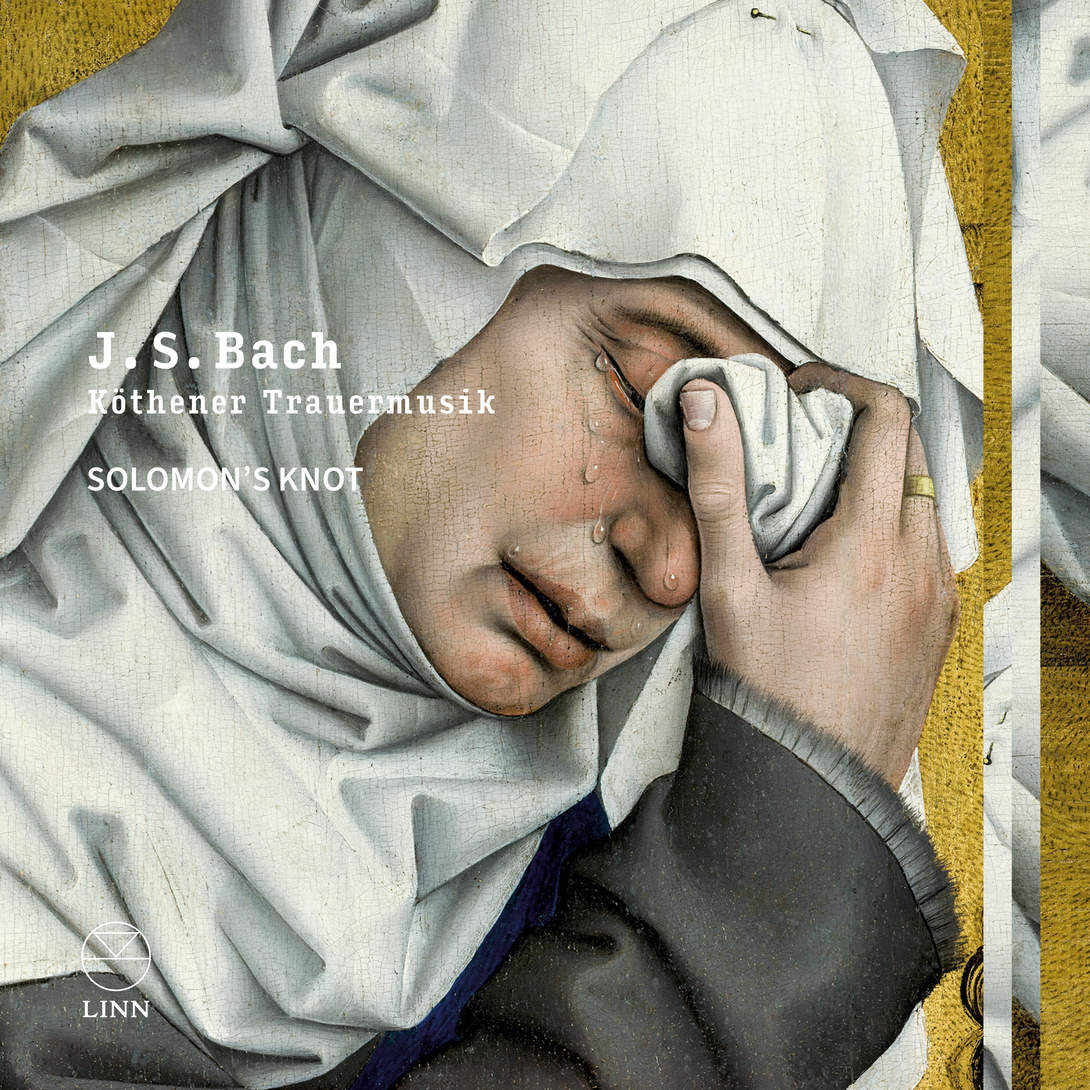
With J. S. Bach: Köthener Trauermusik, released on Linn Records, Solomon’s Knot brings one of Bach’s major lost works back into focus. Written for the funeral ceremonies held in Köthen on 23 and 24 March 1729 in memory of Prince Leopold, Bach’s former employer and a close associate of the composer, the work survives in no musical source. Picander’s text, the service booklet, the date and several details about the performers have, however, been preserved: enough to attempt a reconstruction of a work whose arias and choruses appear to have drawn extensively on material known from elsewhere.
The starting point is a principle familiar in Bach’s music: parody, the reuse of pre-existing music with a new text. Scholars broadly agree that the Trauermusik drew on music from the St Matthew Passion BWV 244.1 and the Trauerode BWV 198, composed two years earlier for the death of Christiane Eberhardine. But the picture remains incomplete: the recitatives, in particular, have no surviving model that can be adapted with any certainty.
This is where Chad Kelly comes in. Commissioned by Solomon’s Knot to create this new reconstruction in consultation with its Artistic Director Jonathan Sells, Kelly chose not to force recitatives from the St Matthew Passion or the Trauerode onto Picander’s verses. Instead, he composed new ones specifically tailored to the text. He did the same for the dictum ‘Wir haben einen Gott’, for which no satisfactory Bach model could reproduce the natural prosody. The project therefore openly embraces a degree of creative intervention: not an attempt to recover a lost score note for note, but a historically informed solution where the sources fall silent.
The reconstruction also seeks to recover something of the dramaturgy of the 1729 ceremonies. Drawing on a hypothesis by Andrew Parrott, it distinguishes between an intimate nocturnal sequence, which may have accompanied the private burial on 23 March, and a more public and solemn section intended for the commemorations the following day. The first opens with the Sinfonia from Cantata BWV 21; the second turns towards collective mourning with ‘Klagt, Kinder, klagt es aller Welt’. Two chorales known to have been sung at the funeral have also been reintroduced at specific points in the sequence.
Another revealing detail: where the reconstruction reuses music from the St Matthew Passion, it follows the earliest surviving source of that version, later copied by Johann Christoph Farlau. Certain differences in instrumentation allow the colours to shift: in the aria corresponding to ‘Komm, süßes Kreuz’, the obbligato viola da gamba part is transferred here to the lute, reinforcing the more intimate character of the opening section of the ceremony.
The recording also bears the unmistakable stamp of Solomon’s Knot. An unconducted collective, the ensemble performs its solo parts from memory and favours a direct relationship between voices, instruments and text. Eight singers share the solo and choral writing, alongside Jonathan Sells, with an orchestra of strings, two violas da gamba, lutes, flutes, oboes, bassoon and organ. The reconstruction was recorded live on 6 and 7 June 2025 at the Dreieinigkeitskirche in Regensburg, as part of the Tage Alter Musik, in co-production with Deutschlandfunk Kultur.
The result fully acknowledges the hypothetical nature of the project. It does not claim to solve the mystery of the Köthener Trauermusik once and for all; instead, it turns it into a field of interpretation at the crossroads of musicology, reconstruction and creation. A way of making audible a work of which almost everything survives – except, precisely, the notes.
You must be logged in to be able to post comments.
Sign in