


 Through years of immersion in 15th-century music, Sollazzo Ensemble has gradually grown attuned to its distinctive rhythm, shaped by repetition and melancholy.
  By Anna Danilevskaia


A medieval manuscript from 1470 can still be a source of richness and renew our way of listening today: Anna Danilevskaia reflects on seven years of musicological and musical work centered around the Leuven Chansonnier—and shares some surprising insights.
2018: Deepening Style and Emotion
One striking feature of the songs in the Leuven manuscript is what we, modern listeners, perceive as a certain melancholy. It is indeed present—but not in an austere way. It is a melancholy that deepens with each stanza, gaining nuance as the piece unfolds. There’s also a risk of confusing melancholy with sensuality: some of the texts are very intimate and sensual. But because the music is slow and suspended, we tend to project a sadness onto it that it doesn’t necessarily contain. There are shades within this omnipresent medieval melancholy—sometimes more painful, sometimes more contemplative. For us, it was a fascinating challenge: how to make these nuances perceptible? We had to refine our interpretation so that each piece could fully express its unique character.
Bringing a Medieval Repertoire into a Contemporary Concert Format
Today, our listening habits and attention span revolve around one key element: contrast. Whether long or short, the formats of the pieces we are used to are built around this element, which has become nearly essential to our ears. Unconsciously, we crave nuance and dramatic gestures. The music in the Leuven Chansonnier is organized differently: although surprise is present and probable, it operates in a different context, with musical forms unfolding in a wholly other manner. Things are said and repeated, and these repetitions structure the piece and are part of its identity. This allows nuances and details to play an essential role in the aesthetic—they become fundamental.
For many listeners, the Chansonnier offers a refuge from our fast and noisy world.
Adapting to a Different Rhythm
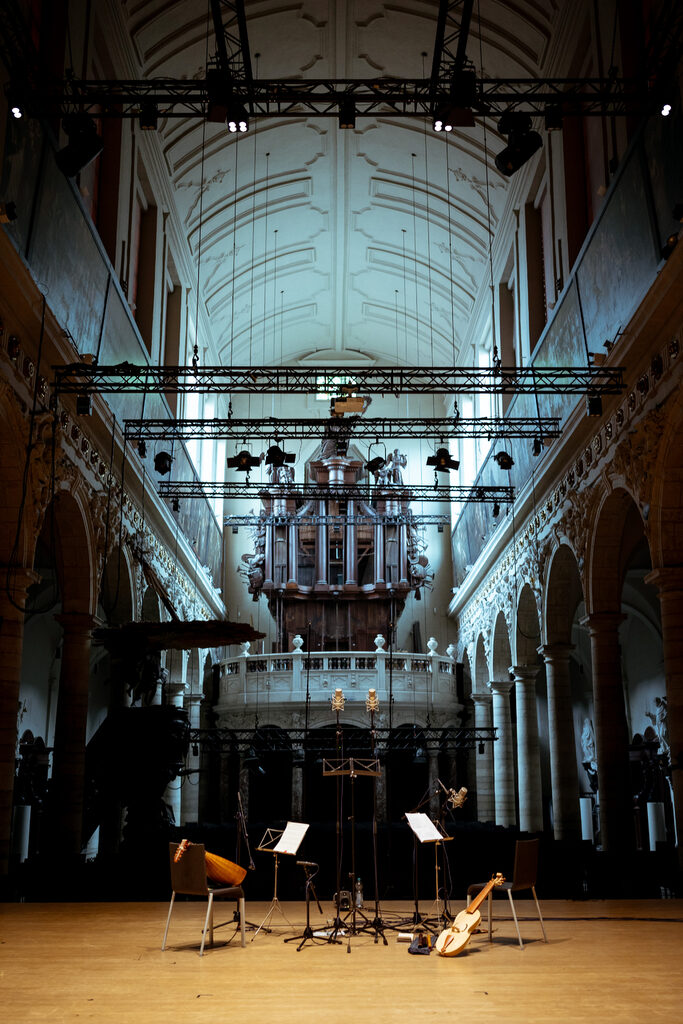
When crafting our concert programs, we had to give the audience a moment, at the beginning of the performance, to ease into this unfamiliar flow, to grow accustomed to these alternative formats, recalibrate their listening in an intuitive way, and immerse themselves in this new rhythm. Once this threshold is crossed, the audience is ready to receive this music with a different sensitivity—and I believe this way of listening can be a refuge for many in our fast and noisy world. It’s fascinating to observe, especially when compared to our other favorite repertoire, the Italian trecento, where the experience is quite the opposite! But I believe cultivating these different listening modes is a source of great richness. It’s a wonderful opportunity for Sollazzo to immerse ourselves in these such different musical worlds today.
The Crucial Support of the Alamire Foundation
A project of this length and ambition required significant financial resources. The entire endeavor was funded by the Alamire Foundation, which coordinated both the musicological and artistic research. The team at the Foundation had a particularly beautiful and clever idea: to find sponsors to “adopt” each piece. Some sponsors were deeply moved by the music and wanted to get involved by funding the research on a particular work, becoming patrons of a song. This support was essential in bringing the project to life, allowing this forgotten music to be rediscovered—not only in archives, but also on stage, before a live audience.

Passacaille, Ambronay Editions, and the Alamire Foundation: A Rewarding Collaboration
In 2017, we were part of the EEEMERGING program, which supported young ensembles in their development. As a result, we had an exclusive recording contract with Ambronay Editions, which raised the question of how to release the Leuven Chansonnier recordings, already slated for publication by Belgian label Passacaille. Rather than working separately, the three organizations decided to pool their resources and collaborate on this production. The result was a joint release on both labels—a choice I found very smart, as it allowed for greater visibility of the project.
Seven Years of Growth: Sollazzo, an Ensemble in Transformation
It’s also thanks to the Leuven Chansonnier that Sollazzo experienced a kind of opening to the wider world, evolving from a fixed ensemble of musicians with similar backgrounds into a far more diverse group. This project offered the opportunity to work with artists from different backgrounds and sensitivities. Looking back, I see how the ensemble gradually became much more varied.
The seven years dedicated to the Chansonnier were pivotal for me: they shaped my way as an artist and crystallized my musical intentions.
A Plurality of Interpretations
It’s quite fascinating to observe how certain fundamental concepts are understood and conveyed completely differently depending on where the musicians were trained. And yet, these concepts are grounded in readings of source material that are equally deep and meticulous. For instance, something seemingly simple like cadences (phrase endings) can take different shapes depending on the musician: some swell the penultimate note toward the final one, creating a tension that resolves in the final chord; others do exactly the opposite. Yet they all draw from the same sources! These are simply different ways of sight-reading, each equally legitimate. I’m sure things weren’t so different back then… I love seeing these varied approaches within the ensemble. For me, that’s where the true richness lies!
A Life-Changing Project
The seven years devoted to the Chansonnier were pivotal in my journey: I believe they played a major role in shaping how I am as an artist today and helped crystallize my musical intentions. At first, it seemed like an overwhelming project—almost too monumental to be possible. But little by little, it took shape, piece by piece, measure by measure. It was a long tête-à-tête with the musical material itself, allowing me to absorb and internalize it, to question it over and over. It wasn’t about striving for some kind of absolute mastery, but simply about the place this project came to occupy in my life. It was my apprenticeship—my real-world artistic training. Of course, I came out of it enriched—but most of all, with new questions!

Upcoming projects
- 15 May — Programme to be announced, Florence (Italy)
- 17 May — La dolce vista, Prague Spring Festival, Convent of St Agnes, Prague (Czech Republic)
- 5 June — Le corps s’en va, le cœur demeure…, Brno (Czech Republic)
- 6 June — Le corps s’en va, le cœur demeure…, Bratislava (Slovakia)
- 8 June — Feast of the Swan, Tage Alter Musik, Regensburg (Germany)
- 29 June — La dolce vista, St Macharius Church, Ghent (Belgium)
- 10 July — Cantano gli angeli, York (United Kingdom)


You must be logged in to be able to post comments.
Sign in