


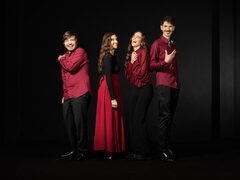
 After the rediscovery of the manuscript, Anna Danilevskaia and Sollazzo were given the opportunity to record it in full.
  By Anna Danilevskaia


The Chansonnier de Louvain (Leuven Chansonnier) is the story of a major musical manuscript that resurfaced in the early 2000s: French vielle player Anna Danilevskaia and the members of her ensemble Sollazzo first contributed to its revival before being offered the chance to record all 50 pieces across four CDs. An irresistible opportunity—but also a true artistic challenge!
Recording the complete Chansonnier: a monumental challenge
In 2018, after the Amuz marathon, we were offered the chance to record the manuscript in its entirety. It was an exciting offer… but also a massive challenge. We’re talking about 50 pieces! Just digging into the literary, musical, and emotional depth of a single work requires deep commitment. But 50? We had to ensure that it wouldn’t sound like a mere musicological document, but remain lively, artistic, expressive. At first, I hesitated. Then I dove back into the manuscript, into pieces we hadn’t yet explored… and I decided we would do it. We recorded four CDs, proceeding chapter by chapter, each time selecting the works that felt the most inspiring. The experience was eye-opening: back in 2017, I had chosen the pieces that seemed most appealing on paper. But as the project evolved, I discovered works I had underestimated, which ended up moving me deeply. That happened at every stage of the project. Between the written score and the actual sound, there was a gap that only interpretation could bridge.

Grasping the rhythm of the rondeau
Another challenge was that 42 out of the 50 pieces were rondeaux—a highly specific musical form of the time. The rondeau follows an AB structure with many repetitions (AB-AA-AB-AB), which is quite distant from our modern formats. We had to find a different way of thinking about music, one where repetition is both a concept and a structural element. After playing part A three times, transitioning to part B can feel like a release—or at times, like stepping into the unknown. You have to feel this in your body, in your interpretation. It’s a very different sense of time and tension than what we know today.
Passionate about early music and want to read this subscriber-only article?
If you are not a subscriber, join the international Total Baroque community. Subscribe here from 5.00€.
I subscribe
If you are already a subscriber, sign in.
I sign in 

You must be logged in to be able to post comments.
Sign in