


 Baroque violinist, founder of Artifices Ensemble, creator of La Turbine and the Seulétoile label, Alice Julien-Laferrière cultivates the art of connecting music, place, and imagination.
  By
By 


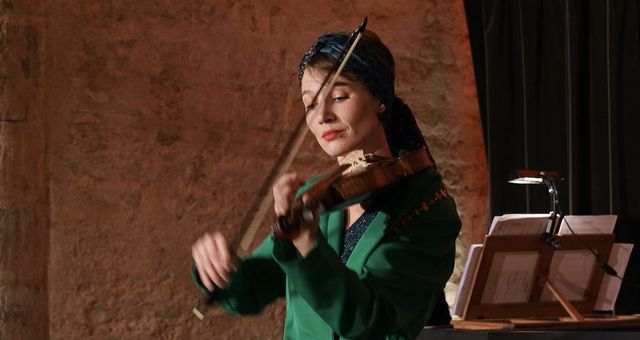
Based at La Turbine, a former Burgundian mill converted into a creative and residential space, Alice Julien-Laferrière leads a musical life far from the beaten track. Through her ensemble Artifices, she explores the links between Baroque music, nature, science, and theatre, while championing an entrepreneurial model rooted in both the land and the realities of the contemporary artistic profession. A conversation with a truly all-terrain violinist, for whom freedom lies as much in the unexpected as in precision.
In 2002, you completed a dissertation on imitation in violin language. That same year, you founded the ensemble Artifices as a continuation of that research. Why the name?
Alice Julien-Laferrière: While compiling examples of imitation in early violin sonatas, I realized how central the evocation of nature was. At that time, “artifice” took on a new meaning: the Baroque artist sought to equal—or even surpass—nature. It was the era of trompe-l’œil, of formal French gardens… a desire for mastery. I chose the name Artifices because it reflects that Baroque mindset, but also because it resonates with our own time: the more we talk about nature, the further removed from it we seem to become…
With La Turbine, a place that orients itself toward nature, are you also proposing a different way of thinking about what’s “natural”?
A.J.-L.: Yes, exactly! We hold many outdoor concerts, musical walks… It’s a different way of listening, away from traditional venues. It creates a new, more mobile context for music. And I can tell you—it was a real learning curve (laughs). Classical training pushes you toward perfection, which can be inhibiting. Playing outdoors forced me to let go: acoustics, weather… nothing is under control. These unexpected elements helped me break free from a deeply ingrained perfectionism. I had to learn how to make space for the impromptu. And that’s how Artifices grew too—in a more direct, lively, ever-shifting relationship with the audience.
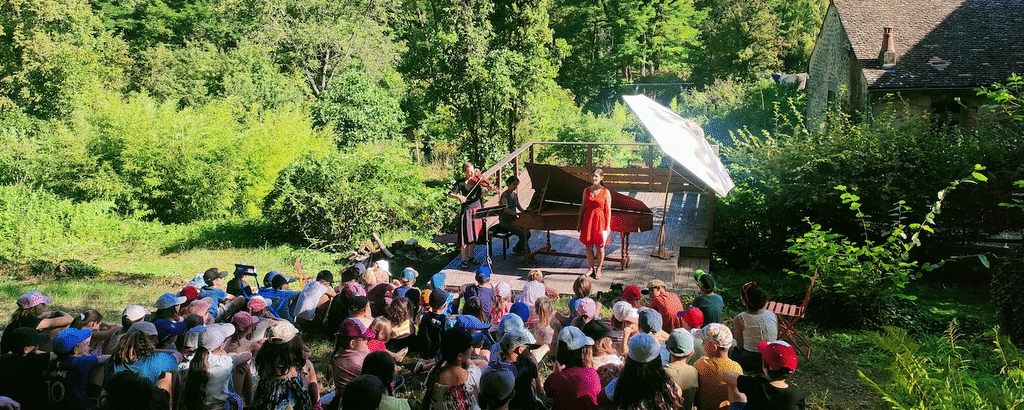
Your ensemble blends music, theatre, circus, but also ecology, astrology, ornithology, and campanology… What was your initial vision?
A.J.-L.: Indeed, that’s quite a list of scientific terms (laughs)! These are the ensemble’s main themes. Campanology, for example, came from a project on bells that mixed performance and lectures. I loved that work—it gave real depth to the music. We even created a repertoire with Joël Grare, a bell percussionist! For ornithology or astrology, we collaborate in a similar way with experts, including with the LPO (Bird Protection League), bridging music and scientific knowledge. These cross-disciplinary connections sharpen the senses and attract new audiences. During our birdwatching walks, for instance, we reach nature lovers who may not know Baroque music; they discover a repertoire, bird imitations… It’s a way to explore a single subject from multiple angles, and that’s immensely rewarding!
Thirteen years later, how would you define your ensemble?
A.J.-L.: Honestly, we’ve taken many different paths since 2012, shaped by different encounters and opportunities. For instance, I’ve worked extensively with young audiences, simply because I was invited to. Still, I think the main thread responds to a deep desire: to be rooted in a specific place, on a piece of land. I’ve always wanted to live in the countryside, and I did everything to make that dream come true—with the good fortune of meeting the right people!
And finding the right place!
A.J.-L.: Yes! I also realize I’ve continued the line of thought from that early dissertation. I wanted to dig deeper into the idea of mimicry, of artifice in music. One of our first projects was about the post horn. We had a ten-year partnership with the Postal Museum in Paris, in various forms—including a recording. And I’m still working on that subject today. So, there is a kind of constant thread, evolving and sustaining us over time.
Passionate about early music and want to read this subscriber-only article?
If you are not a subscriber, join the international Total Baroque community. Subscribe here from 5.00€.
I subscribe
If you are already a subscriber, sign in.
I sign in 

You must be logged in to be able to post comments.
Sign in