


 Salvador Simão (Portugal), Magdalena Hinz (Germany) and Pierre Gennaï (France) are the three winners of the Cesti competition at the Innsbruck Early Music Weeks, the final of which took place on Sunday 31 August. Watch the replay of the final on Total Baroque Magazine!
  By
By 


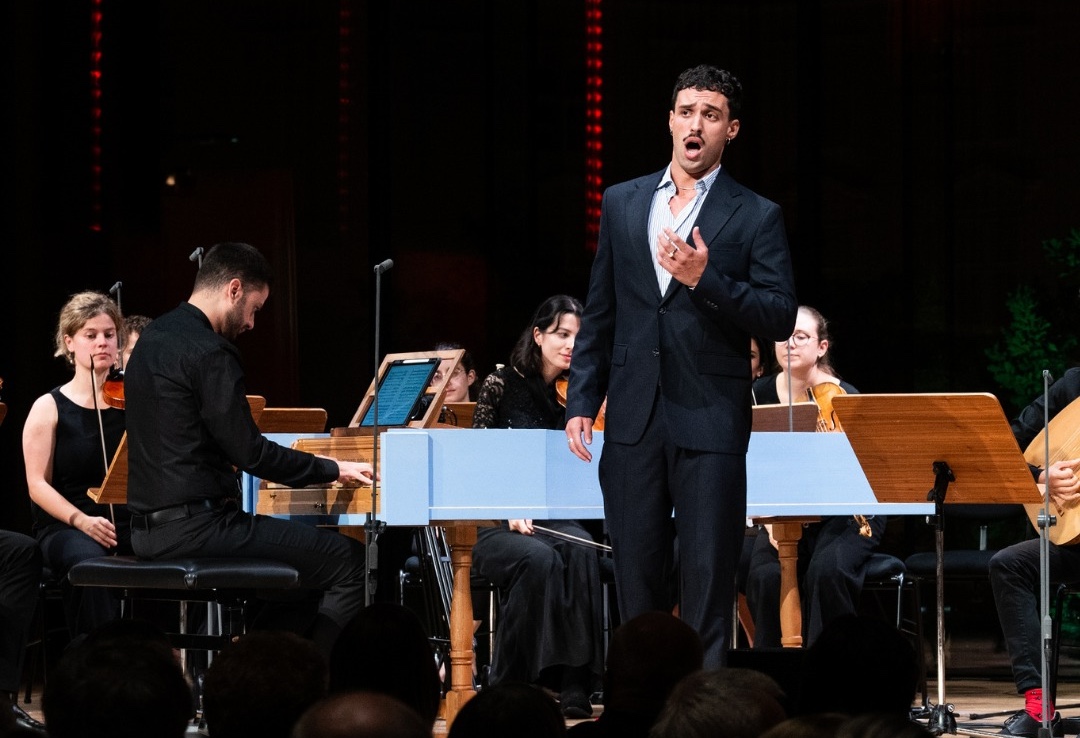
On Sunday evening, Salvador Simão, a 24-year-old Portuguese tenor, won the CESTI Baroque Voice Competition at the Innsbruck Early Music Weeks. He began his vocal training at the Escola Artística de Música do Conservatório Nacional (EAMCN) in Lisbon under Rute Dutra. During his studies, he was an active member of the Opera Studio, the Chamber Choir, and the Baroque Chamber Music course. He was also a finalist in the 2017 Voice of Portugal television competition. He is currently pursuing a master’s degree at the Dutch National Opera Academy (DNOA), where he continues his vocal studies with soprano Charlotte Riedijk. He obtained his bachelor’s degree with honours from the Codarts University of the Arts in Rotterdam.
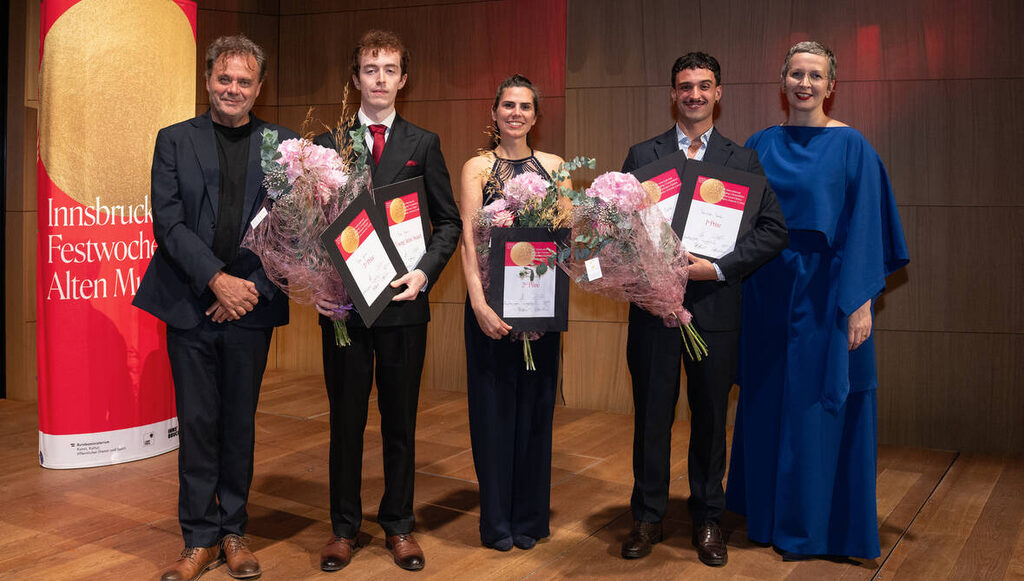
The second prize went to 33-year-old German mezzo-soprano Magdalena Hinz. A scholarship holder at the 2022 International Bach Academy in Stuttgart under the direction of Hans-Christoph Rademann, she works as a freelancer with the vocal ensemble Collegium Vocale Gent under the direction of Philippe Herreweghe, the RIAS Chamber Choir, the SWR Vocal Ensemble and the Gaechinger Cantorey. She works regularly with the Göttinger Barockorchester.
French baritone Pierre Gennaï, 23, won two prizes, taking third prize in the competition as well as the Audience Prize. Having studied the double bass, piano, organ, composition, and choral and orchestral conducting, he started singing in 2020 at the CRD in Nîmes with Laurène Huet. In 2022, he was accepted onto Mireille Delunsch‘s singing course at the CNSMD in Lyon, while continuing to study the organ with Yves Lafargue at the CRR in Lyon. He was a member of the Opera Studio of the Opéra National du Rhin for the 2024-2025 season.
In the compulsory programme for the final, the singers performed an aria from George Frideric Handel’s opera Atalanta, which will be presented next year by Barockoper:Jung. The cast will be made up of participants from all stages of the Cesti competition.
Founded in 2010 by conductor Alessandro De Marchi and artistic director Sebastian Schwarz, the Cesti Competition was conceived as an event dedicated solely to baroque opera singing. The aim: to establish an international competition with a top-level jury, but above all one oriented towards tangible career opportunities for young singers. From the outset, it was not only about financial rewards but about offering real prospects: engagements at Innsbruck’s Festwochen der Alten Musik, or with other leading festivals and opera houses.
The success was immediate. Within just a few years, the Cesti has become one of the most important platforms for young voices specialising in the baroque repertoire. Many major figures of today’s scene had their careers launched or accelerated here: Carlo Vistoli, Filippo Mineccia, Lawrence Kilsby, Neima Fischer, Giacomo Nanni and Marie Lys — all of them were finalists or prize-winners at Innsbruck. Their names now appear on the bills of the most prestigious baroque productions across Europe and beyond.
A living network
On the international stage, the reality is clear for singers: the sector is fiercely competitive. “Let us be frank: for promoters, putting on a concert is far easier than staging an opera production, especially financially. That is obvious. So I understand perfectly when some say there is not enough work in opera — it remains a real challenge,” says Innsbruck’s director Eva Maria Sens. “That is why we are trying to create concrete opportunities for young singers.”
Former participants in the Cesti Competition now form a genuine international network loyal to the Festival. Many return regularly to Innsbruck, to sing leading roles, take part in concerts or act as teachers. Over the years, a veritable musical family has taken shape, perpetuating the spirit of the Festival: artistic excellence, historical vocal culture and a passion for baroque music theatre.
This is also the aim of the project Barockoper: jung (Baroque Opera: Young), closely linked to the competition, which offers prize-winners the chance to appear in a first major staged opera production in a professional setting (this year: Vivaldi’s Il Giustino). The project has become a pillar of the Festival.
International recognition
The jury, chaired by Sebastian Schwarz, consists of a panel of renowned singers, opera directors and artist managers, renewed each year. In 2025, alongside co-founder Sebastian Schwarz, the jury includes Ottavio Dantone (music director of the Innsbruck Festival) and singer Anna Bonitatibus, as well as newcomers such as Francesco Corti (conductor, music director of the Drottningholm Court Theatre), Franziska M. Kaiser (casting director at Staatstheater Wiesbaden) and Julia Maynard (head of vocal and opera at Intermusica Artists’ Management).
Each year, between 150 and 200 young singers from around the world apply. In recent years, the proportion of candidates from Latin America has steadily increased, reflecting a vibrant vocal scene in countries such as Argentina, Brazil, Venezuela and Colombia. Artists such as Franco Fagioli, Bruno de Sá, Denis Orellana and Mariana Flores have blazed a trail and today serve as role models for a new generation.
For Eva Maria Sens, director of the Festival and the Competition: “The economic situation is always an issue, and it would be wrong to ignore it. That is the reality. That said, for a festival that does not have to keep a large opera house running day by day, there is perhaps — at least for now — a little more flexibility. I would not say it is easier, since we all have to tighten our belts, but it is still possible to make savings in some areas, as long as it does not directly affect artistic creation.”
The competition’s objective remains clear: to continue guaranteeing fair and equitable fees for artists, while creating something that brings joy, meaning and genuine added value for the public. In the medium and long term, the situation will certainly not become easier for any of us. But for the moment, we can still “breathe”, as it were. There is still room for manoeuvre to keep the budget afloat.



You must be logged in to be able to post comments.
Sign in