


 On an island ruled by women, men adorn themselves, obey and wait to be chosen. With “L’Uomo femina”, Baldassare Galuppi reverses the gender roles of his time in 1762, turning them into a lively, ambiguous and deliberately ironic comedy. Vincent Dumestre and Le Poème Harmonique now restore the colours of this Venetian curiosity.
 By
 2 minutes


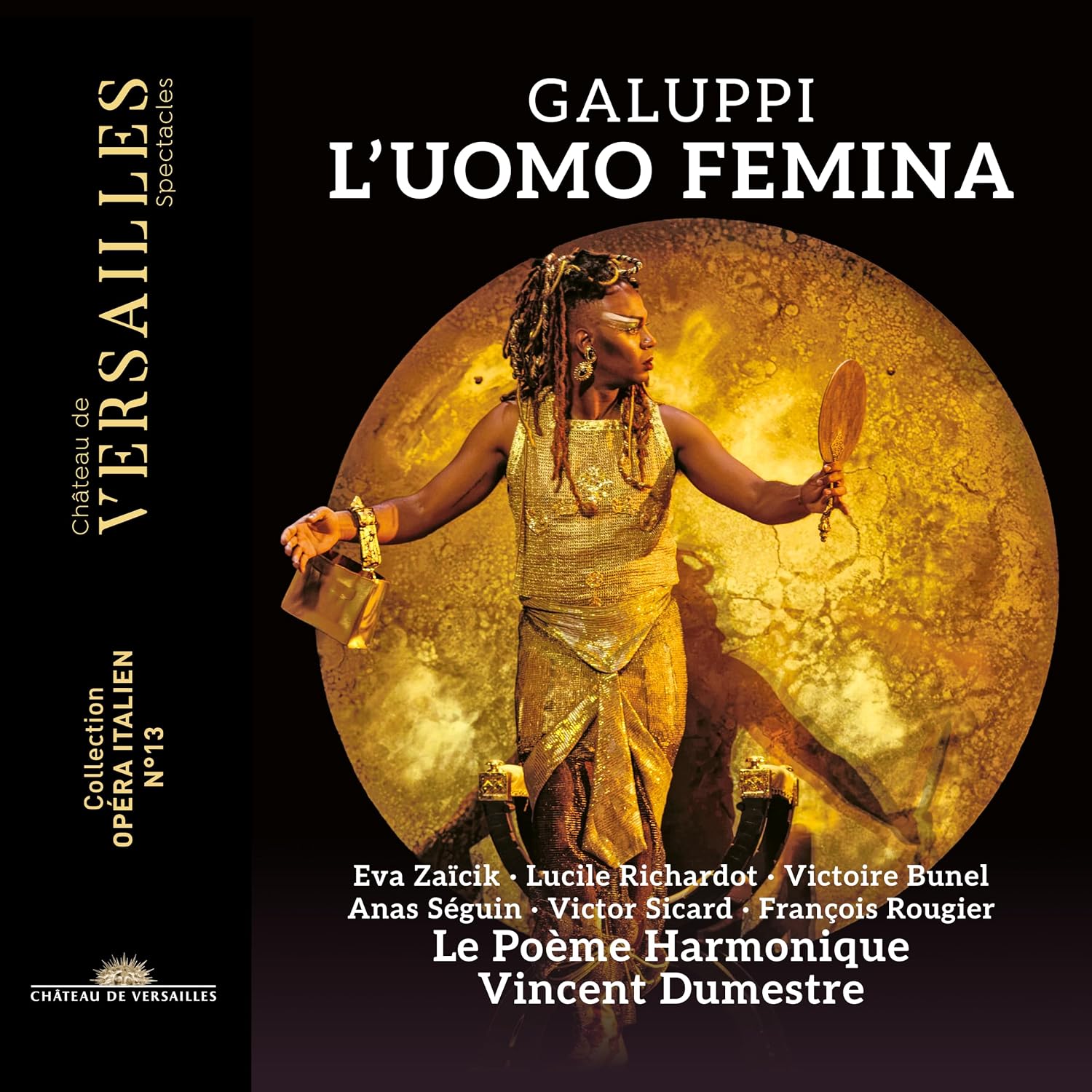
Released on October 16 by Château de Versailles Spectacles, this recording brings together Eva Zaïcik, Lucile Richardot, Victoire Bunel, Anas Séguin, Victor Sicard and François Rougier with Le Poème Harmonique. Long thought lost before being rediscovered in 2006 at the Ajuda Palace Library in Lisbon, the score returned to the stage in 2024 in a production directed by Agnès Jaoui.
The world turned upside down
The premise is simple and effective enough to set the whole mechanism in motion. Roberto and Giannino, two castaways from a world in which male authority is scarcely questioned, discover a society that systematically reverses its customs. Cretidea rules, fights and collects lovers; the men, meanwhile, cultivate their appearance, fidelity and docility. Pietro Chiari’s libretto, however, does not sketch out a feminist utopia avant la lettre: it turns stereotypes on their head to make them more visible, before gradually complicating the interplay of desire and power. Even the final chorus leaves some ambiguity hanging over the restoration of male order.
Much of the album’s appeal lies in the way Galuppi brings this premise to life. At the crossroads of Baroque and Classical styles, his music favours momentum, effective ensemble writing and sharply differentiated characters. Not every aria leaves an equally strong impression, but the composer excels in his treatment of ensembles, which remain closely involved in the action and often lend it an acerbic edge.
Theatre above all
At the centre of the cast, Eva Zaïcik gives Cretidea far more than surface authority: the warmth of her timbre and the depth of her lower register constantly allow the woman behind the ruler to emerge. Lucile Richardot brings her instantly recognisable grain and a sharper presence to Ramira, while Victoire Bunel gives Cassandra a vulnerability that provides a welcome contrast with the more expansive characters. Among the men, Victor Sicard offers a firm, luminous Roberto; Anas Séguin gives substance to the narcissistic Gelsomino, while François Rougier handles Giannino’s more overtly comic vein with complete ease.
From the podium, Vincent Dumestre makes full use of the score’s very tangible orchestral richness. The strings retain bite without sacrificing flexibility, while oboes, flutes and horns bring vivid colours that help define each situation. The continuo is particularly carefully shaped: harpsichord, theorbo and mandolin do far more than simply support the voices. The orchestra thus becomes a genuine partner to the singers, allowing the comedy to retain all its theatrical relief on disc – no small achievement.
The pleasure of listening and discovery lies in writing that thoroughly understands the mechanics of the stage, in the irony with which Galuppi plays with social conventions as much as musical ones, and in an interpretation that never weighs the work down but preserves its ambiguity. Two and a half centuries later, the mirror game remains unsettling enough for this apparently light comedy to leave behind a lingering sense of unease.




You must be logged in to be able to post comments.
Sign in