


 For her first recital on Harmonia mundi, Gabrielle Rubio returns to the composers who first established the French transverse flute as an instrument of distinction. From Michel de La Barre to Michel Blavet, via Hotteterre, Philidor, Boismortier and Couperin, the young flautist traces a journey through dances, reveries and chiaroscuro, from the hushed intimacy of the King’s Chamber to the salons of the eighteenth century.
  By
By 


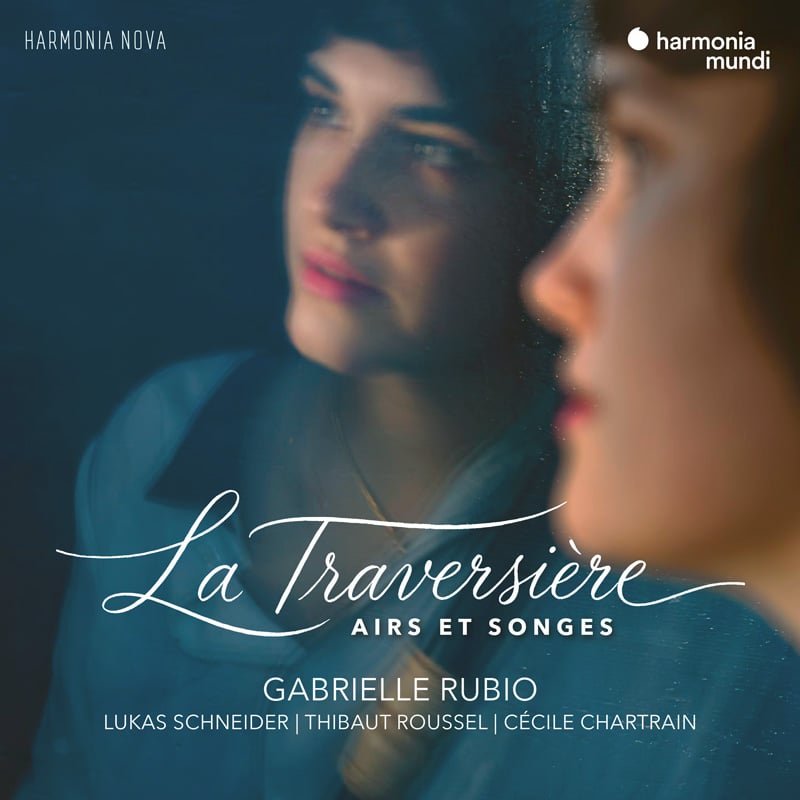
Michel de La Barre, Jacques-Martin Hotteterre and Pierre Danican Philidor were among the first composers to capture Gabrielle Rubio’s imagination when she discovered Baroque music. It was therefore only natural that she should place these guiding figures at the heart of her first recording devoted to the flute. All three were associated with the royal musical establishment and, towards the end of Louis XIV’s reign, helped shape an aesthetic in which the transverse flute found a voice of its own: rounded, supple and close to vocal declamation. Alongside them, the programme also features Boismortier and Blavet, whose music reflects changing tastes under the Regency and Louis XV, as the French tradition opened itself to Italian virtuosity and the galant style.
The dance suites of Hotteterre, La Barre and Philidor are set alongside the more brilliant sonatas of Blavet and Boismortier. The album moves from the allemande La Cascade de Saint-Cloud to the rondeau Le Plaintif, and from the chaconne in the Sonate l’Inconnue to Blavet’s Les Caquets, before concluding with François Couperin’s Les Bergeries, adapted by Blavet and rearranged here for flute and viola da gamba. Rather than merely placing these works side by side, the programme traces the gradual transformation of an instrument that was still rare in the seventeenth century but, within a few decades, became one of the emblems of French musical elegance.
To reflect this evolution in sound, Gabrielle Rubio plays two transverse flutes with distinct characters. A copy of a three-part instrument by Jean Hotteterre, with its rounded, velvety tone, is used for the French suites; a later model inspired by Pierre-Gabriel Buffardin, brighter and more agile, serves the sonatas of Blavet and Boismortier. The recording was also made at A = 400 Hz, the pitch associated with the King’s Chamber: an intermediate tuning that lends the period instruments a particular warmth and flexibility. Rubio is joined by Lukas Schneider on viola da gamba, Thibaut Roussel on theorbo and Baroque guitar, and Cécile Chartrain on harpsichord, all sharing in this exploration of colour and musical breath.
Released in August 2026, La Traversière. Airs et songes does more than evoke the golden age of an instrument. Supported by the Centre de musique baroque de Versailles through its Lab’baroque programme, the album invites us to rediscover a French art of singing without words, shaped by ornament, elegance and nuance. Through these works, Gabrielle Rubio recreates the atmosphere of a candlelit evening at Versailles, before allowing the music, as she hopes, to lead the listener ‘along the path of dreams’.

You must be logged in to be able to post comments.
Sign in