


 He is one of the pioneers of the early music revival, and he has no intention of slowing down. At 80, Ton Koopman remains one of the leading figures in the field, always on the move—overflowing with ideas and projects.
  By
By 


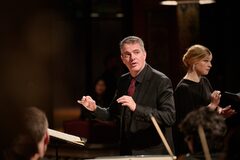
Ton Koopman—harpsichordist, organist, ensemble director, and conductor—may well be the first name that comes to mind (or ear) when one thinks of Johann Sebastian Bach. Not only has he recorded the complete cantatas with the Amsterdam Baroque Orchestra (ABO), which he founded in 1979, and its associated choir (ABC) since 1992, but since 2019, he also acts as president of the Bach Archive in Leipzig. His personal library, containing around 45,000 volumes of historical music works, treatises and sources (including manuscripts and printed scores dating from the 14th century to the present day), has been donated to the Orpheus Institute in Ghent. But of course, at 80, he continues researching and collecting… and, most importantly, he continues to make music!
You have been making music for 70 years, ever since you began playing on the historic organs of your area…
Ton Koopman: …and even before that, I was already singing in a boys’ choir when I was six.
Ah, I didn’t know that—so that’s a 74-yearmusical career!
T. K.: Yes, you could put it that way…
Later, you became a harpsichordist, then started directing your own ensemble, and for a long time now, you have also been conducting modern symphony orchestras. Today, you are one of the most renowned figures in historically informed performance—and one of its pioneers. Looking back, what have been the major developments in the early music world?
T. K.: A lot has changed, of course. Young musicians today can study early music in conservatories, learning all its secrets from specialized professors. In my time, it was different, with only a few exceptions like Gustav Leonhardt in Bruges. There are advantages and disadvantages to this. To me, it is essential that musicians read the sources themselves and question what they are being taught. It’s not enough to say, “This is what I learned, so it must be true.” Behind everything, there must be a question: Why am I doing this? But the younger generation doesn’t always have that instinct to question things. Even those who research sources often do so exclusively online, without ever holding a real book in their hands. And yet, viewing original documents is such a source of inspiration—not only manuscripts, of course, but also old-printed editions! You have to visit libraries.
What are the positive changes and those that are less so?
T. K.: From a technical standpoint, the level has improved tremendously. Today, many musicians can play period instruments, mastering the technical aspects and producing a high-quality sound. But to me, a good musician cannot be satisfied with just playing all the notes correctly—they must bring their own emotion so that the music truly touches the heart. And that is a far more difficult skill than learning how to use one’s fingers, tongue, breath, and everything else. Technique is important, but it’s the heart that makes a great musician. So yes, today there are more musicians playing on period instruments. But too few play or sing with their hearts. And yet, one might have thought that with the growing popularity of historically informed performance, this would have become second nature. But above all, the younger generation is looking for ways to stand out. I attended recently a concert where a percussionist was accompanying a piece for two oboes, a bassoon, and a basso continuo… But why?? What is the point? It makes no sense! You have to check what you’re doing, know what you’re talking about. You are not being original by simply adding percussion, a jazz trumpeter, a gospel choir, or whatever else to create a crossover. You are original by playing the music at the highest level! With emotion, but also with analytical work. And of course, with technical rigour.
Passionate about early music and want to read this subscriber-only article?
If you are not a subscriber, join the international Total Baroque community. Subscribe here from 5.00€.
I subscribe
If you are already a subscriber, sign in.
I sign in 


You must be logged in to be able to post comments.
Sign in