


 By
By 


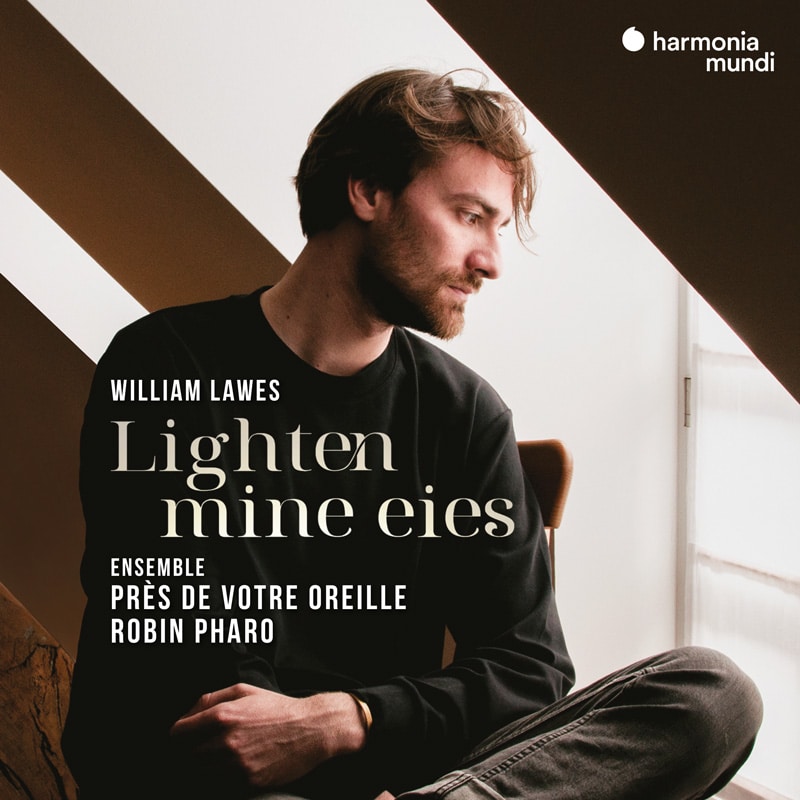
With his ensemble Près de votre oreille (“Near your ear“), gamba player Robin Pharo devotes his new album Lighten mine eies to the singular world of William Lawes. Through elegies, psalms, and Harp Consorts, he explores the English composer’s daring dissonances and the shifting boundary between restitution, re-creation, and memory, in a project where research becomes an act of interpretation.
You explain that discovering Music, the Master of thy Art is Dead was the starting point for this project. What was it about this elegy by William Lawes that moved you so deeply as to make it the key to an entire programme?
Robin Pharo: When I heard this piece for the first time, I felt I was discovering a unique harmonic world that I didn’t know. By taking a closer interest in William Lawes’s music, I was able to confirm that his music holds the secret of dissonances that are entirely his own, and whose mechanism is clearly demonstrated in this piece. Beyond this ability to create poignant suspensions, one can detect in his work—and in this piece in particular—a great aptitude for creating new colours through harmony, which profoundly characterises all of his music. Perfect chords far removed from the original tonalities, avoided, delayed, or anticipated sixths, as well as powerful false relations, punctuate his entire output, more so than in that of many other musicians of his time. Moreover, this piece is an elegy in homage to John Tomkins, whom Lawes elevated to the rank of master of the art of music. Placing this piece at the beginning of the programme allowed us to open the concert with panache, transferring onto William Lawes the admiration he felt for his departed friend.
The album brings together psalms, songs, and Harp Consorts [a form of English chamber music from the 17th century written for harp, viola(s) da gamba, and theorbo or lute]. How did you construct the narrative or emotional thread of this album across such different forms?
R. P.: Designing a recital programme can respond to several constraints. For Lighten mine eies, I instinctively wanted to create an eloquent performance rather than a simple concert. As with any programme, artistic intentions must therefore be varied. In any case, I tried to create a form in which one never grows bored. I aim to make a strong impression right from the start of the programme, while the end of the performance is imbued with infinite tenderness… In fact, even before working with stage director Jeanne Desoubeaux and Thomas Coux on the lighting design, the programme already presented itself as a theatricalised musical project. Being able to alternate between psalms recounting epic episodes from the Old Testament, airs composed for the theatre, songs, and original instrumental pieces gave me a wide range of tools that greatly facilitated the creation of the project.
You added your own diminutions and instrumental parts to certain pieces. Where, in your view, does the boundary lie between restitution and re-creation in this kind of work?
R. P.: Since the beginnings of the ensemble Près de votre oreille, I have made it a habit to associate a writing project with all of our creations. For Blessed Echoes, this was particularly important, as I created reductions of a lute part for two viols da gamba in a tuning different from the usual one, based on similar surviving traces from the period! For the programme The Waves, I transcribed melodies originally for piano and voice for viola da gamba and voice. Immersing myself in composition or arrangement allows me to engage with a programme in a different way. Through this approach—and through the fact that I also copy out the entirety of the pieces in a programme (which allows me to draw closer to the sources, whether manuscripts or early editions)—I acquire analytical skills that enable me to understand the music we perform far more deeply. It is difficult to prove to the listener that this is a noble endeavour, because writing work can also damage the original image of a piece.

Yet when one adopts this approach with the rigour it requires and with the desire to understand the compositional techniques behind the works being performed, one arrives both at a re-creation and at an amplification of interpretative techniques. As for ornamentation and diminution, these techniques were widely used throughout the Renaissance and Baroque periods, and we have preserved many testimonies of these practices. Taking hold of these techniques can therefore enhance the quality of an interpretation, as it allows us to reconnect with somewhat forgotten practices. It is a vast subject… It is obvious that any writing process must be constrained so that its “re-creative” aspect does not overshadow the original work. In the programme Lighten mine eies, since it mainly involves ornamentation and the arrangement of two Harp Consorts for harp and harpsichord, I believe I worked with caution and in respect of the original texts.
The album is dedicated to Virgile Ancely, who passed away shortly before the recording. What place does this human and memorial dimension occupy in Lighten mine eies?
R. P.: Death has become a central element in the programme Lighten mine eies. William Lawes met a tragic fate: he died on the battlefield at the age of 43 during the English Civil War. Virgile Ancely, a permanent member of the ensemble and a friend, also died at almost the same age—42—shortly before the recording. The album is now dedicated to him. This context led me to ask stage director Jeanne Desoubeaux, when she worked on the project as an outside eye, that we conceive a philosophical prologue centred on death. This makes it possible to speak indirectly of Virgile, to invoke a link with William Lawes, and to underline the particular nature of our work, which consists in bringing back to life works from the past that have fallen into oblivion. Jeanne had the idea that we should integrate a text about the dead who are not famous and who have left no trace. This prologue, which I declaim, allows for immediate immersion in the project. The audience immediately understands that it no longer needs to know whether or not it should understand this unfamiliar music. The text serves to formalize the fact that we have entered a space devoted to emotion, where music casts its spell regardless of our ability to comprehend it.
Among all these pieces by Lawes, is there one—or several—that are particularly dear to you, and that you would especially like to introduce to our readers?
R. P.: I think the piece Ne Irascaris Domine is one of the most beautiful on the album. It is also one of the most beautiful sacred pieces I have ever had the chance to hear in my life. Its opening line alone is enough to move me deeply. That E-flat major chord that arrives after a long pedal on G is absolutely sublime and perfectly conveys the serenity sought by the narrator in the face of the Lord’s anger. The end of the psalm, when the ruin of Jerusalem is evoked, dispenses with words altogether. The high notes collide in a spectacular sonic chaos before giving way to a very delicate final cadence. From an instrumental point of view, it would be difficult not to mention William Lawes’s Fantasia—an incredible festival of counterpoint, rhythmic and at the same time endowed with immense sensuality in its finale!

 Press review
I’ll do my best to avoid a blow-by-blow account of the splendours on offer, a true challenge as so much of the album’s delight is in its timbral and textural changes. Some are organic and momentum-building; others are like turning a street corner to be hit by a flood of sunshine.
Mark Seow, Gramophone
As it is, this disc gives us a fine portrait of a composer who had a gift for harmonic and contrapuntal daring, along with an ear for the quirky. Lawes’s instrumental music has been extensively covered on disc, but this is a chance to explore his wider output in a wonderfully engaging disc.
Planet Hugill
This is an outstanding label debut. Ensemble Près de votre oreille’s next ventures should be greatly anticipated by early-music fans.
Anne E. Johnson, Classical Voice North Amercia
Of great variety, the music of William Lawes strikes the listener with its harmonic daring and inventiveness […] Three singers and five instrumentalists are brought together here. A fine conjunction of talents for a joyful rediscovery!
Cécile Glaenzer, ResMusica


You must be logged in to be able to post comments.
Sign in