


 At the crossroads of Bach and spirituals, between America and Europe, from Boston to Berlin — and even via Disney in Japan — American countertenor Reginald Mobley explores the question of belonging in a world still shaped by exclusion. Bridging African American heritage and the Baroque repertoire, he claims an artistic space that has always been his own, reshaping the contours of a musical home.
  By Aaron Keebaugh


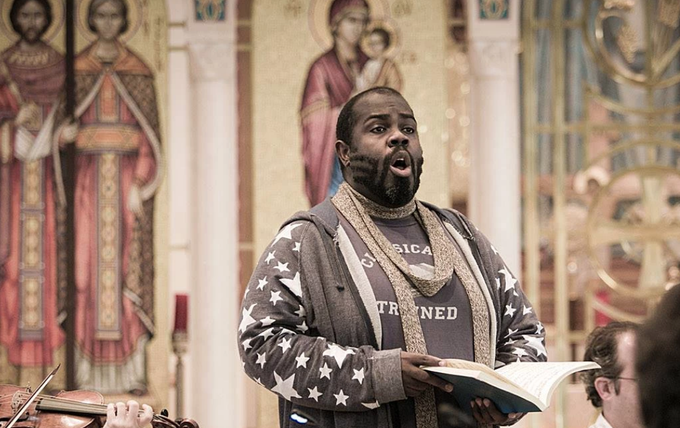
At the crossroads of Bach and spirituals, between America and Europe, from Boston to Berlin—and even (yes!) by way of Disney Japan—American countertenor Reginald Mobley explores the notion of belonging in a world still marked by exclusion. Between the memory of Black America and the baroque repertoire, he claims an original place that has always been his own, redefining the contours of a musical “home.” Grammy-nominated, invited to perform at the coronation of Charles III, and closely associated with the Handel and Haydn Society, Reginald Mobley has emerged as one of today’s leading countertenors. With Coming Home with Music, created with Lautten Compagney BERLIN, he brings Bach and Handel into dialogue with spiritual tradition, while continuing his research into the eighteenth-century composer Ignatius Sancho and the place of Black musicians in history. Underpinned by an intimate reflection on the idea of home — as memory, identity and territory — his journey unfolds as a search for belonging that transcends national boundaries. A portrait of an artist at the intersection of stage, archive and activism, driven by an ongoing quest for self-definition.
Which home?
Countertenor Reginald Mobley feels like he belongs nowhere and everywhere at the same time. In the field of early music, he’s a rare species: a Black body in a predominantly white space. Yet his friendly nature makes it easy to connect with people from all walks of life. He has sung in out-of-the-way churches and the largest concert halls, gotten involved with protests in his Boston hometown, and hung around with the weirdest and dirtiest of hipsters.
But the concept of home makes him pause. On one hand, he revels in familiarity, peppering his recitals with spirituals, jazz, and gospel numbers he grew up singing. On the other, pride of space and a place within it also fuels his political nemesis, the MAGA movement, especially as American democracy limps toward its 250th anniversary. Still, Mobley tries to look to better angels beyond national borders. “I impress a connection to everyone in front of me,” he said in a recent interview. “When I land in Japan or Hong Kong or Seoul or Morocco, every face I see is part of a family I love.”
These sentiments provide the impetus for “Coming Home with Music,” Mobley’s current program with Lautten compagney BERLIN. Personal and reverential, the project rings in the anniversary of American democracy by celebrating the diversity that makes it all work. It was borne from a previous collaboration between Mobley and Lautten compagney. After recording Bach’s St. John’s Passion, where Mobley performed the role of Christ, Lautten conductor Wolfgang Katschner approached the singer about a new program that casts Handel’s music as a symbol for belonging. Raised in Germany and spending his working years in England, the composer knew firsthand how to adapt to new surroundings. Mobley’s own experiences, played out through spirituals and songs by Stevie Wonder and Nina Simone, would place American Blackness at the centre. The result is a timely piece of historical affirmation that extends well beyond 1776. “We were here a lot longer than that,” Mobley said. “The home we had, we didn’t leave. Maybe it was something that was taken from us.”
“Coming Home” has drawn critical acclaim, and the project fills out Mobley’s performance schedule well into this summer. He also plans to record the program for release in 2027. With that, “Coming Home” will conclude an album trilogy that began with Because in 2023 and Solitude last year. The performances on these discs are classic Mobley: his voice carries such soulful weight and rhythmic freedom that the music can’t help but slot into a groove. A similar feel for spontaneity is also evident in a video clip from “Coming Home.” As Mobley sings Blind Willie Johnson’s “Nobody’s Fault but Mine,” the Lautten musicians gradually fall into a jam-session swing and vitality. The audience, taken up in the moment, begins clapping. The scene witnesses Mobley coming into his own. And he recalls it fondly:“It’s not just putting on blinders and locking eyes into the spot in front of you. But just enjoying being in the middle of the part of this thing that will never exist again.”

Passionate about early music and want to read this subscriber-only article?
If you are not a subscriber, join the international Total Baroque community. Subscribe here from 5.00€.
I subscribe
If you are already a subscriber, sign in.
I sign in 


You must be logged in to be able to post comments.
Sign in