


 The French countertenor Paul-Antoine Bénos-Djian unveils a sensitive and refined album centered on Purcell and 17th-century English music.
  By
By 


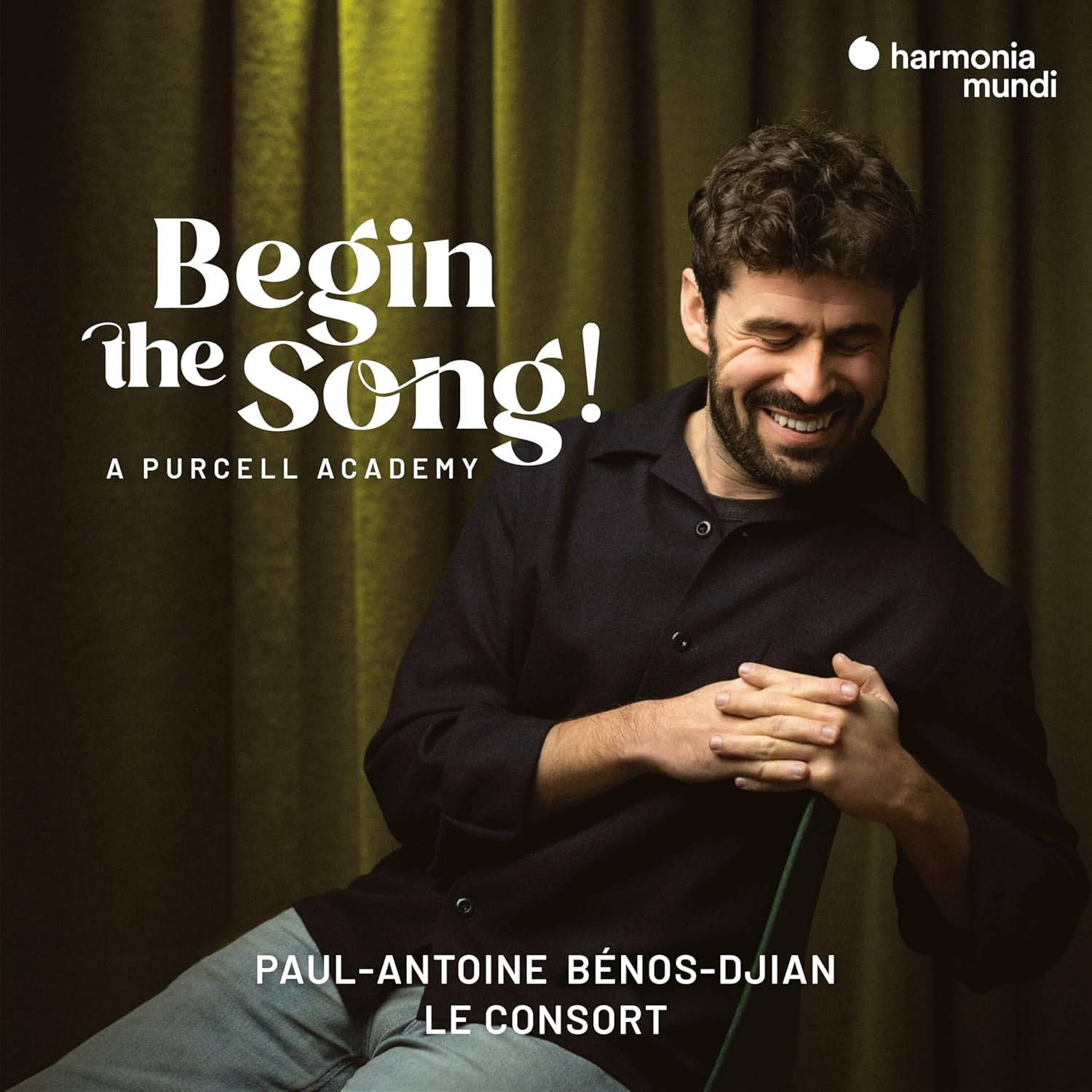
For his first solo recording, countertenor Paul-Antoine Bénos-Djian pays tribute to Henry Purcell and to 17th-century English music, accompanied by Le Consort, with whom he has cultivated a deep artistic bond since 2016. Blending iconic airs and rare gems, Begin the Song! explores the many facets of a repertoire where vocal expressivity, inner pulse, and instrumental elegance are intimately intertwined. A conversation with an artist driven by a passion for detail and a spirit of sharing.
Why did you choose to make Henry Purcell the focus of this recording? And why this resolutely English venture for your first solo album?
Paul-Antoine Bénos-Djian: Several reasons led me to place Purcell at the heart of the recording. First of all, it was a heartfelt choice. I discovered Purcell thanks especially to the sumptuous recordings by Alfred Deller, of course, but also Andreas Scholl and Paul Agnew. His music made its way into my musical world quite early on, and I was eager to interpret it myself. It has to be said that Purcell, much like Handel, is virtually an essential composer for any countertenor! Then, conductors like Vincent Dumestre, Bertrand Cuiller, and Damien Guillon invited me in turn to sing some of his Royal Odes, which I hadn’t known and whose beauty completely captivated me. I promised myself I would record excerpts from them one day if I ever had the chance! Purcell was a heartfelt choice, and that’s no small thing—because I believe that performing music that moves you so personally is an undeniable asset when approaching the recording process. Recording requires, day after day, unwavering motivation, focus, as well as physical and emotional investment. For five days, the musicians and I had to find a unique atmosphere for each piece, engage in constant mutual listening, and give the very best of ourselves in every single take. All of this within a time frame that is anything but infinite, since any recording involves major logistical and financial constraints. It becomes a kind of “race against the clock” that can only be won with genuine love for the music you’re recording. In this respect, all the musicians who accompanied me on this project showed extraordinary patience, commitment, and kindness—I can never thank them enough for that! As for the genesis of the recording project, the idea was to commemorate the wonderful memories we’d created in various concerts with Le Consort featuring 17th-century English music—mixing Purcell, Blow, Lanier, and others. We’d even had the good fortune to film a beautiful video of the programme during the pandemic at Royaumont, but the idea of turning it into a CD felt like the ultimate achievement. It was Théotime who first introduced me to Christian Girardin [director of the Harmonia Mundi label] to talk about the project. Christian was immediately very enthusiastic, and from there we began researching the repertoire. I was particularly intent on singing specific Purcell airs like “Music for a while,” “Here the deities,” “Fairest Isle,” and so many more… But I eventually realized there were far too many for the length of a single CD! Hence Purcell’s dominant presence on the recording—and the need for a few tough choices along the way!
This album is also the result of a long-standing relationship with Le Consort. How has that collaboration evolved since your first meeting in 2016, and how did you approach designing this programme?
P.-A. B.-D.: In 2016, Vincent Dumestre invited us to perform a programme of English music in the sublime Chapelle Corneille in Rouen. Before that, the musicians of Le Consort and I didn’t know each other very well. We would occasionally cross paths in the halls of the Paris Conservatory, but that was about it. That concert project truly brought us together for the first time; it forged a bond and a friendship that has never faded since! As for the programme, as I mentioned earlier, I knew that Purcell would be the central thread. But it seemed fitting to place his work in dialogue with that of his contemporaries or disciples. Every composer inherits a legacy and inevitably writes music shaped by the aesthetic, political, and musical context of their time. Justin and Sophie (the violinist) took a special interest in this task and helped me find pieces in that vein—absolute gems! We then had to make certain choices with an eye to emotional variety and atmosphere, to avoid creating a programme that was too monolithic, or too melancholic… even though melancholy is almost intrinsic to this repertoire!
In the liner notes, you mention being especially drawn to Purcell’s ground bass airs, with their almost contemporary “groove.” If you had to pick one piece to introduce listeners to the album, which would it be?
P.-A. B.-D.: Indeed! As a trained percussionist, the idea of “groove,” of pulse—and more broadly, the tempo I envisioned for each piece—was of utmost importance to me. But I don’t think I’m inventing anything by saying this. In the history of humanity, the very first musical instruments were percussive… which explains, I believe, the almost reptilian connection every human being has with rhythm. Didn’t the dancing rituals of the time use endlessly repeated patterns to induce trance? And let’s not forget that Baroque music was hardly ever conducted! In the opera house, the music director would simply mark the pulse with a staff. Similarly, it was impossible at the time to separate instrumental music from dance! Purcell, like so many composers of his day, was deeply influenced by the world of dance. I actually think that’s one of the reasons Baroque music remains so popular today—it makes it relatively “accessible” to everyone. As for THE piece I’d recommend for a first listen… It’s hard to say, since I’d love to mention every piece on the album, each with its own unique character. But I’d say the opening track, “By beauteous softness” by Purcell, is a personal favorite. The beauty that emerges from the simplicity of the bass line and vocal line is mesmerizing to me. The finesse with which Purcell weaves the voices together is simply magical. Not to mention the brief instrumental symphony that closes the air—it’s a true gem of elegance. The entire atmosphere exudes an exquisite sensuality, a magnificent poetry, and a kind of restrained emotional power that moves me deeply. In fact, if you were to substitute the viola da gamba with an electric bass, or even a double bass, and the strings with a piano, for instance, you’d have music you’d never believe was composed four centuries ago! Recently, the composer Thomas Adès created a marvelous arrangement of the piece for voice and piano—I highly recommend giving it a listen! This kind of modernity in Purcell is absolutely brilliant, I think.
 Press review
Bénos-Djian and Le Consort in the finest Purcell recital in decades!
Scherzo, Manuel de Lara Ruiz
The mood at times is dreamy, ethereal, melancholic, but Paul-Antoine Bénos-Djian brings his unique touch to it—if only through his highly original timbre: rich, warm, radiant, and through the energy he injects into each piece.
Charles Sigel, Forumopéra

You must be logged in to be able to post comments.
Sign in