


 A first: after 27 years of activity and numerous recordings, Vincent Dumestre and his ensemble Le Poème Harmonique are taking on Johann Sebastian Bach for the very first time this December, with the Magnificat in its 1723 Christmas version. But they are not forgetting Italian music either, with a major 2026 project in Rome, Venice and Naples.
  By
By 


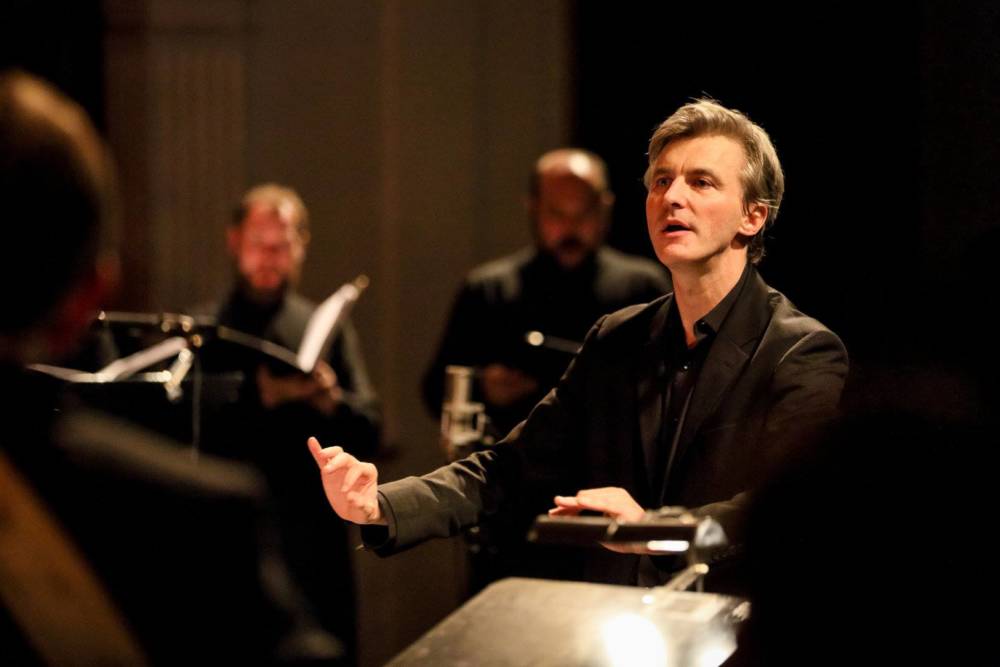
Founded in 1998 by lutenist and conductor Vincent Dumestre, Le Poème Harmonique is among the pioneers of rediscovering the repertoire of the 17th and 18th centuries. L’Huomo Femina, Galuppi’s irresistible comic opera, in Agnès Jaoui’s staging, has just received the 2025 Opera Award in the “Rediscovered Works” category. The ensemble favours well-known or lesser-known pieces that punctuate daily life and court ceremonies at Versailles (Lully, Couperin, Charpentier…), in Baroque Italy from Monteverdi to Pergolesi, or in Purcell’s England. Its programmes reconnect the ties between sacred and secular, art music and popular sources, and also bring together music with theatre, dance or circus, or even include processions and striking spatial effects in concerts. At the close of this year, Vincent Dumestre surprises yet again by tackling, for the first time, Johann Sebastian Bach, in the 1723 Christmas version of his Magnificat. Interview.
Johann Sebastian Bach, now. “Finally!” one might say?
Vincent Dumestre: I’ve been waiting 27 years for this moment: the first Bach for Le Poème Harmonique, meaning the first time we will perform Johann Sebastian Bach’s Magnificat after so many years. It’s an important moment, and a work I’ve known since I was a teenager (as everyone knows it, really) and one I’ve been thinking about for many years. This is Magnificat by J. S. Bach, but in a rather particular framework, since my idea is to recreate Christmas 1723, Bach’s first Christmas after arriving in Leipzig. And for that day, we are lucky enough to have the exact details of what he composed and performed on December 25, 26 and 27, 1723 in the Peterskirche and the Nikolaikirche, because he was of course Kapellmeister in several churches. I would really like to recreate a precise image of that first Christmas in Leipzig, as it unfolded in the presence of the Cantor, with the Magnificat in its original version, interwoven with lauds sung in German from the gallery, telling the story of Christmas in miniature.
On that 25 December, Bach had also performed the cantata BWV 63 Christen, ätzet diesen Tag, and as a counterpart to these two major works, the Sanctus BWV 238 (also premiered on that 25 December), as well as a chorale. This will also be our very first recording of the composer. So you can imagine how moved we are by the project itself! And we will be performing it at the Opéra de Dijon, at the Royal Chapel in Versailles, then in Gdańsk in Poland.

Passionate about early music and want to read this subscriber-only article?
If you are not a subscriber, join the international Total Baroque community. Subscribe here from 5.00€.
I subscribe
If you are already a subscriber, sign in.
I sign in 

You must be logged in to be able to post comments.
Sign in