


 Bernard Foccroulle returns to the source. On historic organs of the former Low Countries, the Belgian organist revives for Ricercar a sixteenth- and seventeenth-century repertoire, revealing its strength, colours and intimacy without affectation.
  By
By 


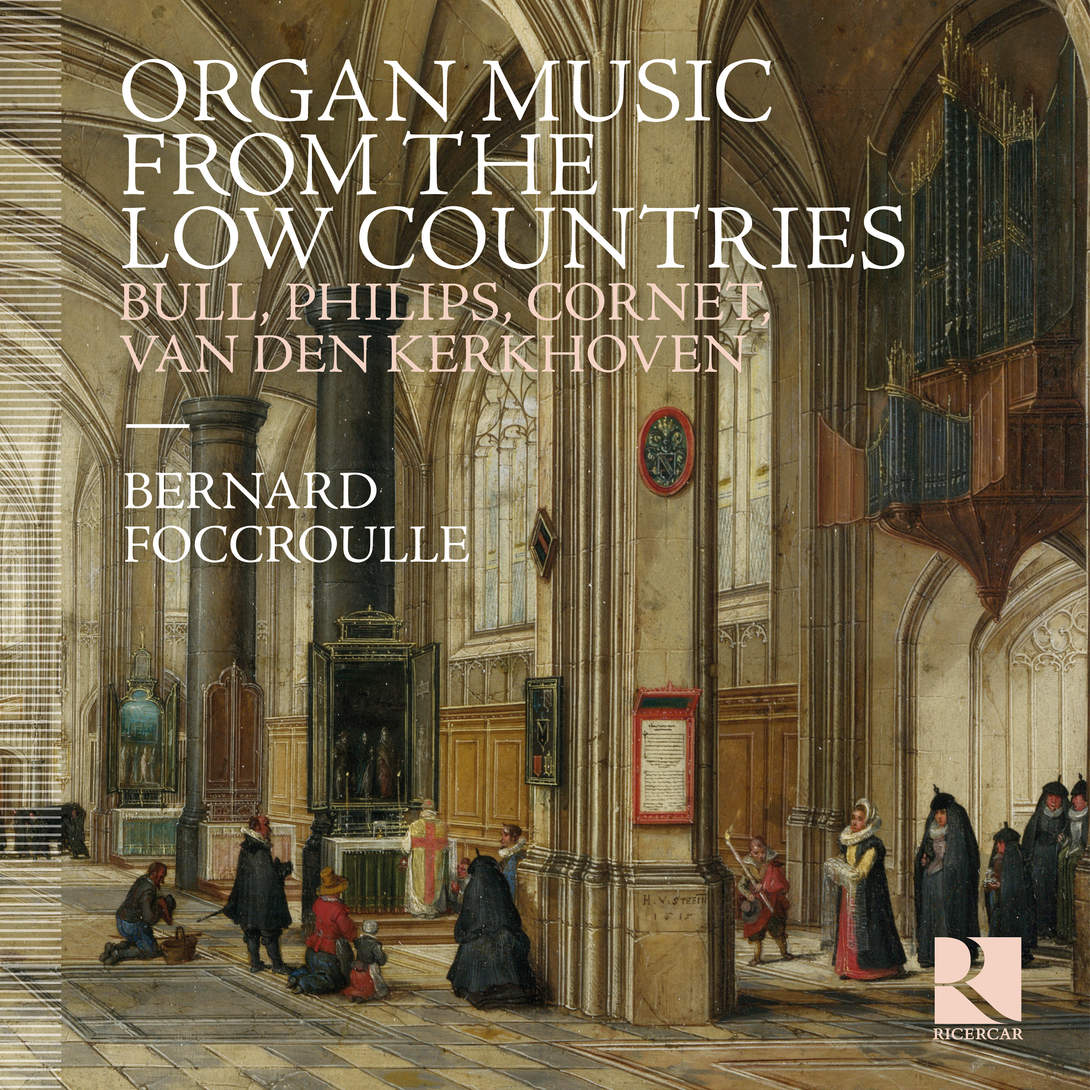
With Organ Music From The Low Countries, Bernard Foccroulle goes back to the roots of the golden age of the organ in the Southern Netherlands. Playing three historic seventeenth-century instruments, the Belgian organist brings John Bull, Peter Philips, Peeter Cornet and Abraham Van den Kerckhoven into dialogue in a programme where richness of colour is matched by a remarkable sense of intimacy.
Although the album bears the title Organ Music From The Low Countries, “Low Countries” here does not refer simply to the present-day Netherlands, but to the historical territories that included the Spanish Netherlands and the Principality of Liège, roughly corresponding to modern-day Belgium. One of the three historic seventeenth-century organs chosen for the recording is, however, located in Cuijk, within the borders of the present-day Netherlands, though the album itself is very much rooted in Belgian musical history.
In the booklet notes, which he wrote himself, Bernard Foccroulle explains that the featured composers – John Bull, Peter Philips, Peeter Cornet and Abraham Van den Kerckhoven – all worked in Brussels and/or Antwerp, alongside travels elsewhere in Europe for some of them. An anonymous Toccata and Fantasia from the Book of the Crosier Brothers of Liège are also included in a programme made up largely of works with an explicitly sacred purpose, alongside Flemish carols and a number of fantasias, some inspired by canzoni.
Across the album’s nearly seventy minutes of music, the tracks are grouped according to where they were recorded: first on the organ of St Martin’s Church in Cuijk, then on that of St James’s Church in Schurhoven, and finally on the organ of St John the Baptist’s Church in Leuven’s Great Beguinage. These instruments postdate the works by a few decades. Bernard Foccroulle points out that they are the closest surviving equivalents to the organs contemporary with the music, none of which have come down to us.
Both the programme and Foccroulle’s playing offer an insight into the diversity of the Baroque – and even late-Renaissance – organ tradition of the Southern Netherlands, ranging from the solemnity of Philips’s Veni sancte spiritus to the refreshing vitality of Bull’s carol “Een Kindeken is ons geboren”. At times airy in flute registrations, at others firmer and more sharply defined, but always lucid, his playing adapts to the repertoire while preserving an almost scholarly clarity and legibility. Less opulent in sound than the great Romantic organs, these Baroque instruments of the Low Countries, all restored to varying degrees in recent decades, reinforce this sense of transparency through the delicacy of their textures. Enhanced by a recording that seems to remove every barrier between instrument and listener, their colours create a striking sense of intimacy, as though Bernard Foccroulle were playing alone in the church.
The more spiritual or meditative passages can take on an almost prayer-like quality, as in the restrained account of “O clemens” from Bull’s Salve Regina. A similarly striking sense of humble admiration emerges in the Fantasia on a Theme by Sweelinck, composed by John Bull shortly after the death of his friend Jan Pieterszoon Sweelinck. The gradual unfolding of the playing and the recurrence of motifs make the “Ora pro nobis” that closes Peeter Cornet’s Regina caeli immersive, at once compelling and meditative. The organ’s almost uncanny ability to accompany itself comes particularly to the fore in Van den Kerckhoven’s Fantasia 356, where one hand adopts an intensely expressive, almost speech-like phrasing while the other weaves a light backdrop around the musical narrative.
Rich in contrast both from track to track and within the individual pieces, the album ultimately reveals the many facets of the Baroque organ of the Southern Netherlands, already a remarkably complete instrument in its own right. From soothing, spiritual tenderness to virtuoso brilliance in the service of religious solemnity, via moments approaching near-darkness or ethereal purity, Bernard Foccroulle’s playing explores not only the musical diversity of this repertoire but, beneath the surface, the complexity of its history and its wider significance.
Technical details
Title: Organ Music From The Low Countries
Composers: John Bull (1562/63–1628), Peter Philips (1560/61–1628), Peeter Cornet (c. 1570/80–1633), Abraham Van den Kerckhoven (c. 1618–1702), anonymous
Performer: Bernard Foccroulle, organ
Label: Ricercar
Format: digital, CD
Release date: 8 May 2026

You must be logged in to be able to post comments.
Sign in