


 Forty years after bringing together a few musician friends in the corridors of the Toulouse and Montauban conservatories, Jean-Marc Andrieu looks back on the journey of his ensemble Les Passions, shaped in particular by a determination to rediscover the Baroque musical heritage of southern France. With serenity, he is preparing to pass the torch.
  By
By 


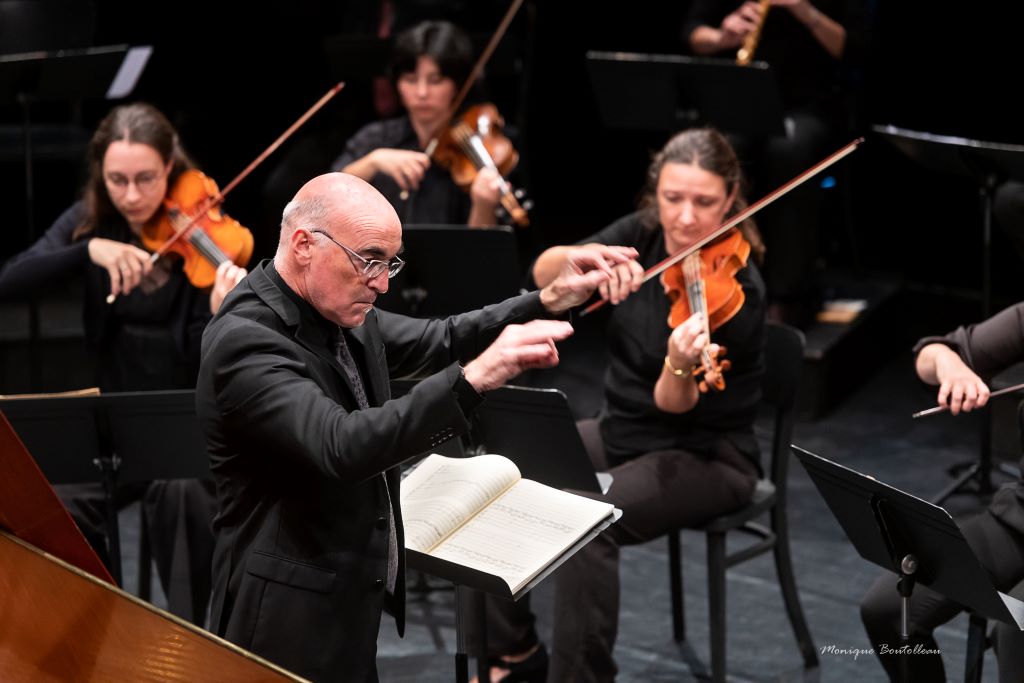
In 1986, flautist Jean-Marc Andrieu embarked on an adventure in Toulouse that was initially called the “Orchestre Baroque de Toulouse,” before becoming the “Orchestre Baroque de Montauban” when he was appointed director of the city’s Conservatory, and then Les Passions in 2003. Forty years later, the ensemble is firmly established on the French Baroque scene, exploring Bach, Scarlatti, and Purcell, but above all an entire body of southern French repertoire that had long been neglected, from Jean Gilles to Mondonville, via Blanchard. As he celebrates this anniversary, its founder has no intention of simply looking in the rear-view mirror. As Les Passions prepares to join forces with the Dulci Jubilo choir and its director Christopher Gibert, Jean-Marc Andrieu reflects on four decades of music, his memories, his attachment to the Occitan region, his South American adventures, and a few dreams still to be fulfilled.
Forty years is already an impressive lifespan for a Baroque ensemble. How do you look back on this adventure today?
Jean-Marc Andrieu: My first feeling is certainly a degree of pride at having lasted so long, through thick and thin! As you can imagine, the journey has not always been smooth or easy. So I am very happy to have reached this point, forty years later: an orchestra that is going strong, with a history, a repertoire, and a genuine identity.
How did this story begin?
J.-M. A.: At the time, I was a professor at the Toulouse Conservatory, and I divided my time between Toulouse and Montauban. In 1985, together with a few friends who were also professors at the Conservatory, I founded a small vocal ensemble. Little by little, we gravitated towards the Baroque repertoire. I still remember going around the corridors of the Toulouse conservatories recruiting friends, suggesting that they join us in this adventure and play “in the style,” as we used to say at the time—in other words, in the Baroque style!
Why Baroque music in particular?
J.-M. A.: It came quite naturally from my instrument of choice, the recorder, whose golden age was during the Renaissance and Baroque periods. My studies in choral conducting had also led me towards this repertoire. And then there was Bach. I had sung his cantatas, the Mass in B Minor… This music fascinated me and truly made me want to continue in that direction.
Over the course of those forty years, which memories have been particularly meaningful to you?
J.-M. A.: On an emotional level, one of the most powerful moments remains the St Matthew Passion, recorded at the Halle aux Grains in Toulouse in 2000 to mark the 250th anniversary of Johann Sebastian Bach’s death, with choirs from the region and a double orchestra. It was a somewhat crazy project, and the memory of it remained so vivid that it later inspired me to give the orchestra its current name: Les Passions. The ensemble had previously been called the Orchestre Baroque de Montauban. We renamed it Les Passions in 2003, when we entered into an agreement with the DRAC (Regional Directorate of Cultural Affairs) that provided us with new resources for our development. But we kept “Montauban Baroque Orchestra” as the subtitle: it was important to us to maintain this reference to our home city.
Were there other decisive milestones?
J.-M. A.: There have been many. I think of our experiments with pitch, beginning in the 1990s—I believe I was one of the first to offer a performance of Monteverdi’s Vespers of the Blessed Virgin at A=466—or a concert at the Utrecht Festival, which made an enormous impression on us. There are also the recordings. Our first recording with Isabelle Poulenard, devoted to Scarlatti, remains a very moving memory. I am also very happy about our three invitations to the La Chaise-Dieu Festival, centred on the works of Jean Gilles, a composer to whom I am deeply attached and to whom we have devoted three recordings. And, of course, I would mention our many trips to South America, particularly Bolivia.
Passionate about early music and want to read this subscriber-only article?
If you are not a subscriber, join the international Total Baroque community. Subscribe here from 5.00€.
I subscribe
If you are already a subscriber, sign in.
I sign in 

You must be logged in to be able to post comments.
Sign in