


 Playing standing up, walking, dancing—La Capriola breathes new life and movement into Renaissance violin consorts, gracefully reinventing a forgotten practice for today’s audiences.
  By Elisabeth Houpert


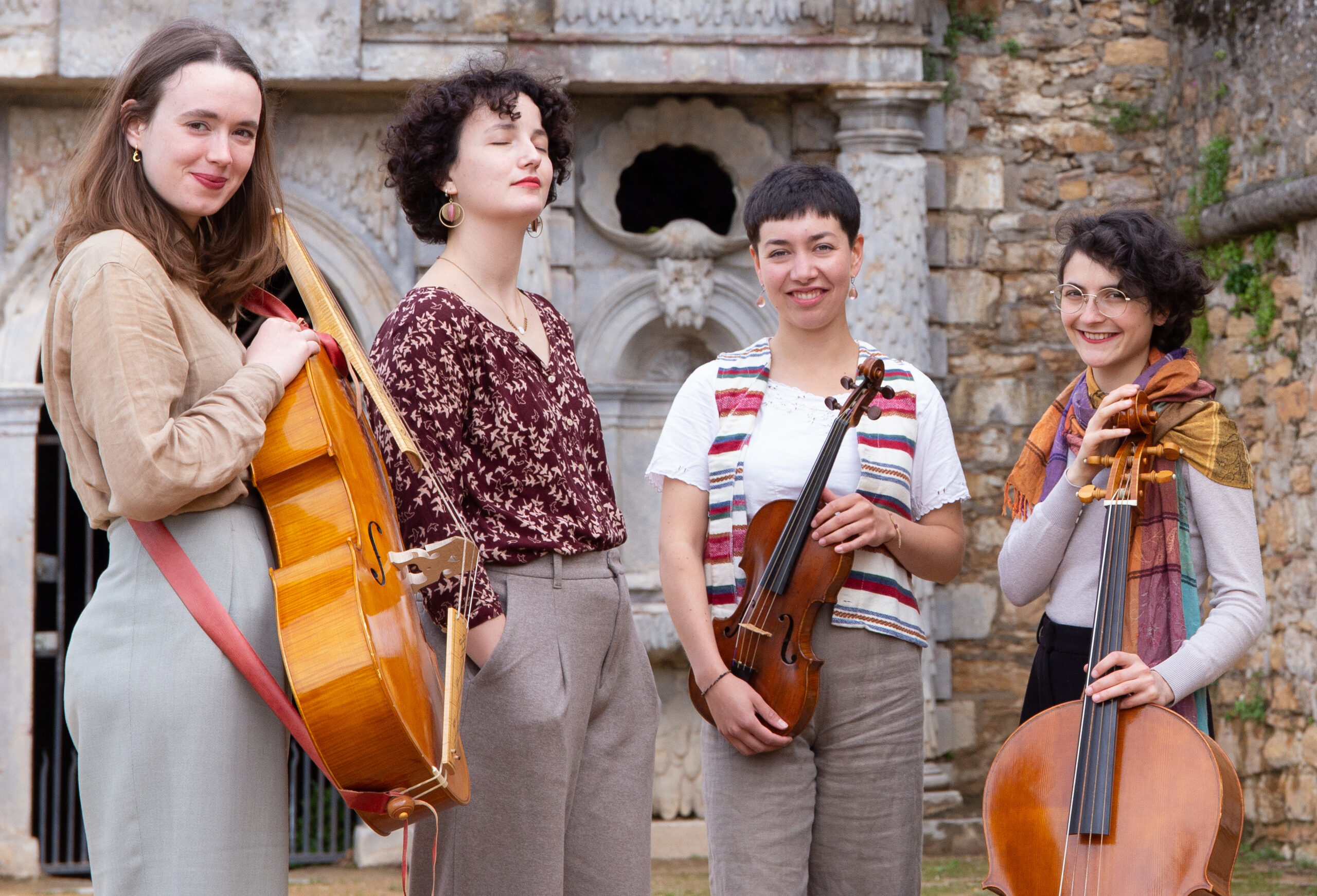
Founded in 2021 at the Conservatoire National Supérieur de Musique et de Danse (CNSMD) in Lyon, the ensemble La Capriola has, in just a few years, become one of the most promising young groups on the scene. Winner in 2025 of both the First Prize and the Audience Prize at the Première competition in Brussels, and a member of the European programme Sustainable-EEEMERGING+, the group brings together violinists Dorine Lepeltier-Kovács, Charlotte Gerbitz, and Manon Papasergio. Together, they explore Renaissance and early Baroque music on period instruments, while opening their work to artistic collaborations and the theatrical stage—notably with Harlou, a show presented this summer at the Avignon Festival. A conversation.
What is the origin of the ensemble?
Dorine Lepeltier-Kovács: We met at the CNSMD in Lyon. All four of us shared a special affection for Renaissance music. Manon [Papasergio] and I were in the cello class, and Charlotte [Gerbitz] and Juliette [Ridel], who was with us before, were in the violin class with Odile Edouard. We tried out several groupings and projects, and then in 2021, we decided to make it a bit more official.
Manon Papapsergio: Our instruments are violins of different sizes! The cello is actually a bass violin tuned in C. The main difference is that we play standing up.
Dorine L-K.: When violinists played for nobles, they weren’t allowed to sit down. And for processions, having a bit of mobility was important too.
And you walk while playing?
Manon P.: And we dance while playing! The violin is, after all, the dancing instrument.
Dorine, you play the tenor violin. How does one approach an instrument that is no longer played or taught today?
Dorine L-K.: There are several stages: the first is to play a bass violin tuned a fifth higher, to get a feel for it. Then you have to have an instrument built—mine was made by Jean-Paul Boury, who had already built one of this type for the CNSMD in Lyon. It’s a small cello, the size of a three-quarter, like those for children.
Passionate about early music and want to read this subscriber-only article?
If you are not a subscriber, join the international Total Baroque community. Subscribe here from 5.00€.
I subscribe
If you are already a subscriber, sign in.
I sign in 


You must be logged in to be able to post comments.
Sign in