


 Languishing, passionate, bitter, venomous or consuming, jealousy, or ‘Gelosia’ in Italian, can take many forms. Philippe Jaroussky and his ensemble Artaserse explore them in their new album.
  By
By 


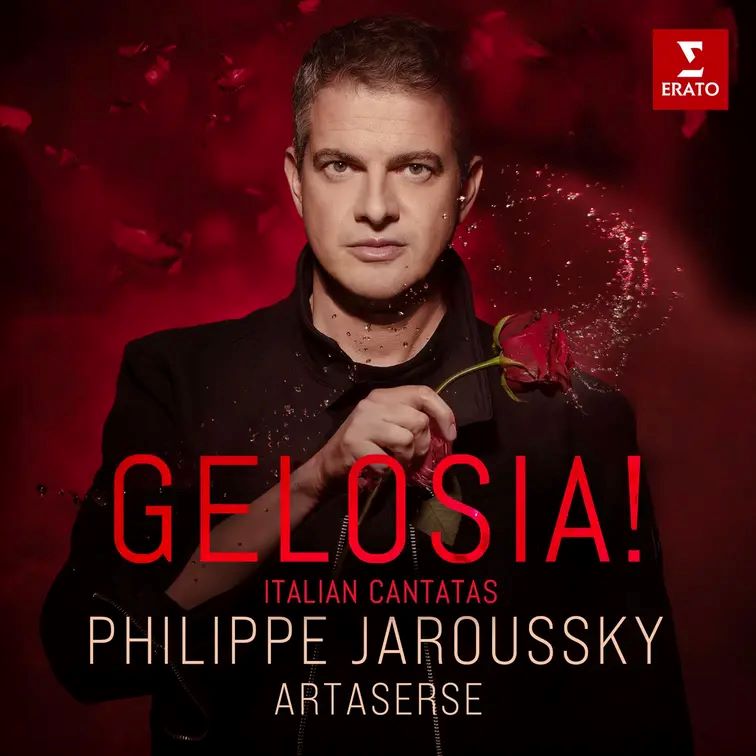
Released on the Erato label, Gelosia!, Philippe Jaroussky’s new album, includes six cantate da camera (as opposed to cantate da chiesa, which deal with religious subjects and are often more expansive in form), written by six different composers over the course of the eighteenth century, all devoted to the theme of jealousy, as the title indicates. Two of them, set to the same text nearly forty years apart by Porpora and Galuppi, are recorded here for the first time. For the recording of this album, the French countertenor is joined by his ensemble Artaserse, founded in 2002.
Jealousy, a perennial theme in opera, is being rediscovered in these cantatas. As Philippe Jaroussky explains in his statement of intent, the choice of this form allows each work to be presented in its entirety on a single album, while offering a variety of eras and treatments of this emotion. The sweet darkness of Scarlatti’s Ombre tacite e sole, with its evocations of death, contrasts with the fiery vigour of Vivaldi’s Cessate, omai cessate and the elegant restraint of Galuppi’s more classically inspired La Gelosia. Handel is represented in his youth with Mi palpita il cor (composed in 1710-1713), whose arioso concentrates an explosion of virtuosity into its thirty seconds.
The CD comes in a cardboard sleeve with a booklet. The latter contains a few artistic photographs of Philippe Jaroussky against a red background with a rose, as well as photos of the musicians during the recording sessions. In addition to the liner notes, the inclusion of the original Italian texts and their translations into three languages (French, English, and German) helps listeners engage with these largely unfamiliar cantatas.
The first listen makes you want to dive in and dive in again. Performed by specialists in the repertoire and, of course, on period instruments, these cantatas are presented above all with a concern for authenticity, even if the use of a countertenor tessitura with its falsetto raises the same questions as usual. While Philippe Jaroussky’s voice has undeniably lost a little of its fullness in recent years, his technical mastery has continued to deepen, as has the singer’s experience, lending full sensitivity to his interpretations.
Attention to nuance is particularly striking throughout the album. The lover’s wandering in the opening aria by Scarlatti is conveyed through subtle changes in volume along the vocal line, creating the impression that the character is searching for a path with little real hope of finding it. The power of the voice comes to the fore in the second aria by Vivaldi, a veritable storm of passion in which Jaroussky deploys the full range of his tessitura across the melodic lines. Illustrating a thirst for blood and vengeance, the lower notes—sometimes sung in full voice—are as gripping in their intensity as the cutting high notes. The rhythmic structure shaped by the vocal accents fully contributes to the drive of this passage. The opulence of the coloraturas, tastefully ornamented, suits the complexity of Handel’s final aria, hesitating between the pain of unrequited love and the hope that it might one day be returned.
Consisting of a flute, a string quartet, a theorbo (or a Baroque guitar depending on the passage), and a harpsichord, the instrumental ensemble possesses the freedom required by the cantata da camera. Jaroussky’s supple direction leaves ample space for the musicians’ expression while maintaining the essential framework that ensures the unity of the ensemble and supports the vocal line. The latter is followed with finesse in the play of dynamics and harmonies. From the very first bars, the orchestra succeeds in immersing the listener in the atmosphere of each piece, whether made up of ethereal shadows or unleashed emotions. At certain moments, the rendering of orchestral effects proves striking, such as the evocation of the sea in the final aria of Porpora’s La Gelosia. Like foam carried by the tide, the effusion of notes alternately ebbs and flows.
The cohesion between Philippe Jaroussky and his ensemble, the countertenor’s sensitivity as he absorbs the album’s theme, and his vocal maturity form the solid pillars of this Gelosia… Let’s hope its success does not arouse too much jealousy!
Technical details
Title: Gelosia!
Artist: Philippe Jaroussky
Ensemble: Artaserse
Musical direction: Philippe Jaroussky
Release date: October 24, 2025
Programme:
- Alessandro Scarlatti — Ombre tacite e sole
- Antonio Vivaldi — Cessate, omai cessate, RV 684
- Nicola Porpora — Perdono, amata Nice (“La Gelosia”)
- Georg Friedrich Handel — Mi palpita il cor, HWV 132C
- Baldassare Galuppi — La Gelosia
Label: Erato (Warner Classics)
Format: 1 audio CD; duration: approx. 71 min
Note: The album brings together two settings of the same Metastasio text by Porpora and Galuppi, offering world premiere recordings within this dramatic programme devoted to the cantata da camera.

You must be logged in to be able to post comments.
Sign in