


 The supplications of the chosen people, the relentless yet exultant unleashing of the Plagues of Egypt, and the brilliance of divine triumph over paganism all feature in the new recording of Israel in Egypt, released by Alpha Classics.
  By
By 


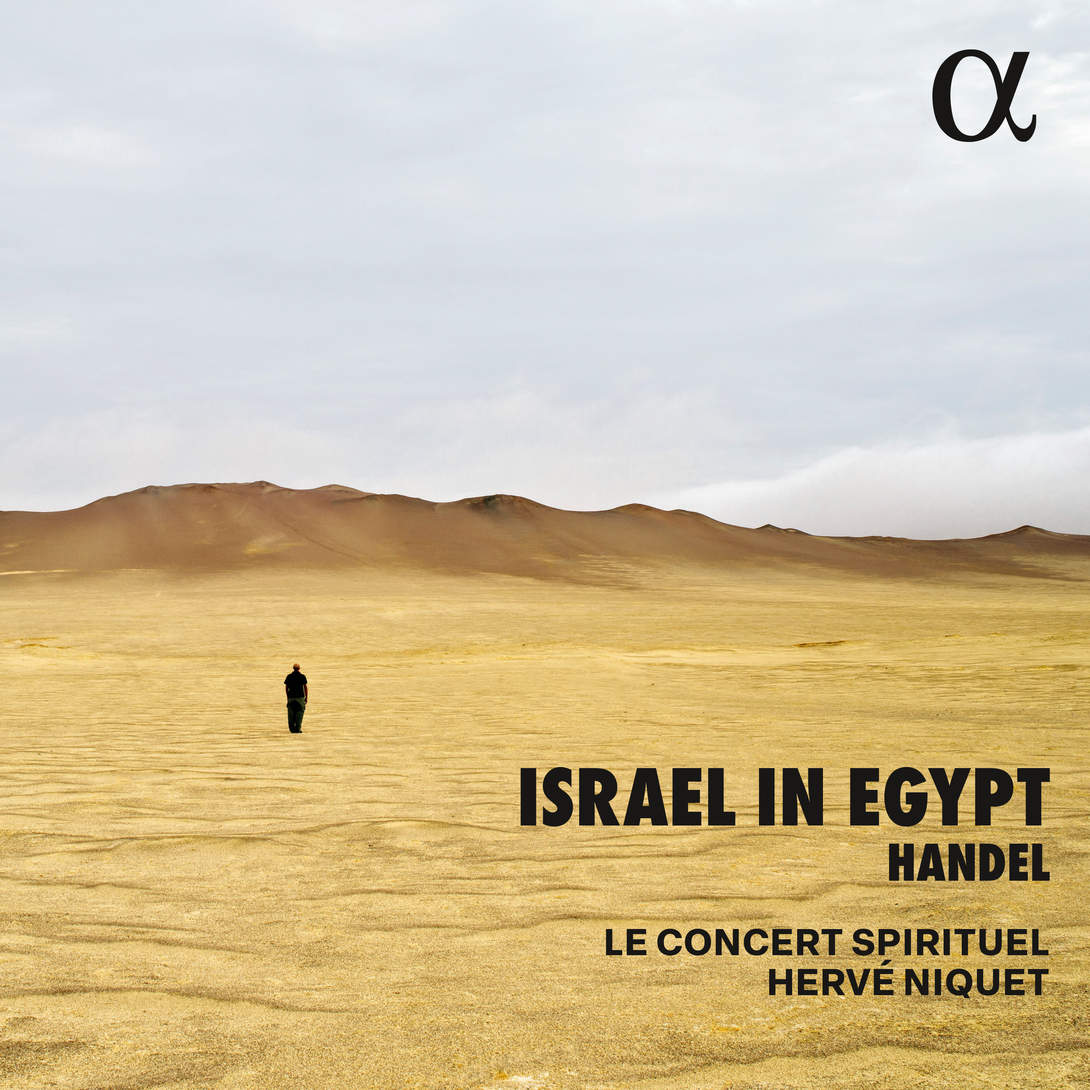
Combining the tradition of period instruments with a timeless passion in interpretation, the communicative vigour of Hervé Niquet at the head of his Concert Spirituel (choir and orchestra) brings renewed freshness to Handel’s oratorio Israel in Egypt.
The production has chosen to record the oratorio in its first published version, that is to say in two parts: the Exodus and the Song of Moses. Although composed simultaneously, the first part (The Lamentation of the Israelites for the Death of Joseph) was initially issued separately and is therefore absent from this recording. The disc comes in a cardboard sleeve and includes a trilingual booklet (French, English, German) featuring photographs, a statement of intent, a brief presentation of the project and the work, as well as the complete libretto (excerpts compiled from Exodus and Psalms of the Old Testament).
In addition to the choir, the cast includes sopranos Myriam Leblanc and Lucie Edel, tenor Laurence Kilsby, bass-baritones Andreas Wolf and Alexandre Baldo, and contralto Lena Sutor-Wernich. Hervé Niquet and his Concert Spirituel — who notably performed the composer’s Coronation Anthems before His Majesty King Charles some years ago — inject invigorating momentum into this score, poised at the crossroads of drama and sacred music.
Without neglecting clarity and transparency of execution, the relatively brisk tempi contribute to the compelling impact of a performance that paradoxically feels both light and strongly characterised. By way of comparison, the disc runs to approximately one hour and ten minutes, as opposed to one hour and forty minutes for Simon Preston with the English Chamber Orchestra, or around one hour and thirty minutes for John Eliot Gardiner and his ensemble, both of whom also recorded the two-part version. The Concert Spirituel orchestra combines ardour with responsiveness. It proves especially precise in shaping string motifs, such as those depicting the gradual invasion of Egyptian crops by swarms of insects. The brilliant density of the brass makes the triumph of the Hebrew people blaze forth through divine intervention. The continuo remains close to the voices, accompanying them with finesse and elegance. Thus, the dramatic nature of the oratorio is largely driven by the orchestra’s vitality, while its religious dimension emerges principally from the voices.
These find the right balance between involvement and restraint, avoiding any excess of effect that might obscure the biblical message. The unity and coordination of the choir particularly highlight the purity of its sections and the harmonic blend of the singing. The skilful articulation of rhythms contributes both relief and fluidity to the choral passages. The recording quality, however, does not always favour the balance between the various forces involved.
Unlike other oratorios, the solo vocal parts here do not occupy a predominant place. In this recording they are generally well delivered, though without constituting a major asset in comparison with the broader discography. Laurence Kilsby’s phrasing effectively punctuates the tenor recitatives, bringing out their narrative character. The bass duo is structured through the precision of their vocal attacks, and their breath control allows for appropriate ornamentation in their exchanges. The two sopranos, however, struggle at times to bring out the complementarity of their voices. Myriam Leblanc’s devout appeals in the final section elicit the warm response of choir and orchestra. Lena Sutor-Wernich occasionally seems to lack ease in breath support and in her ascent to the upper register. The choice to employ a countertenor (as at the work’s première in Handel’s time) has at times proved more rewarding (notably James Bowman in Simon Preston’s aforementioned recording).
Like the Exodus itself, recounting a people moving towards its destiny, listening to Israel in Egypt by Hervé Niquet and his Concert Spirituel feels like an adventure in which both the darker episodes and the radiant divine resolution are equally magnified.
Title: Israel in Egypt
Composer: Georg Friedrich Handel
Musical direction: Hervé Niquet
Ensemble: Le Concert Spirituel
Release date: 31 octobre 2025
Format: 1 CD audio ; durée : env. 70 min
Label: Alpha Classics
Programme:
Georg Friedrich Handel — Israel in Egypt, HWV 54, Part I – Exodus
Georg Friedrich Handel — Israel in Egypt, HWV 54, Part II – Moses’ Song
Cast:
- Myriam Leblanc — soprano
- Lucie Edel — soprano
- Lena Sutor-Wernich — contralto
- Laurence Kilsby — tenor
- Andreas Wolf — bass
- Alexandre Baldo — bass
Note:
Recorded at the Arsenal in Metz in October 2023, this release adopts the two-part version of Israel in Egypt which Berlioz and the nineteenth century regarded as definitive — comprising the Exodus and the Song of Moses — offering an intense dramatic and choral reading of Handel’s oratorio.


You must be logged in to be able to post comments.
Sign in