


 John Eliot Gardiner has just completed a European tour with his new ensemble, Constellation, featuring a Bach trilogy: two cantatas and the Easter Oratorio. A year and a half after his departure from the Monteverdi Choir and Orchestra (which he founded in 1964), he reflects on this new musical and human adventure. He will be performing at the Royal Chapel in Versailles on 11 and 12 June.
  By
By 


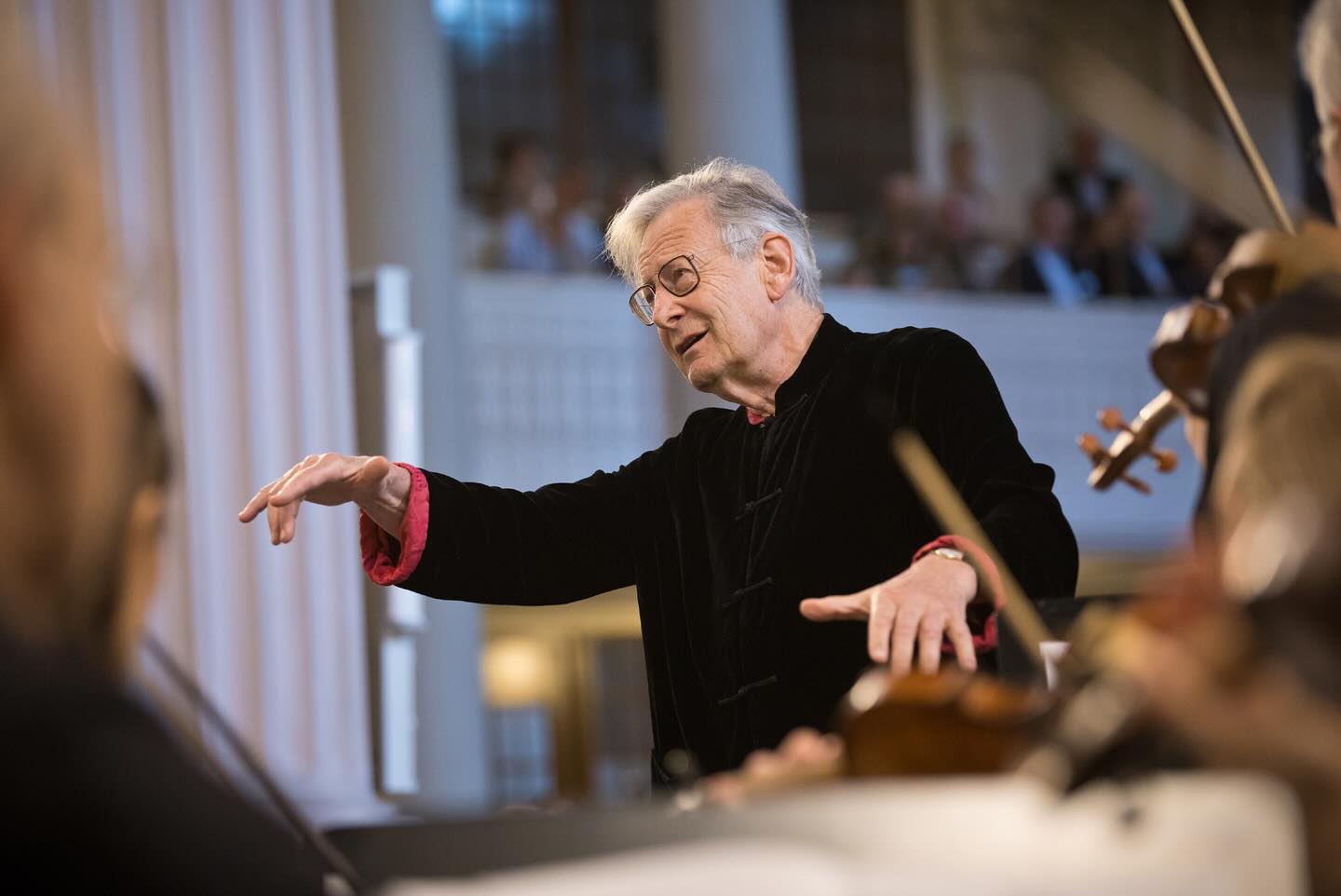
A major figure in Baroque and Classical interpretation for more than half a century, John Eliot Gardiner has profoundly shaped the way we hear Monteverdi, Bach, and Berlioz. Founder of the Monteverdi Choir in 1964, and later of the English Baroque Soloists as well as the Orchestre Révolutionnaire et Romantique, the British conductor has been one of the pioneers and architects of historically informed performance, the driving force behind landmark ventures such as the Bach Cantata Pilgrimage in 2000. Following the widely reported incident at the Berlioz Festival in 2024, which ultimately led to his departure from the ensembles he had founded six decades ago. At 82, he might have chosen to retire. Instead, he chose to bounce back by founding Springhead Constellation, a new choral and orchestral ensemble conceived as an agile, nomadic collective, rooted in his family estate in Springhead, England. Eighteen months later, a large number of musicians have joined him, and the ensemble has just completed a European Bach tour, following concerts in Asia in March. We meet in Heidelberg with a conductor who readily speaks of “a second act”: free, inventive, and now also devoted to mentoring.
We’re meeting today in Heidelberg, where the Spring Festival is hosting your new Ensemble Constellation for a concert titled “Easter Trilogy.” Heidelberg is the penultimate stop on a tour that has taken you to Athens, Budapest, Versailles, and tomorrow to Udine, Italy. Your ensemble Constellation appears under the full name “Springhead Constellation.” If I understand correctly, it is more than just an orchestra and choir…
John Eliot Gardiner: It is above all a new opportunity. I do not want to dwell too much on the past, because it cannot be changed. But one can make better choices for the future. And the creation of Springhead Constellation is precisely that: a choice for the future, connected to Springhead, the family estate where I was born, in England. With this new organisation, we have created a much lighter and more agile structure, which gives us great freedom and flexibility to work in a way that feels fully aligned with our artistic vision. Today, the administrative structure is minimal and in a very short time, we have succeeded in bringing together once again the finest musicians, who came spontaneously, with a strong desire to take part. There is loyalty, a new energy. It truly is a new adventure.
You had to leave the Monteverdi Choir and the English Baroque Soloists in autumn 2024, ensembles you had founded, following the incident during a concert at the Berlioz Festival in La Côte-Saint-André in France. How did you experience that period?
J. E. G.: Of course, I deeply regret what happened in La Côte-Saint-André at the end of August 2024. For me, it led to a period of very intense reflection—almost prayer, even therapy. It was a difficult, very painful time and I had always felt a very deep musical bond and loyalty to many of the musicians in both the choir and orchestra. At the same time, there were increasingly different views about the future direction and structure of the organisation. But with hindsight, two years later, I also see that this episode was an opportunity. The new structure allows for a greater sense of flexibility and artistic responsiveness than had become possible within a much larger institutional framework – but of course being constantly aware of economic realities and financial challenges.
As co-founder and CEO of Constellation, your partner Gwyneth Wentink plays an important role in this new organization…
J. E. G.: Yes. Gwyneth has been my partner for several years. We met in 2010 during a production of Pelléas et Mélisande at the Opéra-Comique in Paris where she played principal harp. Gwyneth also aims to build bridges between the arts, education, and ecology through multidisciplinary projects combining music, history, philosophy, science, and nature. We form a true team. The orchestra and the choir clearly feel this understanding between us. With our administrators Margot Moseley and Jane Kemp, we make up a small but highly effective team.

Passionate about early music and want to read this subscriber-only article?
If you are not a subscriber, join the international Total Baroque community. Subscribe here from 5.00€.
I subscribe
If you are already a subscriber, sign in.
I sign in 



You must be logged in to be able to post comments.
Sign in