


 As artistic director of the Händel Festival Karlsruhe (Germany) Christoph von Bernuth is breaking new ground by launching the first edition of the Farinelli Competition for countertenors, taking place from February 27 to March 2. Step behind the scenes of this exciting new venture!
  By
By 


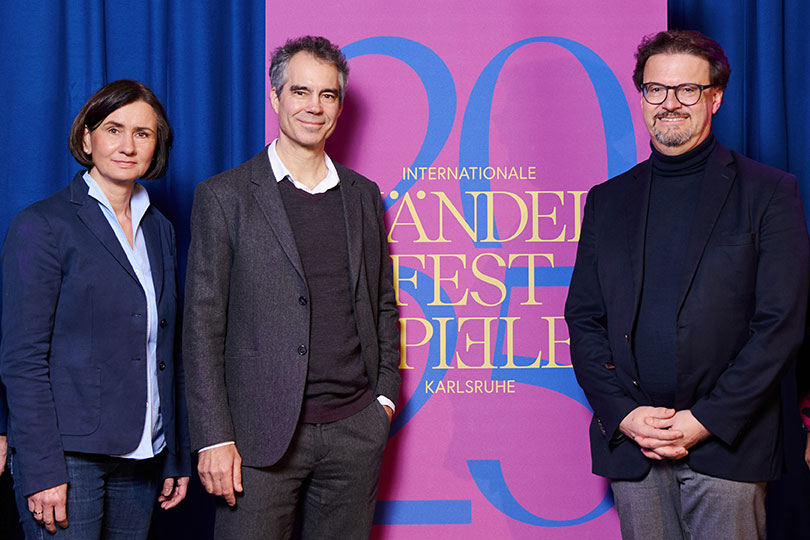
Christoph von Bernuth is Director of opera and a stage director at the Badisches Staatstheater Karlsruhe, as well as artistic director of the Handel Festival based there. As part of this festival, the first Farinelli Competition for countertenors is taking place this year from 27 February to 2 March at his initiative. We talked to Christoph von Bernuth about it.
Mr von Bernuth, why hold a competition for just one type of voice – and only for men?
Christoph von Bernuth: Because the castratos are men who sing, not women. It’s simply a question of technique.
But in those days, it wasn’t because of their technique that the castrati sang so high… so actually women are closer vocally to the castrati than to a countertenor. And a countertenor has a far narrower range than the vast majority of female voices – and than the castrati of long ago.
C. v. B.: That’s right, but there are quite a few countertenors who also sing the roles of the castrati of long ago. And that is, of course, spectacular because they are male roles. Having said that, I don’t think that all castrato roles should always be sung by men. But we don’t just cover the castrato repertoire in the competition; we also have countertenors who offer soprano roles and contemporary repertoire.
Where did the idea for this competition come from?
C. v. B.: I worked for many years at the Innsbruck Festival and founded the Cesti Competition there with Alessandro De Marchi. And it has been a great success ever since. I experienced how wonderful it is to discover young talent and offer them a platform – especially when the finalists actually go on to have a career. I hope to see the same effect here. And there are already so many competitions that I asked myself what makes baroque music special. The answer was the countertenor competition, which really doesn’t yet exist.
How many singers have applied?
C. v. B.: Almost 50 – which I think is a pretty good number for the first time. They had sent in videos, from which we made a pre-selection – and we invited 24 of them to Karlsruhe.
Was the selection difficult?
C. v. B.: Well, of course you quickly hear who the possible finalists are, where there is already high quality; they stand out. Then there are some, where you don’t know exactly where they are headed based on the videos, but maybe it turns out to be a bit different in reality. But that’s why this competition is such an important platform, because there are hardly any opportunities for young countertenors to present themselves. And I think that’s incredibly important: where should they show themselves if they are not yet known?

But countertenors are in great demand: in early music, in the independent scene, every church music director kisses their feet when they sing St. John Passion or Messiah for him!
C. v. B.: But I would venture to say that you can’t make a living from that. You are talking about concerts, after all.
Yes. But many singers in early music make a living from it. Depending on the season and the singer’s reputation, it may not be as well paid as a permanent contract at a well-subsidised opera house – but people do make a living from it; perhaps mixed with some ensemble work.
C. v. B.: Yes, you may have a different view of things. But I don’t think that countertenors can start a great opera career with a church concert.
We don’t just cover the castrato repertoire in the competition; we also have countertenors who offer soprano roles and contemporary repertoire.
No, that’s right. In the concert field, the classic path is for singers to study at a university or department specialising in historical performance practice. And then, by the time they finish their studies, they are often so at home in the early music scene that they can more or less make a living from the music.
C. v. B.: Yes, I think we are talking about two different scenes here. It is different in the opera world. However, it is rather rare for a countertenor to have a permanent position at an opera house.
Does that even exist?
C. v. B.: Yes, we did that once!
Oh, great!
C. v. B.: Of course, it’s worth it if, for example, you have a contemporary production in a season in which a countertenor is needed, and in addition a baroque production. But it’s the exception. That’s why I think that it’s the job of the competitions to enable singers to present themselves to a jury of prominent members who will then hire you. It’s a stepping stone. And we have received applications from all over the world: from Europe, but also from Brazil, Chile, Haiti, Honduras, Canada, the USA, Israel, Russia, China, Japan, South Korea – it’s really crazy! But presumably it’s quite difficult for a Chilean countertenor to make himself known in this country. It’s perhaps different if you’ve already gained a foothold in Germany or Europe or have studied here.
Sure, yes. What repertoire did you choose for the competition?
C. v. B.: We tried to cover the different vocal ranges within the countertenor spectrum in the choice of arias, from the lower to the soprano range. And of course, since this is a Handel festival, there are a few arias from Handel operas. But we have also selected arias by Broschi, Monteverdi, Vivaldi and Mozart, and the singers can also suggest contemporary arias themselves.
What prizes are there?
C. v. B.: In addition to the main prize of €5,000, there is also a second prize of €2,500, as well as a young talent prize of €1,000 for singers under 25 years of age – all donated by the Karlsruhe Handel Society, which is very supportive of us in general. Another prize is a commission for a contemporary repertoire concert at the Baden State Theatre, which also provides the Audience Award, worth €1,000. And Max Cencic, for example, is on the jury and will also select someone for a concert at the Bayreuth Baroque Festival. But what I also think is important for the singers is that we stream the final. We are working together with Total Baroque for that, and it’s wonderful, of course, that we have a forum there. It also gives young singers an international audience.
The Karlsruhe Baroque Orchestra will play in the final, right?
C. v. B.: Yes.
And in the preliminary rounds?
C. v. B.: Singers will be accompanied on harpsichord and grand piano. This is mainly because contemporary music and baroque music naturally have different requirements. You can’t accompany all repertoire with a period-instrument orchestra.
This competition is such an important platform, because there are hardly any opportunities for young countertenors to present themselves.
Is there any connection between the criteria used by the jury, and the standards of the Baroque period – or Farinelli? We know, for example, that he had a long breath, a very even voice and a huge range…
C. v. B.: Yes, of course you apply criteria with regard to the Baroque. For example, you have to be able to sing coloratura, otherwise you don’t really belong in the Baroque opera genre. Then technique and security, virtuosity and interpretation are incredibly important. There are singers who have beautiful voices, but you don’t know why they sing what they sing.
Or baroque rhetoric – I also miss that in some opera singers.
C. v. B.: Yes, exactly, that is very important! I am also a stage director, so I pay a lot of attention to that. Diction is also essential.
How is the jury made up?
C. v. B.: It’s very diverse, and I think that’s great: there’s our artistic director Christian Firmbach, a great voice expert who comes more from the mainstream opera field. Then Max Emanuel Cencic, countertenor, and Vivica Genaux, mezzo-soprano. In addition, the new director of the International Opera Studio at the Hamburg State Opera, Véronique Walter, and Natascha Ursuliak from the Zurich Opera, where Baroque opera is also frequently performed.
What does the festival hope to gain from this competition?
C. v. B.: First of all, more internationality. Through the judges, but also through a wider broadcasting of the Handel Festival thanks to the stream. I also hope that maybe a few more people will become aware of these countertenor voices, which are associated with a certain glamour, so that more people who would not otherwise go to the theatre will come. And it was also important to me to expand the competition to include male sopranos with regard to soprano or mezzo roles for women. I think this is a movement that will grow more and more in the coming years, and I find that very exciting. Because although we have long since become accustomed to trouser roles, it is still not common to have a man singing a female role (unless it is for parodic or comic effect). If we can play a small part in developing that, I would be delighted.
Mr von Bernuth, thank you very much for this interesting conversation!

You must be logged in to be able to post comments.
Sign in