


 Concerto Soave brings together the two Venite, exultemus settings by Campra and Bernier, highlighting the techniques that shaped the French motet at the dawn of the eighteenth century: Italianate writing, rhetorical contrasts, text-painting, and an interplay of forces that reveals each composer’s unique voice.
  By
By 


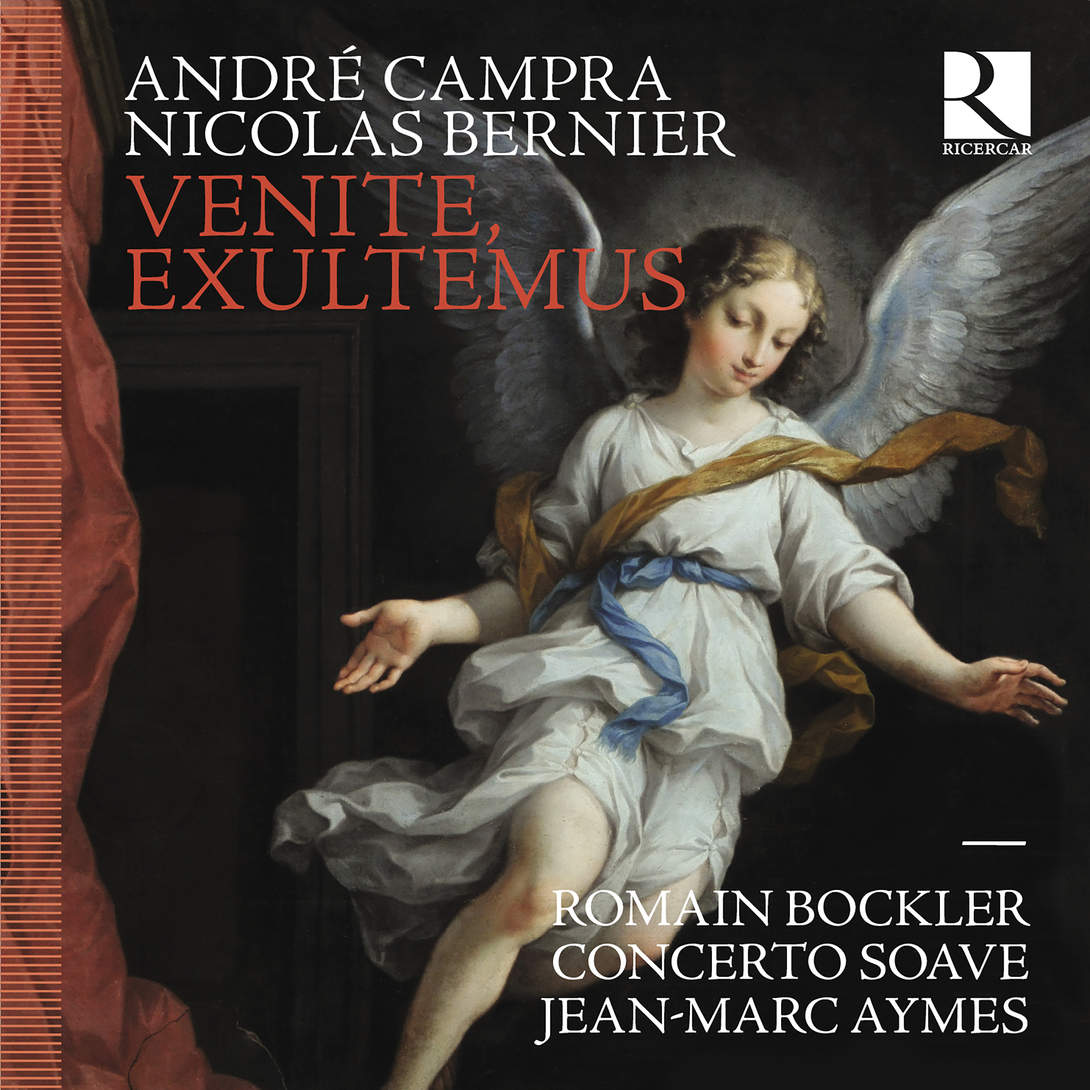
Released by Ricercar, Venite, exultemus brings together Concerto Soave around Romain Bockler and Jean-Marc Aymes to revisit a little-known aspect of French motets at the turn of the 18th century. By comparing the musical settings of Psalm 94 by Campra and Bernier, two composers who were almost contemporaries, the disc highlights their choices of figuration, color and declamation, while placing these works back in their liturgical context by alternating them with organ pieces. This precise architecture reveals an art of contrast, instrumental dialogue, and spiritual interiority that serves as the guiding thread throughout the program. Interview.
This programme sets side by side two almost-contemporary composers, Campra and Bernier. What prompted you to bring them together on the same album, and what does comparing their two versions of the psalm Venite, exultemusreveal?
Jean-Marc Aymes: First of all, the fact that Bernier and Campra are practically contemporaries (they were born four years apart). They followed parallel musical and professional paths, both in the “capital,” even if one of them was born in the provinces (Campra was born in Aix-en-Provence). Their output spans the same spheres, sacred and secular. It is true that Campra went on to have a more dazzling opera career, but Bernier’s stage works—mostly written for the Duchesse du Maine—are far from negligible. Both share a taste for the latest Italian innovations, which means the motets featured here are written “in the Italian manner,” that is, for solo voice and two treble instruments. Of course, Marc-Antoine Charpentier (whose successor at the Sainte-Chapelle would be Bernier) had introduced this form as early as the second half of the seventeenth century. But no composer illustrated it as successfully as Bernier and Campra. Finally, their paths converge again in 1723: both would hold the posts of sous-maîtres at Versailles, alongside Charles-Hubert Gervais. Bringing them together—within a specific domain, the motet for bass with violins, which both composers cultivated splendidly—was therefore an obvious way to highlight a lesser-known facet of two major composers from the final years of Louis XIV’s reign and the Regency.
The comparison becomes especially enriching and revealing by offering listeners two settings of the same text, Venite, exultemus, Psalm 94. Both composers elevate the art of the petit motet by shaping every word, every melisma to draw out very precise affects. In this respect, the gentleness and intensity of verses 6 and 7 (“Venite, adoremus”) are a magnificent example—Bernier underscores the weeping (“Ploremus”) with suave, very Italianate chromaticisms, while Campra presents a passage of incredible tonal instability, switching constantly between major and minor in a wholly novel way. He also plays with the instrumental forces, even having the baritone return to the main theme entirely a cappella to evoke solitude and interiority. The setting of the penultimate verse (“Quadraginta annis”) also differs greatly. Bernier returns to the brilliant style of the opening of his motet, here in ternary metre, full of verve, virtuosity, and sparkle. Campra, for his part, offers a fugue quite unique for its time (which favoured accompanied melody), in the antique manner common to the conclusions of Lalande’s grand motets. This is not to say Bernier was a lesser contrapuntist: his Judica me is dazzling proof of his command of counterpoint.
Here the motets alternate with organ pieces. How did you imagine this liturgical breathing-space between voice and instrument, and how does it change the listener’s perception?
J.-M. A.: We chose pieces by composers who were practically contemporaries, or at least still performed at the time Campra’s and Bernier’s collections were published. Beyond allowing us to showcase the magnificent instrument in the church of Cucuron, this also restored the motets to a more “liturgical” context. The organ pieces serve as introductions to the vocal works, but also as “breathing-spaces,” inviting meditation and reflection of a more intimate kind.
In what way did the venue—its acoustics or atmosphere—shape your interpretation?
J.-M. A.: Recording sacred music in a church is always inspiring, of course. In Cucuron, we also found a superb quality of silence, and the Provençal landscape in autumn, just outside the church walls, is always a source of wonder—one that helps you recharge and forget the pressures of rehearsal that a recording demands. Finally, the presence of the organ, this magnificent “small” instrument (compact, exacting, charming, so full of character) allowed us to come as close as possible to a “historical” context!
The solo voice and instruments engage in very expressive dialogue throughout these motets. How did you work on the balance between spiritual fervour and theatrical sense, so typical of the early eighteenth century?
J.-M. A.: As we mentioned earlier, Bernier and especially Campra were composers for the stage. Their sense of dramatic effect is undeniable. One finds it in Campra’s operas as well as in Bernier’s magnificent cantatas. And yet both held the most important positions in the kingdom’s sacred-music establishment. And even though sacred music “lightened” somewhat from the Regency onwards, the latter part of Louis XIV’s reign required a deeply rigorous understanding of the sacred text—far from ornamental frivolity. Bernier and Campra embody the perfect Baroque equilibrium between spiritual exaltation and musical grace, contrapuntal rigour and melodic variety. Here, too, we favoured dialogue between the voice and instruments—the latter extending and commenting on the former’s discourse with great rhetorical force. We were, of course, committed to an interpretation as faithful as possible to historical practices (both musical and linguistic), and without ever seeking “effects” not inherent to the score, we found an inner strength that we hope will convince listeners of the power of these motets.
What is your favourite piece, and why?
J.-M. A.: On this point, I’ll let Romain answer. As for me, I’m equally fond of all the pieces we recorded.
Romain Bockler: Personally, my favourite excerpt is Quare tristis es, anima mea (“Why are you cast down, my soul?”). Is it the way Bernier begins the verse with only the continuo accompanying the voice, then the entry of the violins with those gentle repeated notes, or the interiority of that B-minor tonality and the violins’ chromaticisms that heighten this intimate and heartrending question, Quare conturbas me (“Why do you trouble me?”)? From the very first read-through, Jean-Marc and I were utterly enraptured by the beauty of this piece…
 Press review
This recording shows that the genre of the petit motet deserves more attention […] These performances are a strong case for both. […] The engaging and dynamically differentiated performances of the instrumentalists are a perfect complement.
Johan van Veen, Musica dei Donum
Romain Bockler and Jean-Marc Aymes offer a programme dedicated to the motets of Nicolas Bernier and André Campra for bass and violins—a scoring rarer than the soprano-and-violins model, but one in which both composers displayed magnificent inventiveness. In these works, they achieve an admirable blend of French elegance and nobility with Italian freshness, dramatic flair, and naturalness.
Télérama
The petit motet format is finely and faithfully ‘restored’ through the interpretation. The search for detail and depth of perspective reveal the corpus’s delicate synthesis of styles. This disc may well bring together connoisseurs and newcomers thanks to its singularity and sonic beauty.
Florence Lethurgez, Olyrix


You must be logged in to be able to post comments.
Sign in