


 Why did the young Bach travel several hundred kilometres to hear Buxtehude in Lübeck? On their second album, the Chœur & Ensemble Poséidon trace the roots of his musical language, setting the cantata BWV 150 alongside works by the older composer he so admired, with Johann Kuhnau also entering the conversation. A journey into the musical world of Germany around 1700, when the future Cantor’s style was still taking shape.
  By
By 


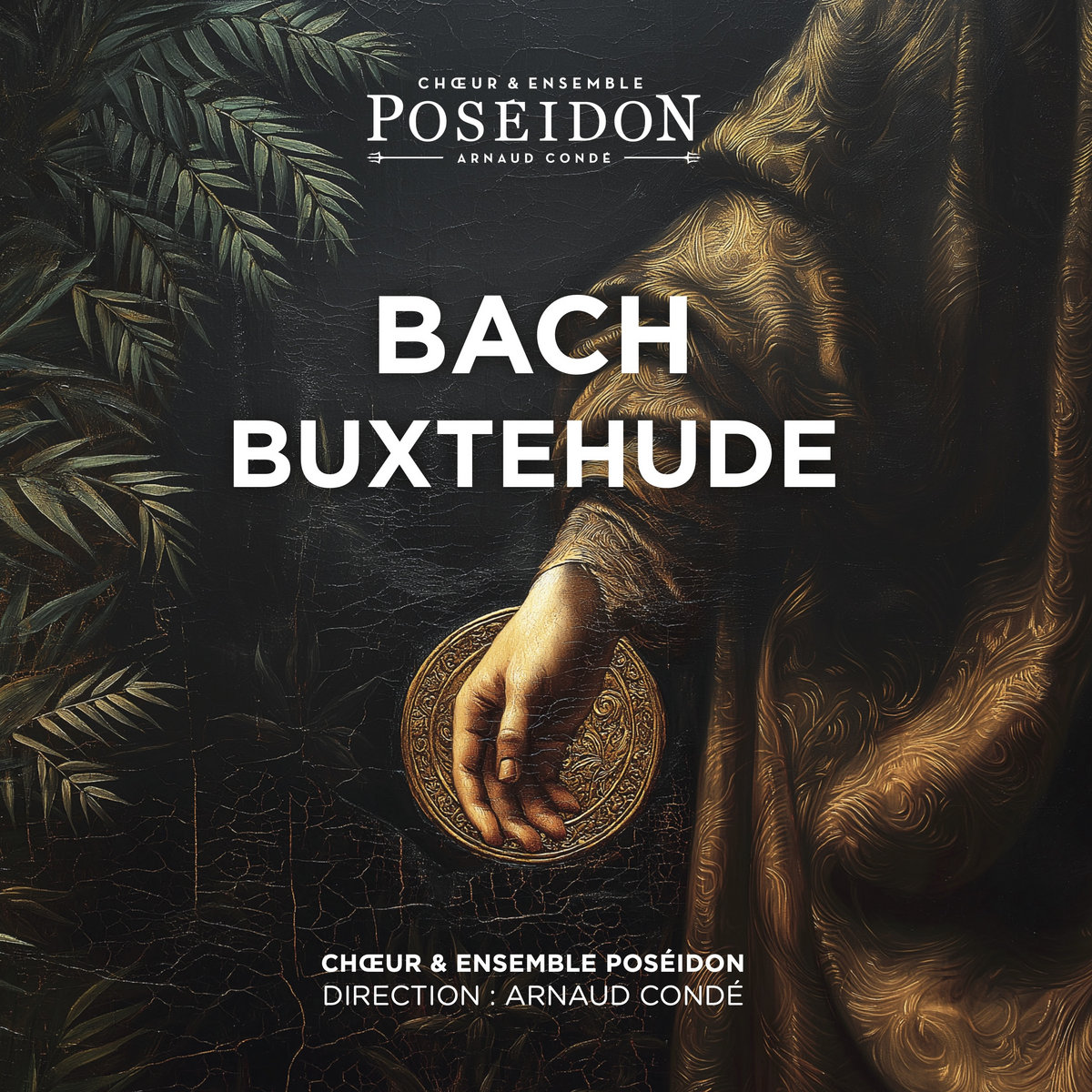
In the autumn of 1705, the twenty-year-old Johann Sebastian Bach left Arnstadt for Lübeck to meet Dietrich Buxtehude, one of the most prestigious musicians of his day. It is this musical lineage that the French Chœur & Ensemble Poséidon and their director Arnaud Condé place at the heart of their second album: set alongside two works by Buxtehude, the youthful cantata Nach dir, Herr, verlanget mich BWV 150 reveals a Bach still close to the musical world of his predecessors, yet already strikingly inventive.
Bach in Buxtehude’s footsteps
Probably composed between 1704 and 1708, Nach dir, Herr, verlanget mich is one of Bach’s earliest surviving cantatas – perhaps even the earliest. The work is remarkable for its concision: seven short movements alternate sonata, choruses, aria and trio, in writing where contrast and responsiveness to the text take precedence over the large-scale structures Bach would later develop. The instrumental forces are equally modest, comprising two violins, bass violin, bassoon and organ.
As a counterpart, Poséidon first turns to Buxtehude’s Gott, hilf mir BuxWV 34. The psalmist’s opening cry – ‘Save me, O God, for the waters are come in unto my soul’ – gives way to a series of episodes for soloists and chorus, before the injunction ‘Let Israel hope in the Lord’ returns. The ensemble also performs Ad genua, the second cantata from the cycle Membra Jesu nostri, a meditation on the knees of the crucified Christ in which solo passages are framed by two choral statements of Ad ubera portabimini.
Around 1700: a German sound world in transition
The programme opens, however, with a third composer: Johann Kuhnau, Bach’s immediate predecessor as Thomaskantor in Leipzig, and his motet Tristis est anima mea. The juxtaposition thus paints a broader picture of German sacred music around 1700, spanning the generation of Buxtehude and Kuhnau and the young Bach’s earliest experiments.
One of the album’s most intriguing choices concerns the instrumental colours of this transitional period. Arnaud Condé plays a three-keyed Baroque bassoon specially commissioned from the maker Olivier Cottet, after an instrument by C. Lauenstein dating from around 1700–1710. As the booklet explains, at the turn of the century the French wind instruments newly introduced into Germany did not necessarily share the pitch of local instruments. In BWV 150, the bassoon part is therefore notated in D minor, while the organ, violins and voices play a third lower, in B minor.
Founded by Arnaud Condé in 2018, Ensemble Poséidon performs on period instruments; its vocal counterpart, Chœur Poséidon, brings together amateur singers selected by audition and works within a historically informed approach. Recorded from 6 to 8 August 2025 at the church of Saint-Sulpice in Saint-Cyr-en-Val, in the Loiret, Bach / Buxtehude was released on 15 December 2025.

You must be logged in to be able to post comments.
Sign in