


 At 25, French lutenist Gabriel Rignol has turned La Nébuleuse into a genuine collective laboratory, where singers and instrumentalists work hand in hand, from research into sources to the shaping of original programmes, notably around Virgilio Mazzocchi (1597–1646). On 18 October, he will appear in Gosnay with Sur les traces du théorbe (‘In the Footsteps of the Theorbo’).
  By
By  7 minutes


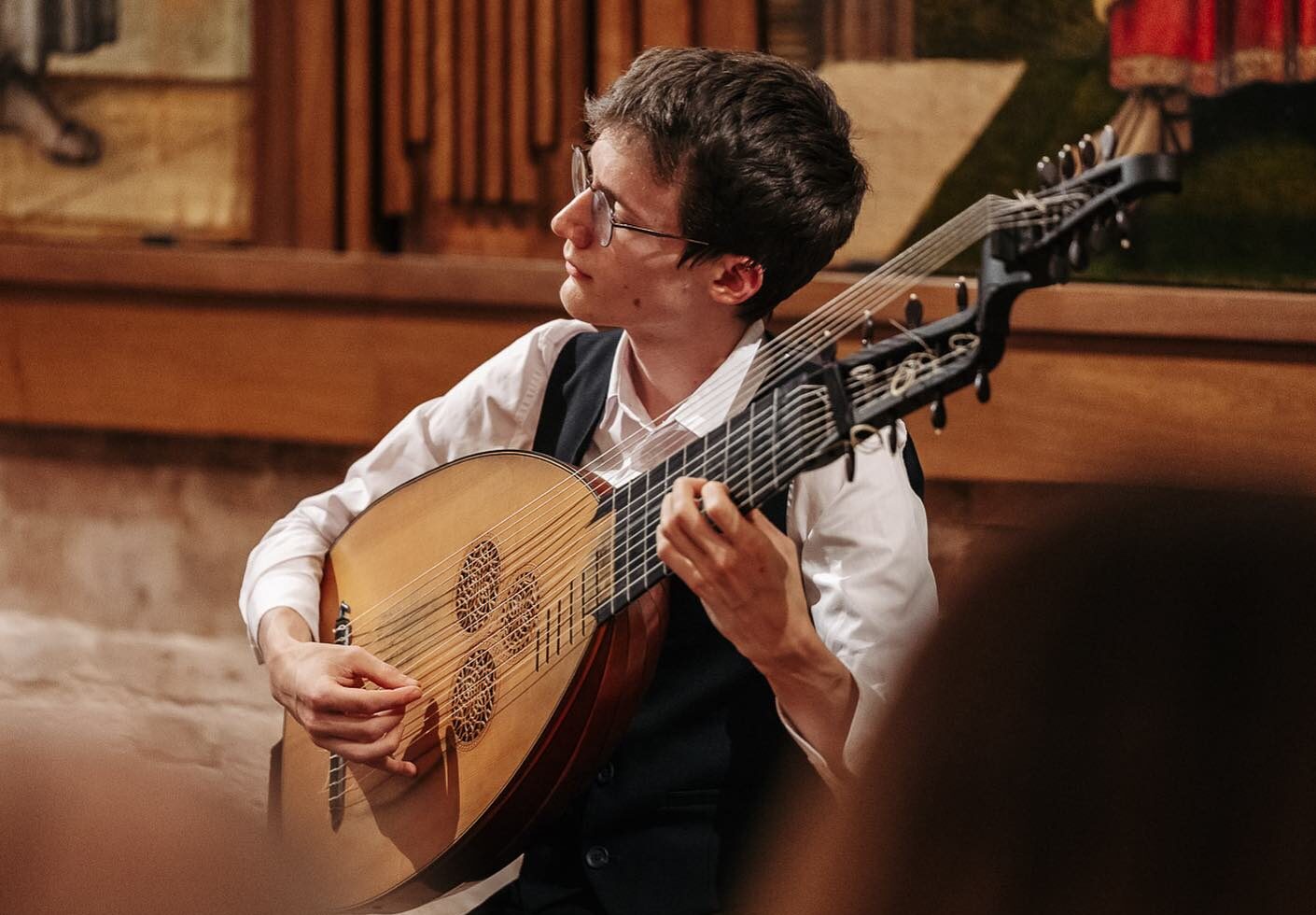
Gabriel Rignol is already celebrating the fifth anniversary of La Nébuleuse, the Baroque ensemble he founded when he was barely 20 and studying lute and theorbo at the Conservatoire de Lyon. Formed around a dozen young musicians and an initial exploration of Monteverdi’s The Combat of Tancredi and Clorinda, the collective has since built up a repertoire of some ten programmes, ranging from Mazzocchi to Charpentier, Carissimi, and Lorenzani. Following the 2023 premiere of Domenico Mazzocchi’s Dido Furens, the ensemble recorded a first album devoted to motets by Marc-Antoine Charpentier for the Musica Ficta label in 2025. At the heart of the project is a desire to break down barriers between the work of singers and instrumentalists, and to make research into sources a collective endeavour. We meet a young artistic director determined to help La Nébuleuse grow without losing sight of what it was founded on: the pleasure of exploring and “making music together.”
In 2021, at the Lyon Conservatoire, while working on the Italian Baroque repertoire with his lute and theorbo teacher, Gabriel Rignol discovered Claudio Monteverdi’s The Combat of Tancredi and Clorinda. He was 20 at the time and was immediately captivated by “this little gem of storytelling: in the space of about twenty minutes, you go through every possible emotion.” He was struck by the power of the narrative: “the intensity of the emotions it aroused, the intelligence with which Monteverdi set Tasso’s text to music—it was incredibly powerful.” Gabriel began to imagine “other avenues to explore beyond what had been done up to that point: something more direct, more respectful of the primary sources, closer to what Monteverdi actually wrote, which is in fact extremely precise.”
The young student gathered around him a dozen students from Lyon and elsewhere, motivated by the desire to explore the work and also to rethink the dynamics within an ensemble. Gabriel explains: “In my first professional productions, I was quite shocked by the divide between instrumentalists and singers, as though we did different jobs, with a different understanding of music and a different vocabulary, when in fact we are all musicians. For example, on one opera production, I went an entire week without speaking to the singers because we instrumentalists kept to ourselves, and the singers did the same. Of course, we are accompanists, but without the continuo, singers can’t do very much!”
With this observation in mind, in 2021 he envisioned an ensemble “as one great whole”: La Nébuleuse [The Nebula] was born. Gabriel Rignol recalls: “When the name came up in discussion, it spoke to all of us for different reasons: the power of the explosion, the death of a star, a cloud that can take any form.”
From the outset, La Nébuleuse was not a student project, although the ensemble was fortunate to receive substantial support from the Lyon Conservatoire and advice from many of its professors. Gabriel takes his role as artistic director seriously and devises much of the programming: “I provide the initial impetus, the broad outlines, and the theme. But it is very important to me that everyone has their share of freedom. In particular, I try to make sure that each singer has a solo in every programme, and that the instrumentalists can suggest pieces they would like to perform. I create the skeleton, and together we create the flesh and tissue.”

Passionate about early music and want to read this subscriber-only article?
If you are not a subscriber, join the international Total Baroque community. Subscribe here from 5.00€.
I subscribe
If you are already a subscriber, sign in.
I sign in 



You must be logged in to be able to post comments.
Sign in