


 Why does an album devoted to Antonio Caldara also feature Legrenzi, Vivaldi, Biber, Muffat, Fux and even Bach? For their debut recording, The BanXhies follow not so much a catalogue as a journey: that of a Venetian who became vice-Kapellmeister at the imperial court, and with him the circulation of musicians and styles between Italy and the German-speaking world at the turn of the seventeenth and eighteenth centuries.
  By
By 


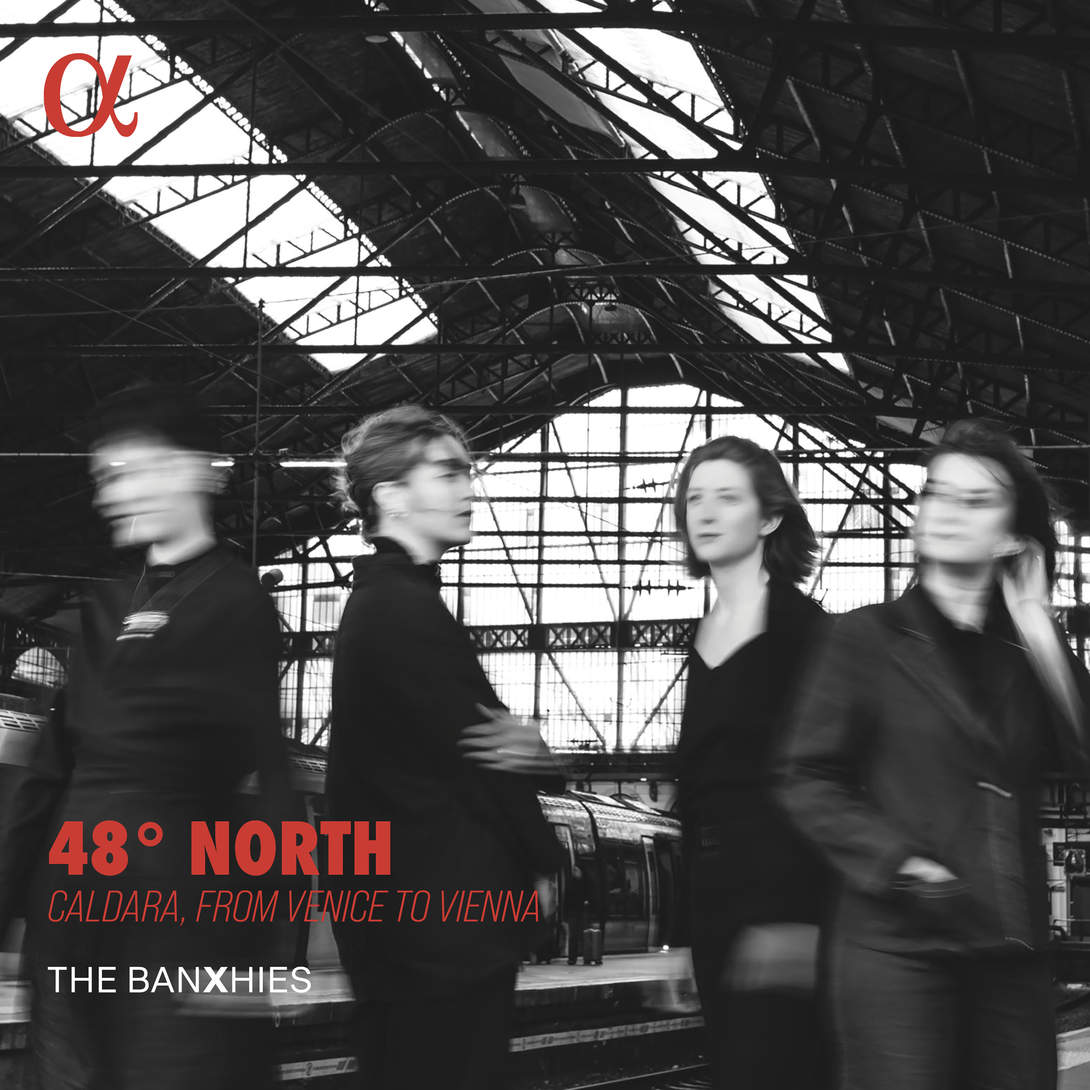
With 48° North. Caldara, from Venice to Vienna, released on 4 September 2026 by Alpha Classics, The BanXhies make their recording debut. Roxana Rastegar and Yaoré Talibart on violin, Suzanne Wolff on cello and Louise Acabo on harpsichord and organ take Antonio Caldara as the guiding thread for a journey from Venice to Vienna. The title refers precisely to the latitude of the Austrian capital, where the composer settled permanently in 1715 after a career that had taken him through Barcelona, Rome and Milan.
The album therefore does not attempt to portray Caldara through his works alone. Several movements from his Op. 1 trio sonatas form its backbone, but they are surrounded by music that evokes the different worlds to which he belonged. Giovanni Legrenzi, maestro di cappella at St Mark’s when Caldara was a young cellist there, points back to his Venetian training; Antonio Vivaldi represents another trajectory linking Venice and Vienna. Further north, Georg Muffat, Heinrich Ignaz Franz Biber and Johann Joseph Fux evoke a German-speaking musical world itself deeply shaped by Italian influences.
This web of connections goes beyond biography alone. Caldara arrived in Vienna in a cosmopolitan environment where styles had been interacting for decades. Appointed vice-Kapellmeister under Fux in 1715, he developed a language that combined Italian virtuosity with a denser Germanic contrapuntal tradition. The programme lets us hear this cross-fertilisation rather than setting it out chronologically: a Canzona by Legrenzi sits alongside the Adagio from Bach’s Concerto BWV 974, after Alessandro Marcello; Porpora, Marini and Froberger precede Biber and Muffat, before Fux and Caldara bring the journey to a close.
The choice also says much about the identity of The BanXhies. Built around the trio sonata, the ensemble conceives its programmes as narratives, alternating works from the repertoire, transcriptions and shifting instrumental roles. 48° North grew out of their encounter with Caldara’s music in 2022, during an initial reading of one of his sonatas. Here, no instrument remains permanently in the foreground: the two violins, cello and keyboards continually rebalance the texture from one piece to the next, with Emmanuel Arakélian joining them on organ.
The choice also says much about the identity of The BanXhies. Built around the trio sonata, the ensemble conceives its programmes as narratives, alternating works from the repertoire, transcriptions and shifting instrumental roles. 48° North grew out of their encounter with Caldara’s music in 2022, during an initial reading of one of his sonatas. Here, no instrument remains permanently in the foreground: the two violins, cello and keyboards continually rebalance the texture from one piece to the next, with Emmanuel Arakélian joining them on organ.
You must be logged in to be able to post comments.
Sign in