


 Formed in Lyon, the French quartet ApotropaïK describes its music as ‘new music of the Middle Ages’: troubadours, the Ars Nova, oral tradition, improvisation and stage productions all contribute to an approach that is as well-researched as it is free-spirited. Their next performance will take place this coming December in Enghien-les-Bains (France) with their new programme, ‘Bestiaire’.
  By
By 


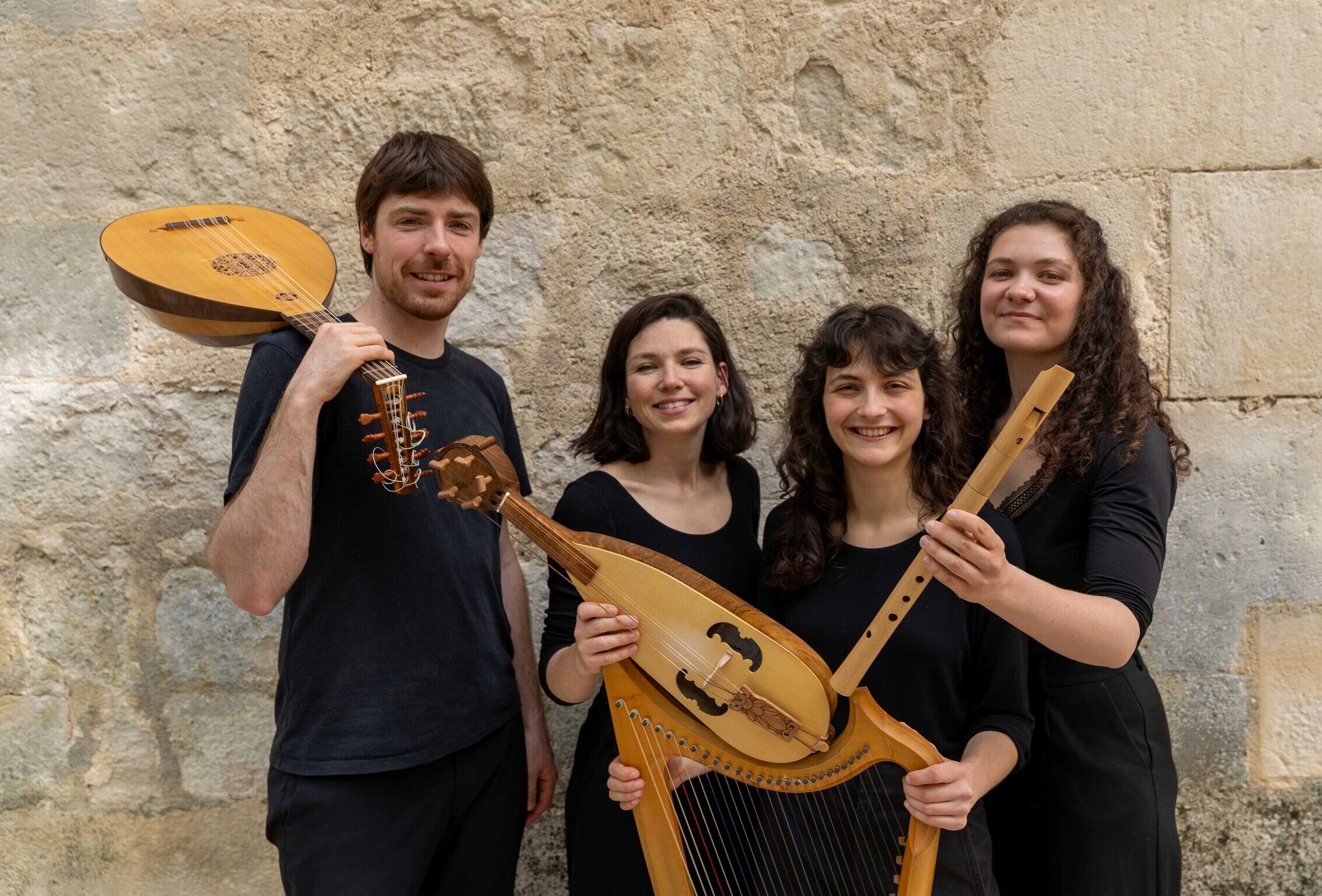
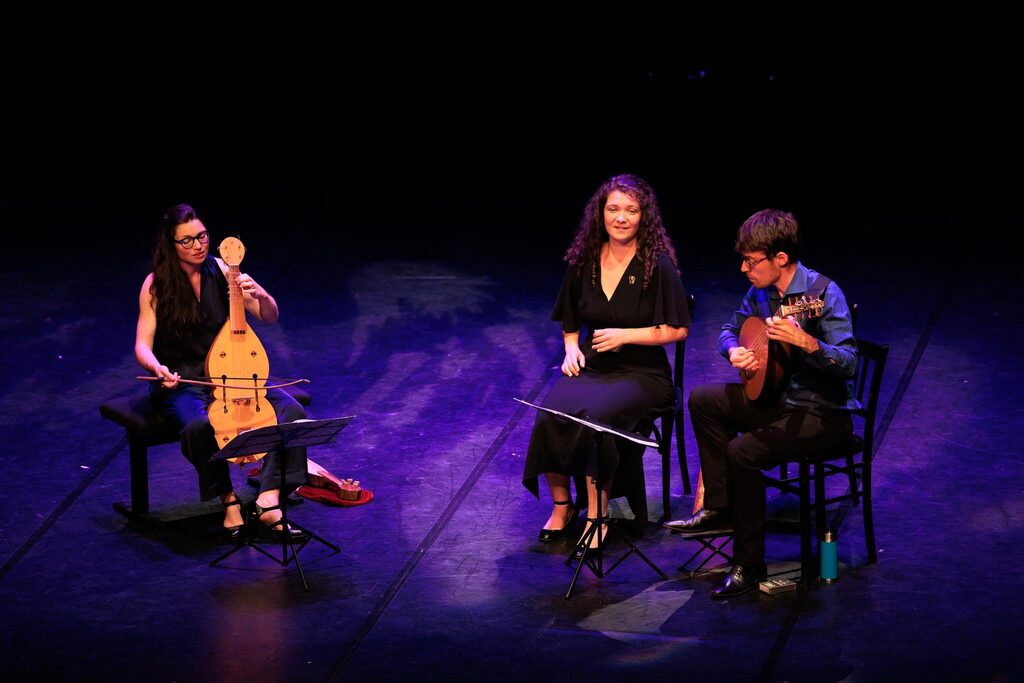
They champion “New Music of the Middle Ages,” cultivate a taste for building bridges, and refuse to regard the medieval repertoire as a museum piece. Formed at the Conservatoire national supérieur de musique in Lyon, the French quartet ApotropaïK brings together Clémence Niclas (voice and recorders), Louise Bouedo-Mallet (bowed vielle), Marie-Domitille Murez (Gothic harp), and Clément Stagnol (medieval lute). Supported by the Eeemerging+ programme and subsequently welcomed for a residency at the Fondation Royaumont, they presented their programme “Bella donna” at the Laus Polyphoniae festival in Antwerp in 2025, before the release of their first album on the La Belle Abbesse label. We meet three of the four musicians, who combine historical rigour with a desire to speak to audiences today.
If you had to define ApotropaïK in just a few words?
Louise Bouedo-Mallet: I would say a very colourful bird carrying things in its beak and taking them elsewhere to sow them. It is up to everyone to make something of them!
Clémence Niclas: You’re really into the bestiary now! I think you’ve been completely swept up in our new creation… To sum up ApotropaïK, we aim to stay as true to historical accuracy as possible – within the limits of what we know about historical accuracy. We want to perform authentic medieval music, but we allow ourselves to push those boundaries in order to achieve the greatest possible expressiveness, emotional impact and accessibility for today’s audience.
Clément Stagnol: We are careful not to think of medieval music as something dogmatic. For us, this is our way of bringing it to life, rather than simply doing archaeology. In the sense that, ultimately, we reinhabit the grey areas, and that is what interests us, because those are precisely the areas that allow creativity to express itself.
Where do you come from?
Clément: We are a French ensemble, founded about ten years ago. We began working together while studying at the Conservatoire national supérieur de musique in Lyon. It is a school specialising in early music, but it also had the distinctive feature of being open to the earliest repertoires, going all the way back to the Middle Ages and the Renaissance, which is not the case everywhere in Europe.
Louise: We spent several years together at the conservatoire. That allowed us to discover medieval repertoires, experiment with instruments, but also to get to know one another as people. We learned together, at the same time as we were discovering this music. That is what still binds us today.
How did the name ApotropaïK come about?
Louise: It did not come immediately. We tried out several ideas, had brainstorming sessions…
Clémence: As I remember it, though, it was fairly obvious! We were mainly in a hurry: the Musée de Cluny had booked us for our first concert, and we needed a name quickly. Louise suggested “apotropaic,” the art-historical term for something that wards off evil. At first, I found the word a little complicated, not even particularly attractive… But its meaning immediately resonated with us.
Louise: We replaced the final “que” with a K, both to evoke the word’s Greek origins and to give it a different graphic energy. And it is a name that arouses curiosity, which fits well with our relationship to this repertoire.
Passionate about early music and want to read this subscriber-only article?
If you are not a subscriber, join the international Total Baroque community. Subscribe here from 5.00€.
I subscribe
If you are already a subscriber, sign in.
I sign in 
You must be logged in to be able to post comments.
Sign in