


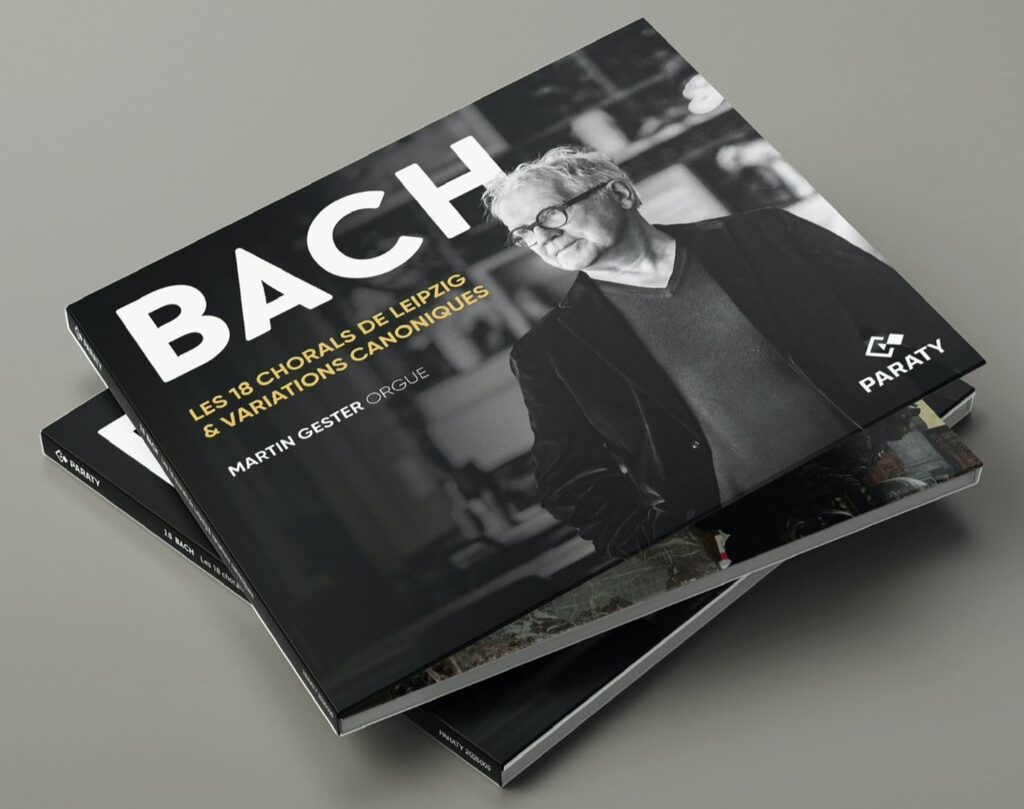
 With the 18 Leipzig Chorales, Bach brings together, at the end of his life, a fully realized reflection on the organ, the chorale, and counterpoint. On the Thomas organ in Namur, Martin Gester approaches these pages as a space for sonic invention, playing with styles, colours, and balances to create a dialogue between learned elaboration and expressive intensity.
  By
By 


With the 18 Leipzig Chorales, French keyboardist Martin Gester takes on one of Bach’s last major projects for the organ, which remained in manuscript form. Recorded on the Thomas organ of Église Saint-Loup in Namur and released on the Paraty label, this album explores the genesis, the writing, and the expressive stakes of this late collection. The organist unfolds an approach informed by the history of styles, organology, and an in-depth reflection on the transmission of Bach’s musical language. To accompany the listening experience, Total Baroque Magazine put four questions to Martin Gester.
What prompted you to record the 18 Leipzig Chorales, works you describe as a “narrow path” toward the quintessence of Bach’s language?
Martin Gester: When one compares the last five years of the life of, say, Mozart with those of Bach, one cannot help but be struck by the former’s creative explosion as opposed to the Cantor’s decreasing compositional output. During the last fifteen years of his life, instead of multiplying cantatas and concertos, Bach refocused on works for few performers, or even soloists—such as the vast project of the Clavier-Übung—bringing together in each genre the diversity of styles he had always pursued, within a demanding synthesis, perfectly achieved and marked by an extreme economy of means. Here, he merges modern art and ancient polyphony; vocal and instrumental styles; the expressivity of the passions and a musica mathematica laden with symbols. Clavier-Übung I (the keyboard Partitas), which I recorded previously for Ligia, represents for me a point of culmination: the most perfect synthesis of styles and musical art within the genre of the baroque suite, with its great preludes, its multiple dance characters imbued with counterpoint and charged with symbolism.
The subsequent works—Clavier-Übung II (for harpsichord), III (for organ), IV (the Goldberg Variations), the only works published during the composer’s lifetime, as well as the second volume of The Well-Tempered Clavier—transpose this demanding concern for diversity and recapitulation into other genres, according to an ever-increasing intellectual rigour. Then come the eminently contrapuntal works composed in the context of Bach’s admission to the Mizler Society, an assembly of learned philosophers, musicians, mathematicians, and adherents of Leibniz’s philosophy. The Canonic Variations were the “masterpiece” Bach presented to gain admission. The Musical Offering and The Art of Fugue follow in their wake.
It is within this context that Bach reworked a collection begun as early as his Weimar years, consisting of fifteen “great” chorales to which three others would later be added, including Vor deinen Thron, appended to the posthumous edition of The Art of Fugue. Remaining in manuscript form, this new collection of “18 Great Chorales” (The Great Eighteen) constitutes, in the composer’s mind, a late, mature, ideal collection, alongside the Orgelbüchlein (made up of forty-five shorter, earlier chorales) and Clavier-Übung III (a more imposing but more cerebral work). It is for its origin, towering over the creative periods, and for its perfection—ideally balancing learned elaboration and strong emotional content, on a par with the keyboard Partitas—that I wanted to record these works. It is a summa, too rarely explored given its perfection. In doing so, I was also reconnecting with the program of my first recording for the Pamina label forty years ago, devoted to the great preludes and fugues of the Leipzig period, which I still love. Taken together, these works represent for me the absolute summits of the organ repertoire: those of a Bach at full maturity, just before he became increasingly drawn to extreme stylization and quintessential rarity, which gradually made him alien to his contemporaries.
You speak of the extraordinary elaboration of these chorales, between the legacy of musica reservata and contrapuntal writing. How did you reconcile this refined expressivity with the demands of virtuosic playing?
M. G.: Let us say straight away that there is little ostentatious virtuosity here. Rather, it is another form of virtuosity, quite different from that of the composer’s youthful works, such as the keyboard and organ toccatas, or the great preludes and fantasias of the Weimar period, composed under the vivid impression of models by Vivaldi and Buxtehude. What we have here are true marvels of writing: an idiom that is both effective and elegant, varied according to the chorale texts, less complex and overwhelming than in Clavier-Übung III, but constantly renewed—polyphonic style and galant style, subtle or profuse ornamentation, chamber trio or organo pleno five-part polyphony, and so on. The performer must constantly avoid ready-made touches, formulas, and registrations; must play the orchestra, the chamber trio, the art of bel canto over an articulated bass, and make use of the subtleties of the organ mixtures available to Bach.
One should remember that Bach was Kapellmeister and composer, but also organist and instrumentalist—on the harpsichord, the violin, and many other instruments. His art goes far beyond the instrument and stylizes the genres and styles he encountered and practiced in multiple ways. It is up to us to follow him through constant imagination and instrumental and technical adaptation. Even the art of dance is present in many chorales (An Wasserflüssen Babylon, Schmücke dich…), which must be recreated with the discretion befitting the instrument, the space, the polyphony, and the character. The most difficult task remains the art of making all these parameters interact in the service of expression and a fragile balance, which confers on these works both intensity and nobility of intent.
The Thomas organ of Saint-Loup Church in Namur offers an immense palette of colours. In what way did this instrument prove particularly well suited to this repertoire?
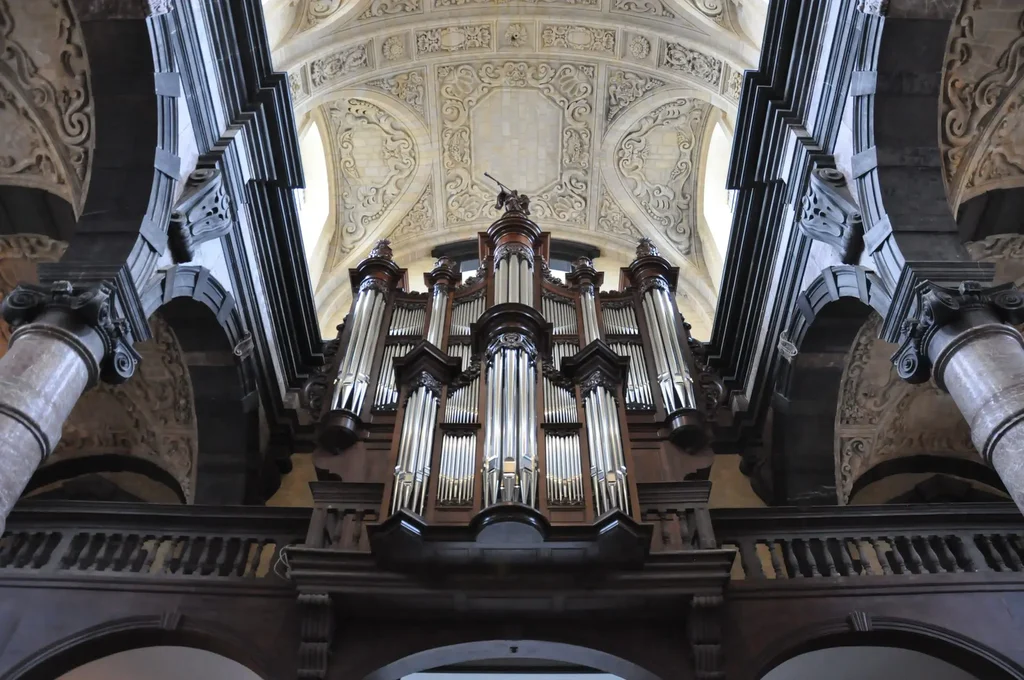
M. G.: This organ is marvelous. It is a great achievement of the Atelier Thomas on which I had already had the opportunity to play a related, older instrument in Strasbourg, though one less well served by its acoustics. The Namur instrument, inspired by Central German organ building toward the end of Bach’s life, offers numerous subtle colours of principals, strings, and reeds—singing or brilliant, as the case may be. The possibilities for mixtures are countless, very different from what was practiced in France and which has sometimes been too hastily extended to Bach’s sound world. I also paid close attention to period sources, notably the indications of Georg Friedrich Kaufmann, a student and colleague of Bach in Leipzig, who provided abundant registrations for his works. One observes there a search for gravity, with a marked fondness for the Vox humana and extensive use of 16′ stops on the manuals, including the Fagott (bassoon), even in complex counterpoint. This calls for restrained tempos, in which clear and varied articulation becomes the primary source of vitality and intensity. To crown it all, the acoustics of Saint-Loup Church in Namur enhance the instrument’s many colours—each highly successful and inspiring—and superbly support a plenum that is by turns brilliant, weighty, hollow, or sumptuous.
Among these eighteen chorales, which one moves you the most—and why?
M. G.: It is difficult to choose. All these masterpieces are so diverse and illuminate one another through contrasts or more subtle nuances. There is, of course, the very well-known Nun komm, der Heiden Heiland BWV 659, Italianate in style, with its bel canto over a regular bass—so appreciated by pianists—proof of a perfection that is more stylistic than strictly instrumental, and so reminiscent of the opening of Pergolesi’s Stabat Mater, which was circulating everywhere at the time. An Wasserflüssen Babylon BWV 653, with its tenor cantus, somewhat in the manner of French tierces en taille, its sarabande motion and its ornamentation, brings together elements that stylize a noble and intense lament. O Lamm Gottes, unschuldig BWV 656, in the key of A major—the key of grace—is contradicted by the treatment of Christ’s Passion in painful chromaticisms. And then there is the final chorale, Vor deinen Thron BWV 668, in its bareness and timelessness. Among many others. I even specified this in the presentation: eighteen poems for a desert island…
 Press review
The Paraty double album establishes itself as a reference: an alliance of analytical rigour and inspired momentum, of agility and depth, it places Martin Gester among the organists capable of understanding and expressing the uniqueness of Bach’s ultimate masterpieces. The performer succeeds in the decisive equation that combines musicological rigour with poetic fervour. This fluid, eloquent playing—poised between embodiment, humility, and expression—proves highly convincing.
Carter Chris-Humphray, Classicnews
Throughout these two discs, one cannot help but admire the learned writing of a polyphony brought to perfection, to which the performer’s sensitivity lends great poetic qualities.
Cécile Glaenzer, ResMusica


You must be logged in to be able to post comments.
Sign in