


 Intimate and radiant, Luc Beauséjour’s new album explores Bach’s artistic evolution through his harpsichord works.
  By
By 


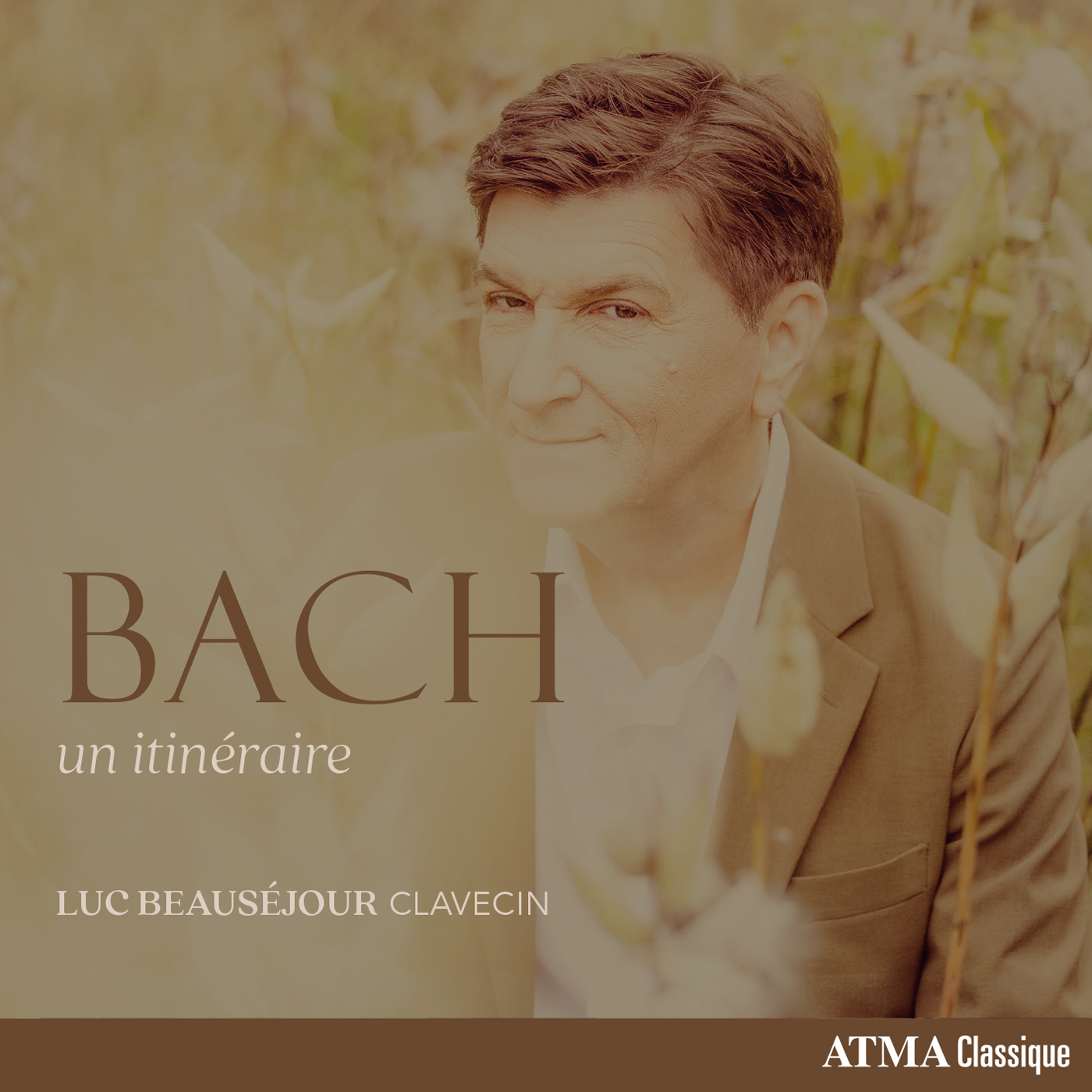
With his latest album, Luc Beauséjour offers a personal journey through Johann Sebastian Bach’s harpsichord repertoire, highlighting the composer’s artistic development and the influences that shaped his music throughout his career. This recording continues a path dedicated to Baroque music, adding to a discography acclaimed for its sensitivity and technical mastery, where the works of the German composer hold a prominent place.
For your debut with Atma Classique, you are presenting an ambitious album. What is your personal connection with Bach?
My connection with Bach was established in my childhood, sparked by listening to recordings of the Fourth and Fifth Brandenburg Concertos—we didn’t have the others at home—as well as the famous Toccata in D minor for organ. From my earliest piano studies, I was intensely fond of certain pieces from The Little Notebook of Anna Magdalena Bach, the small preludes, the two little fugues in C major, the Inventions… Then came the harpsichord, the discovery of his organ works, the cantatas… In short, throughout my life, Bach has remained my favourite composer, my demanding master, and my faithful companion. I often wonder what other career I could have pursued without his music!
You maintain that, whether as a church organist, a court musician, or in service of a municipality or a music-loving prince, Bach was always influenced by the places and roles he held. How is this reflected in the pieces you have selected?
It is true that the positions Bach held largely shaped his musical output. In Weimar, for example, where he served as an organist and violinist at the court, he absorbed the Italian concerto style while composing a significant portion of his organ works. In Köthen, a period marked by a freer context without religious constraints, he devoted himself entirely to instrumental music. Finally, in Leipzig, as a cantor, Bach returned to composing cantatas before dedicating the final years of his life to more complex and scholarly music, with an ever-deepening exploration of contrapuntal techniques. With Bach: A Journey (Bach : un itinéraire), I wanted to bring together a wide variety of harpsichord works that I hold dear and that highlight the astonishing richness of his writing. But how can one combine on a single recording the Capriccio on the Departure of a Beloved Brother and the Ricercare a 3 from The Musical Offering, two pieces representing such distinct universes? It became clear to me that the best approach was to imagine an itinerary that, by following the thread of his career, would showcase the diversity of styles Bach explored. This journey thus offers a reflection of the many facets of Bach’s art, illustrating the evolution of his musical language through different forms and genres: dance suites, program music, masterfully constructed fugues, and even pieces that evoke the spirit of improvisation.
Unlike other repertoires, Bach’s harpsichord works, as you write in the album booklet, span “his entire lifetime.” What was his relationship with this instrument?
The harpsichord played a central role throughout Bach’s life, both personally and professionally. He became acquainted with the instrument at an early age thanks to his brother Johann Christoph, who introduced him to the fundamentals of keyboard writing. From then on, the harpsichord became a daily companion, with which he developed his musical language. The plucked-string instrument offered him complete freedom, allowing him to explore both virtuosity and the most intricate polyphony. Bach unlocked the full potential and expressive richness of the harpsichord while remaining accessible to performers, sometimes composing pedagogical works. We know that Bach owned several harpsichords throughout his life. In fact, inventory records following his death in 1750 list at least five plucked-string keyboard instruments, including two double-manual harpsichords. Bach saw the harpsichord as a vehicle capable of conveying both the richness of his contrapuntal language and the diversity of his stylistic influences, making this instrument a privileged witness to his artistic evolution.
With this album, you offer a decidedly overarching perspective. What does it reveal, in your opinion, about the composer’s artistic evolution?
This recording indeed provides a comprehensive overview of Bach’s harpsichord works, tracing a prolific and fascinating artistic journey. From his early pieces, still influenced by his predecessors and contemporaries, to his most accomplished compositions, we discover a composer who, through his experiences, gradually shapes a unique and deeply personal musical language. I am convinced that listeners will perceive, much like observing a painter’s evolution from their first canvases to their ultimate masterpieces, a significant transformation—one that reflects the maturation and affirmation of Bach’s genius.
 Press review
“What is striking (and truly moving) is the quiet serenity of this carefully considered and reimagined journey, aiming for a clarity that is both radiant and soothing.”
Christophe Huss, Le Devoir-Montreal


You must be logged in to be able to post comments.
Sign in