


 Legendary violinist and founder of Musica Antiqua Köln, Reinhard Goebel now views the baroque world from a distance. Having moved to the podium of modern symphony orchestras, he remains driven by the same quest: to rediscover the logic of phrasing, and the hidden meaning within music.
  By
By 


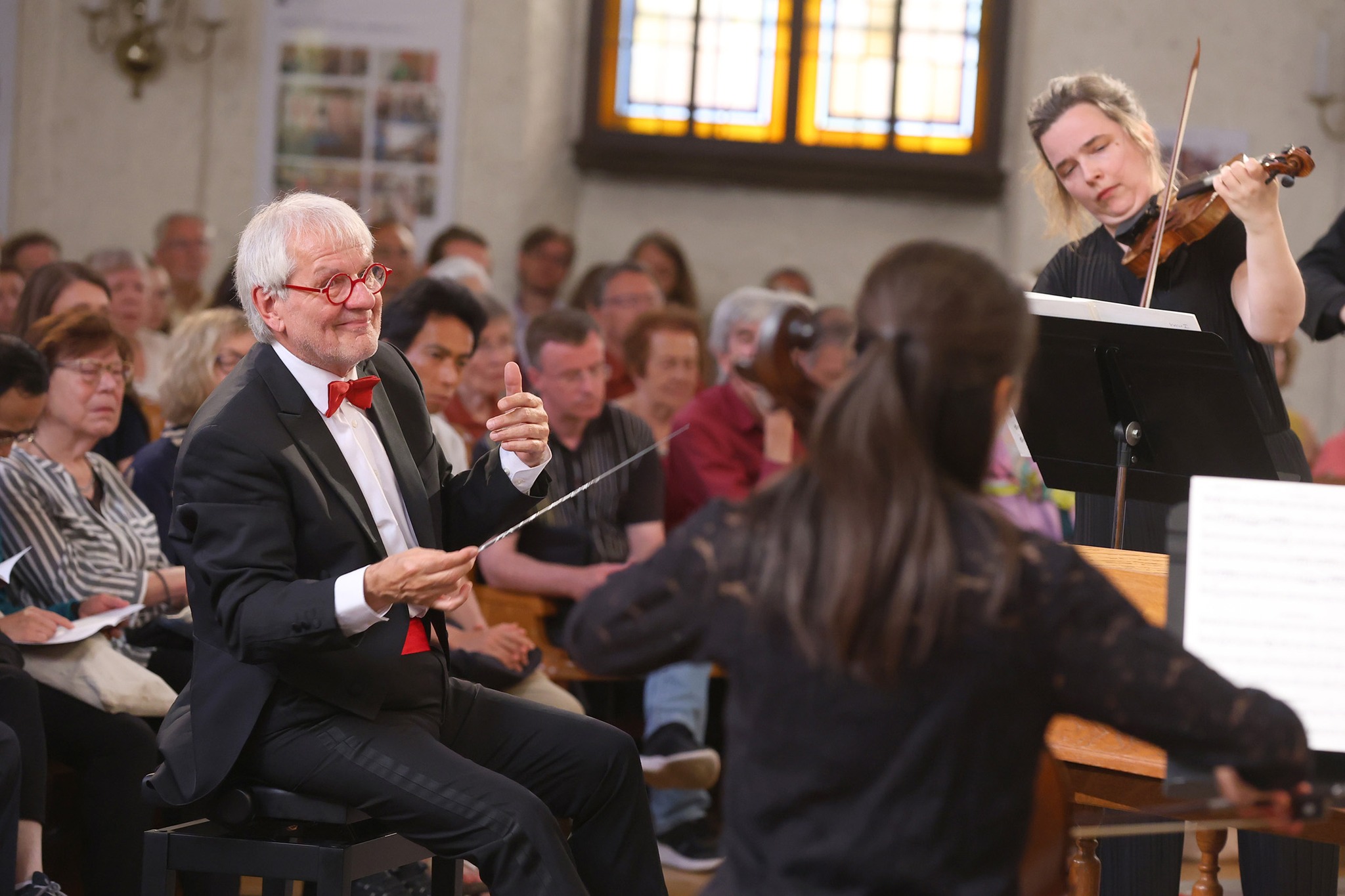
In 1973, the young baroque violinist Reinhard Goebel founded Musica Antiqua Köln with a few classmates. The ensemble quickly made its mark on the international scene through its boldness and precision, bringing vast forgotten repertoires back to life. After thirty-three years at its helm, Goebel turned a new page in 2006, devoting himself to conducting modern symphony orchestras, to which he imparts his rigorous and innovative vision of music. In this second part of the interview, he reflects on the performance of early music today: what has been lost, what still remains, and what it can teach modern orchestras.
What can you do today with modern orchestras that you couldn’t do with baroque instruments, and vice versa?
Reinhard Goebel: Late eighteenth-century music can hardly be played on period instruments any more; very few violinists could manage a Cannabich symphony properly, for instance. As for me, I’ve turned the page on early music. When I occasionally work with so-called “baroque” ensembles, I notice that, except perhaps in England, most play on poor-quality modern instruments that haven’t been restored. And the moment I suggest something, everyone thinks they know better than I do. It’s simply no longer my audience, except for those who look for meaning behind the music. With modern orchestras, what interests me now is achieving absolute perfection in sound. In early-music circles there was always a slightly blurred passage here, a missed trill there, and in the long run it began to irritate me. Of course, that’s a personal evolution, not necessarily that of the field as a whole.
Still, after seventy years of research into early music, one might think we’d have made progress.
R. G.: Ah! (laughs) You know, I once owned three violins by Jakob Stainer. At Musica Antiqua Köln we also had a Rogeri, among others. And today, when I go to hear a small early-music ensemble, I see violins worth €3,000. Very few musicians invest in fine instruments. That also depends on their income, which I understand perfectly. Their interest in exceptional instruments only comes once their careers are established. For me it was the opposite: it was the starting point. You can’t imagine how obsessively I hunted down violins, like a cat stalking a mouse.
Violins you could actually afford to buy?
R. G.: I’ve never chased money or career success; only repertoire interests me. But yes, it eventually pays off. Our recordings are still available, streaming brings in a little, and I’m often surprised by what I earn. Yet I reinvest everything, and for ten or twenty years I lived in relative insecurity. Violins were expensive, and scores too. And I never went to libraries to borrow and return my sources: I bought them, so I could consult them at five in the morning if I wished.
Listening to your baroque recordings, one notices you often used rather modern voices. Why was that?
R. G.: I believe I was the first to do so. In fact, it was at the label’s request; they chose the singers.
Honestly, I might have chosen others at times.
R. G.: I understand, but the truth is we still don’t really know how people sang back then. The important thing, in the end, is to sing well. Christine Schäfer, for instance, is an excellent singer, and who knows, perhaps Madame Bach sang like that?
Passionate about early music and want to read this subscriber-only article?
If you are not a subscriber, join the international Total Baroque community. Subscribe here from 5.00€.
I subscribe
If you are already a subscriber, sign in.
I sign in 

You must be logged in to be able to post comments.
Sign in