


 With “Vieni, o Notte”, Francesca Aspromonte and Arsenale Sonoro delve into the intimate world of Scarlatti: three vocal works for soprano, two violins and basso continuo, interwoven with two sonatas for four instruments without harpsichord, form an album of striking poetic and musical unity.
  By
By 


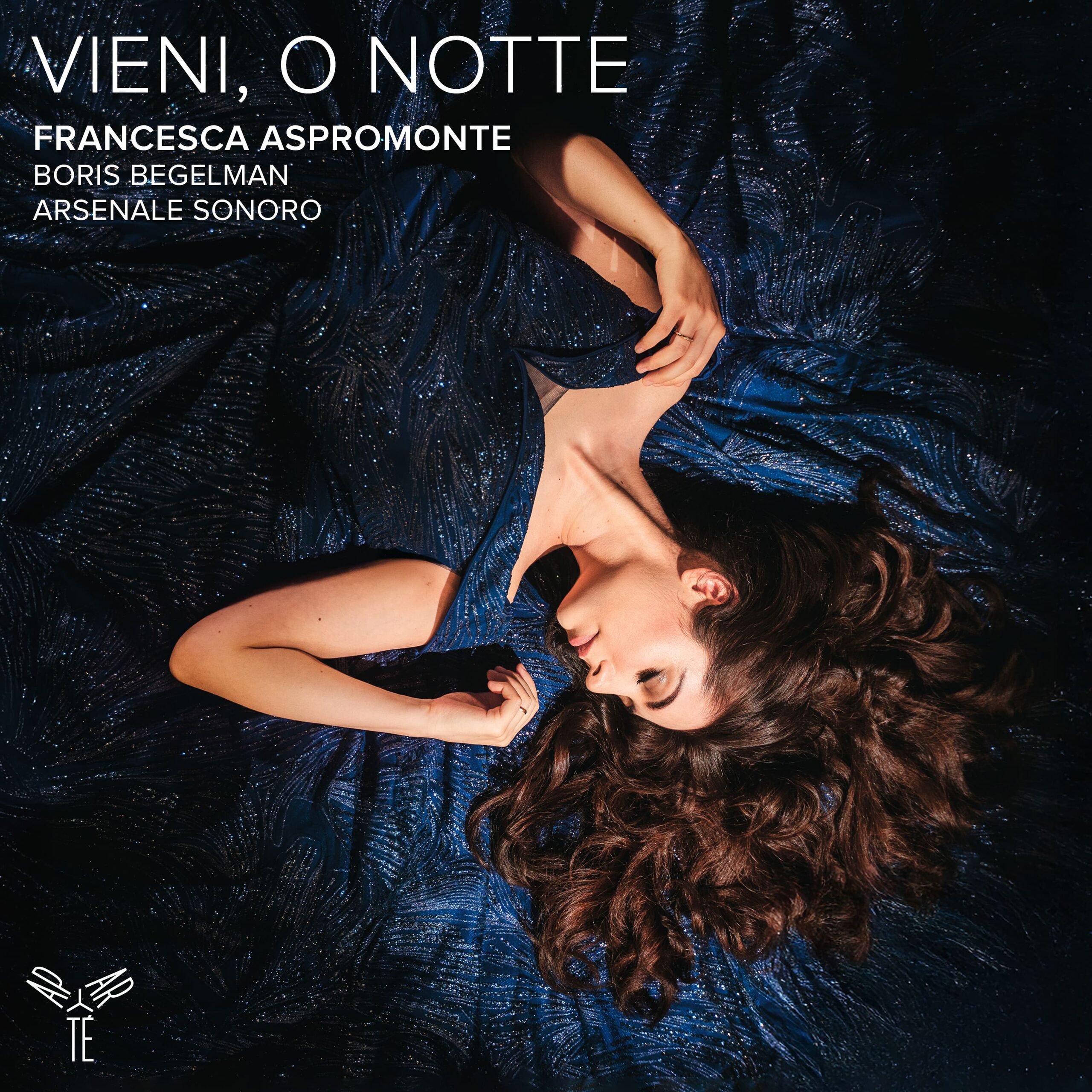
Recorded in September 2024 at the Sala Ghislieri in Mondovì and released by Aparté, this album is the result of a long-standing artistic devotion. It was during a masterclass marking the 350th anniversary of Alessandro Scarlatti’s birth that soprano Francesca Aspromonte came to regard him as her foremost composer of the Baroque era. The vocal programme brings together two serenatas, Notte ch’in carro d’ombre and All’hor che stanco il sole, alongside the cantata Silenzio, aure volanti, complemented by two sonate a quattro senza cembalo. These three vocal works share a common atmosphere: night, unrequited love, and lament addressed to the elements.
What immediately strikes the listener in Vieni, o Notte is the ease with which Scarlatti allows emotion to flow from one genre to another. Accompanied recitatives slip into arioso; the da capo arias open up a space for ornamentation that Aspromonte inhabits with poised freedom; and the obbligato violin, played by Boris Begelman, engages with the voice as a dramatic counterpart rather than a mere accompanist. The two sonate a quattro senza cembalo interspersed throughout both punctuate the programme and shape its overall architecture: without the harpsichord, the strings draw closer into a tightly woven and evocative polyphonic texture. The cantata Silenzio, aure volanti extends this circulation between forms and affects within a more compact framework, where continuity arises from the flexible interplay of recitative, arioso and aria.
The serenata All’hor che stanco il sole, preserved in a Neapolitan source and recorded here for the first time in its entirety, may well be the jewel of the album. In F major—the only major key in the programme—it unfolds the heartrending monologue of the shepherd Fileno through dances, lullabies and lyrical surges that seem to resist any formal boundaries. It is precisely this quality of fluidity, which Aspromonte herself identifies as central to Scarlatti’s style, that gives the recording its distinctive breath: nothing is fixed, everything remains in motion, from sorrow to hope, and back again into shadow.


You must be logged in to be able to post comments.
Sign in