


 In their latest album, Les Cris de Paris delve into the “strange harmonies” of the late Renaissance—microtonal works like those of Nicola Vicentino—inviting us to hear with entirely new ears.
  By
By 


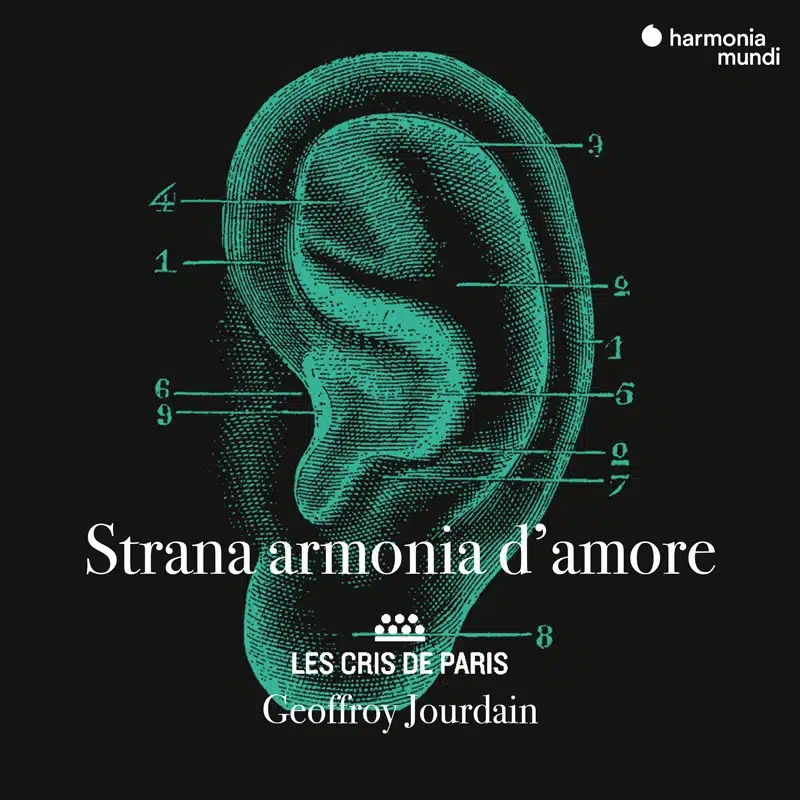
With Strana armonia d’amore, Les Cris de Paris and their director Geoffroy Jourdain take us on a singular sonic journey between Italian Renaissance and contemporary creation. Centered around madrigals by Carlo Gesualdo and his followers, the daring experiments of Nicola Vicentino, and new works by Francesca Verunelli, the program pushes the boundaries of harmonic language. It’s a fascinating dialogue between past and present, delivered with vocal precision and hypnotic clarity.
Your new album draws from the music of late Italian Renaissance and the experimental figure of Nicola Vicentino to create a truly unique musical path. What do you hope to reveal through these “strange harmonies”?
Geoffroy Jourdain: Italian music of that era, and in particular the polyphonic madrigal, continues to fascinate and inspire me with a deep curiosity. Strana armonia d’amore is a natural continuation of the work I’ve been doing for years with Les Cris de Paris—exploring this repertoire that I consider to be the true laboratory of opera. I’ve always been drawn to musical “cabinets of curiosities,” which has led me to track down surprising composers and collect unusual scores over the years. I wanted to share some of these discoveries by tracing a line of musical filiation: from Nicola Vicentino in Ferrara, through Gesualdo and his followers, to Sigismondo d’India and Michelangelo Rossi—a possible history of the Italian avant-garde of the 16th and 17th centuries.
In this project, you create a dialogue between that Italian avant-garde and the contemporary composer Francesca Verunelli, blending early music with modern writing. What, in your view, does this juxtaposition bring?
G. J.: We often talk about contemporary pieces being written “in echo” or “in response” to older works—but those terms make me uneasy when it comes to creation. I don’t believe in simply making something new from something old. I’m more inspired by the idea of making time periods resonate with one another. That was the spirit behind this project: inviting Francesca Verunelli to compose “within” a selection of madrigals I suggested—not to comment on them, but to inhabit them. Like a visual artist curating a collection of ancient works, she selected the madrigals that spoke to her and wove a kind of musical dramaturgy between them.
Dividing the octave into 31 intervals opens a vast harmonic space—but also presents a challenge for vocalists. How did you approach this with your singers?
G. J.: Vicentino’s idea of dividing the octave into 31 intervals—a theory he first heard before writing it down—is actually based on skills familiar to early music specialists: pure intonation. That is, tuning intervals without interference or beats, which isn’t possible with our standard 12-tone equal temperament. Vicentino’s system (or rather, his revival of the ancient Greek enharmonic genus) essentially allows for pure intervals from any point on the keyboard. Imagine a ladder with twelve rungs—now imagine new rungs, of different colors, added in between. Vicentino even designed an archicembalo, a keyboard instrument with split keys, to play these notes. One such instrument survives in the Museo Civico in Bologna. To honor that spirit, we “detuned” two triple harps, creating a polychromatic scale that allowed us to open our ears as wide as possible.
 Press review
“…a fascinating journey through largely unknown territory that, while full of discoveries and surprises, brings rich rewards, particularly through repeated listening.”
Gramophone
“It’s only February, but this is already a contender for my favorite album of 2025.”
Weston Williams, New Releases
“Each singer flourishes and develops their own identity, their own tone and diction, while remaining deeply unified with the group. It’s clear: Geoffroy Jourdain’s work with Les Cris de Paris is remarkable.”
Res musica


You must be logged in to be able to post comments.
Sign in