


 The week’s highlights: Chanticleer brings Machaut to the stage in San Francisco, Paul O’Dette explores Central European lute music in Antwerp, Dame Emma Kirkby brings Rossi and Schütz together in Cologne, while Les Arts Florissants return to Charpentier in Ambronay.
  By
By 


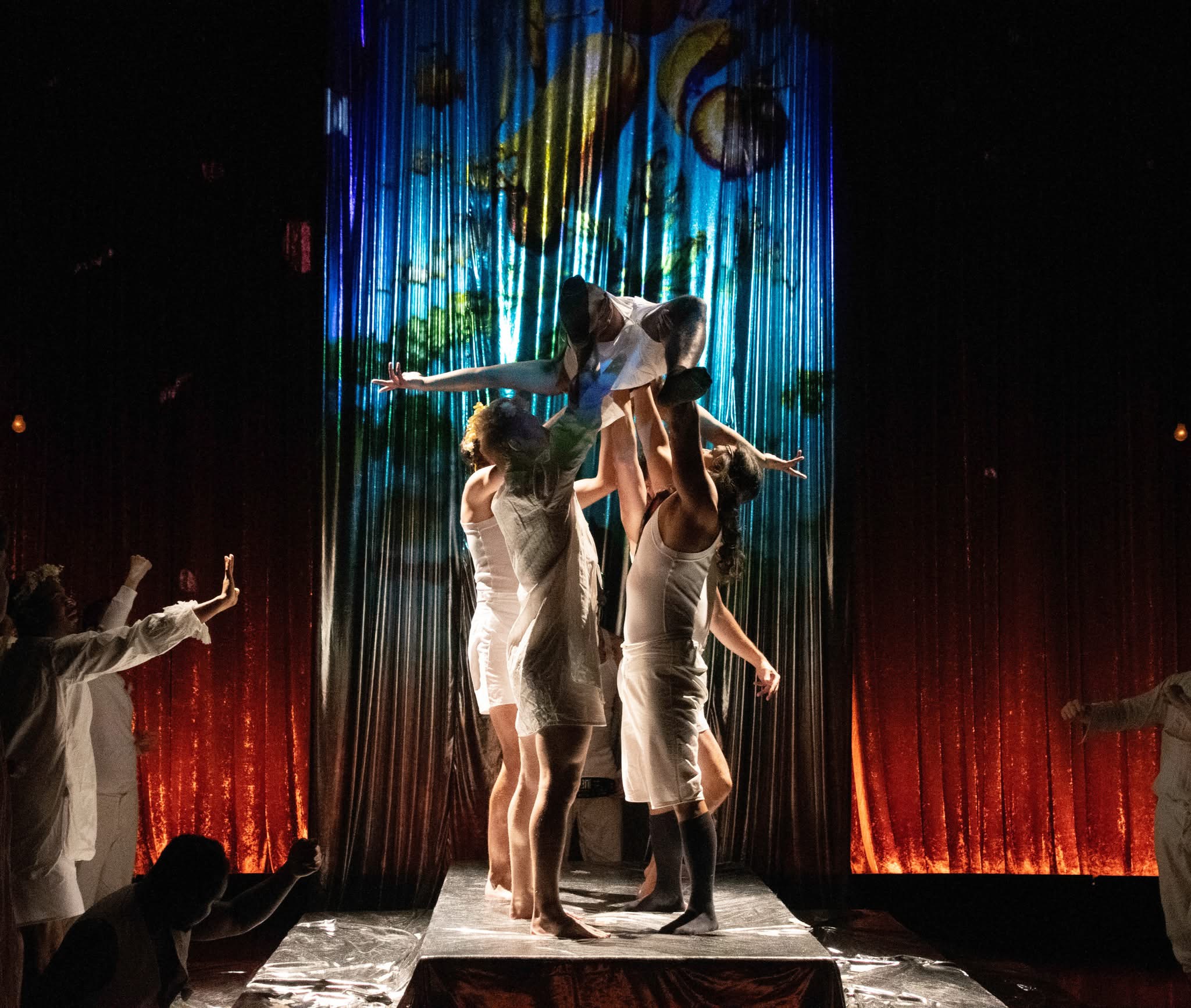
In San Francisco, Chanticleer brings Guillaume de Machaut to the stage
To open its 49th season in the San Francisco Bay Area, vocal ensemble Chanticleer ventures far beyond the traditional concert format with The Machaut Project: Devotion & Desire, receiving its world premiere at San Francisco’s ODC Theater from 13 to 20 September 2026. It is the American vocal ensemble’s first fully staged production since its 1994 Curlew River.
Directed by Elkhanah Pulitzer, a regular collaborator of John Adams, the production takes as its starting point the two sides of Guillaume de Machaut (c. 1300–1377): a churchman and master of the Ars nova, but also a poet of courtly love, desire and absence. The staging turns Love, Faith and Hope into genuine dramatic presences, using a theatrical language based on ritualised gesture and a deliberately spare staging.
The project accompanies the release, on 11 September on Delos, of Chanticleer’s new album Machaut, under the musical direction of Tim Keeler. Alongside the Messe de Nostre Dame are secular songs including Douce dame jolie and Riches d’amour, which likewise reveal the composer’s sacred and courtly sides.
With Chanticleer and Tim Keeler.
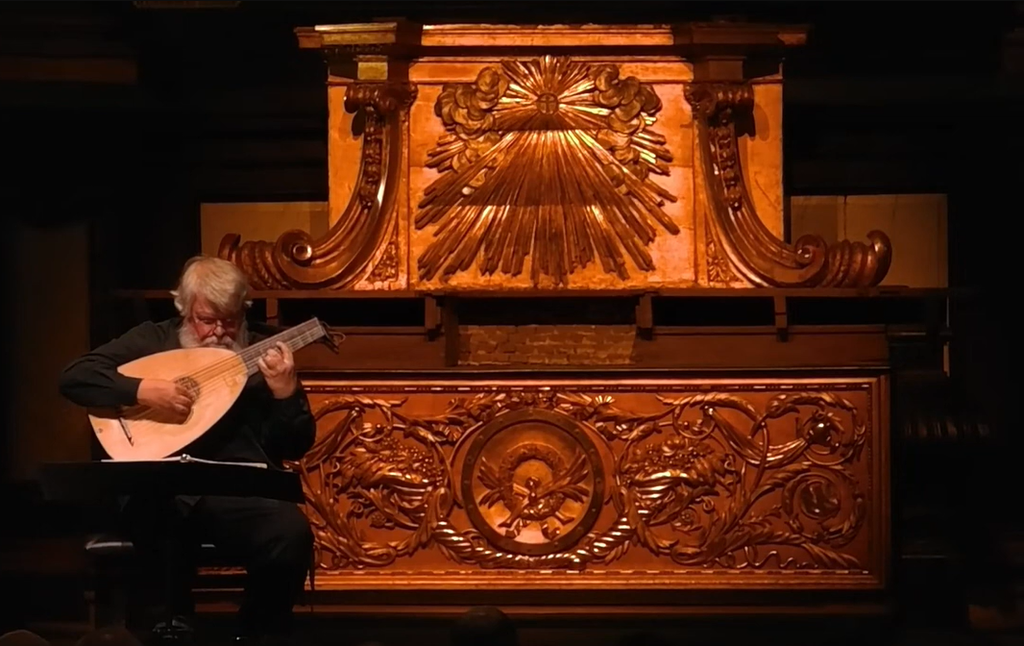
In Antwerp, the elegance of Paul O’Dette’s solo lute
At the Laus Polyphoniae festival, organised by AMUZ in Antwerp, Paul O’Dette gave a solo recital on 24 August entitled Destination Central Europe. In the former St Augustine’s Church, now AMUZ’s concert hall, the American lutenist explored the repertories that circulated across Central Europe around 1600.
The programme brought together Matthias Reymann, Melchior Neusidler, Wojciech Długoraj and Jakob Reis, alongside John Dowland and Jacques Gautier. Dances, polyphonic writing and more meditative pieces painted a portrait of a musical Europe in which composers, manuscripts and styles constantly crossed borders. It is particularly familiar territory for Paul O’Dette, who has spent decades exploring the many facets of the lute repertoire.
With Paul O’Dette.
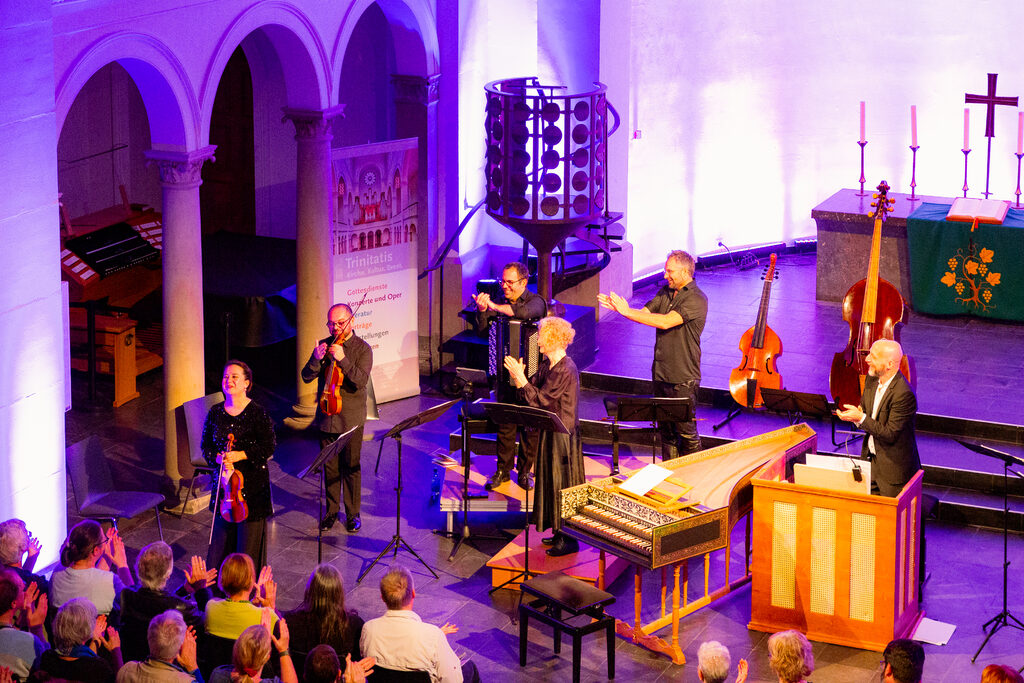
In Cologne, Dame Emma Kirkby at the SHALOM-MUSIK.KOELN festival
The closing concert of the fourth edition of SHALOM-MUSIK.KOELN, held on 10 September at Cologne’s Trinitatiskirche, was entrusted to Dame Emma Kirkby. Entitled Mizmor le David – Psalmen Davids, the programme set the Hebrew psalm settings of Salomone Rossi (c. 1570–c. 1630), a Jewish composer active in Mantua, alongside contemporary settings by Heinrich Schütz (1585–1672), rooted in the German Protestant tradition: the same texts, two religious and musical worlds.
Emma Kirkby was joined by four young scholarship singers from the WDR Rundfunkchor’s Choral Academy – Katharina Hirtz, Laura-Maria Püsch, Felix Läpple and Daeyeon Won – as well as Ensemble Ārt House 17, violinist Alfia Bakieva and Michael Hell on harpsichord and as musical director.
The festival ran from 1 to 10 September under the motto Zuhören (‘Listen’), taking over more than 25 venues across Cologne with a programme devoted to the diversity of Jewish music, from tradition to contemporary creation.
With Dame Emma Kirkby, the Ensemble Ārt House 17, Alfia Bakieva and Michael Hell.
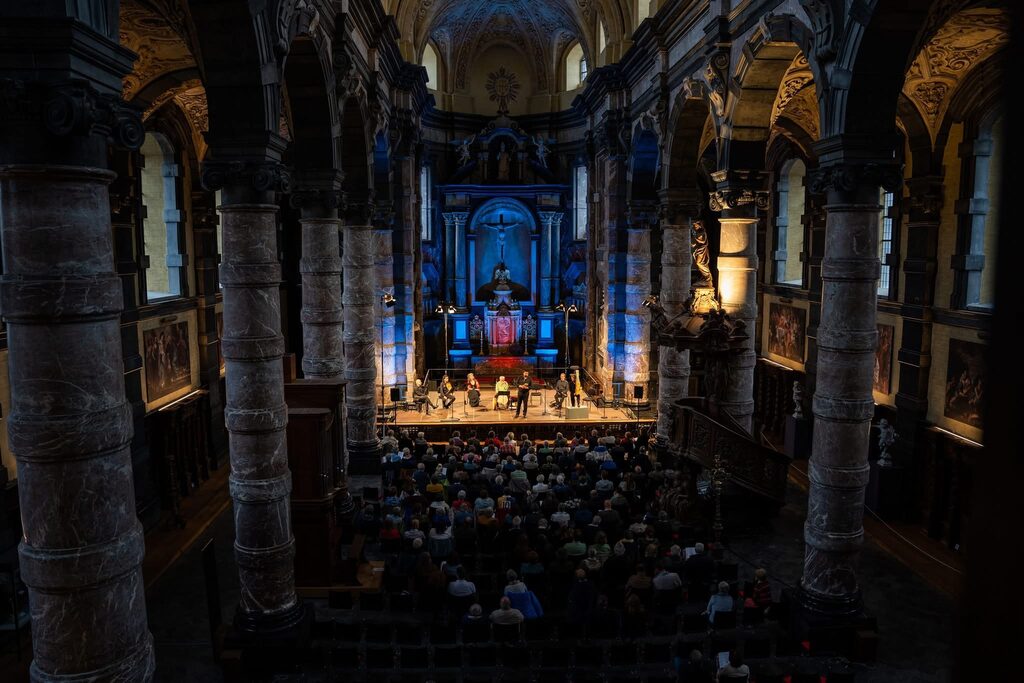
In Alsace, Céladon brings the miracles of the Cantigas de Santa Maria back to life
At the church of Saint-Jacques in Feldbach, as part of the Festival Voix et Route Romane, ensemble Céladon and its artistic director Paulin Bündgen presented Les miracles de Santa Maria on 5 September, a musical ‘epic’ drawn from the celebrated Cantigas de Santa Maria.
Composed and compiled in the 13th century under the impetus of Alfonso X of Castile and León (1221–1284), known as ‘the Wise’ or ‘the Learned’, these 427 songs dedicated to the Virgin are the work of a large workshop directed by the king, to which he himself also contributed. Written in Galician-Portuguese, they form one of the largest collections of lyric poetry from the Western Middle Ages.
Their world also bears witness to the cultural intermingling of the Alfonsine court, where Christian, Jewish and Muslim scholars worked side by side and where Romance and Andalusian traditions met. Céladon offers an interpretation that openly embraces the element of reconstruction: two voices surrounded by a rich array of instruments – vielles, medieval lute, harp, flutes, cornett, percussion, clavicymbalum and sinfonia – inspired in particular by the illuminations found in the manuscripts.
With the ensemble Céladon and Paulin Bündgen.
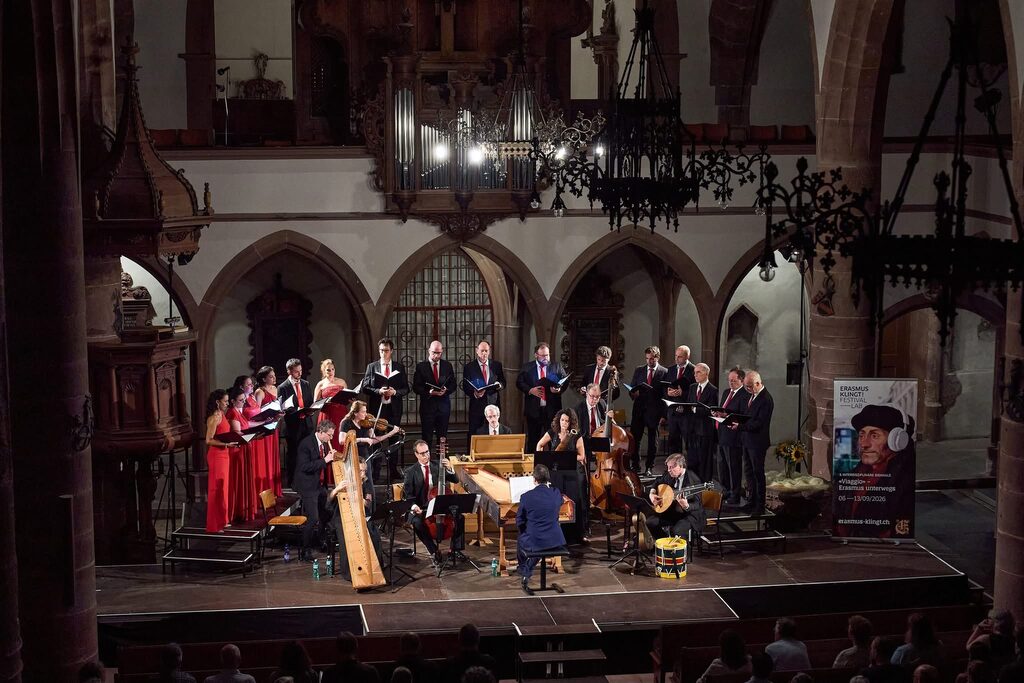
In Basel, Carmina Latina from the Iberian Peninsula to the New World
As part of the third edition of the Erasmus klingt! – Festival Lab biennale, devoted to Erasmus of Rotterdam, Cappella Mediterranea, the Namur Chamber Choir and Leonardo García-Alarcón presented Carmina Latina on 8 September at Basel’s Peterskirche. Erasmus himself had particularly close ties with the city: he spent more than ten years there in total and died there in 1536.
The programme traced a journey from the polyphony of the Iberian Peninsula to the sacred and secular music of Baroque Latin America, featuring composers including Victoria, Gaspar Fernández, Torrejón y Velasco, Francisco Valls and Juan de Araujo. This circulation of styles and traditions was particularly well suited to the festival’s 2026 theme, Viaggio – Erasmus unterwegs, devoted to travel and cultural exchange.
With Cappella Mediterranea, the Chœur de chambre de Namur and Leonardo García-Alarcón.
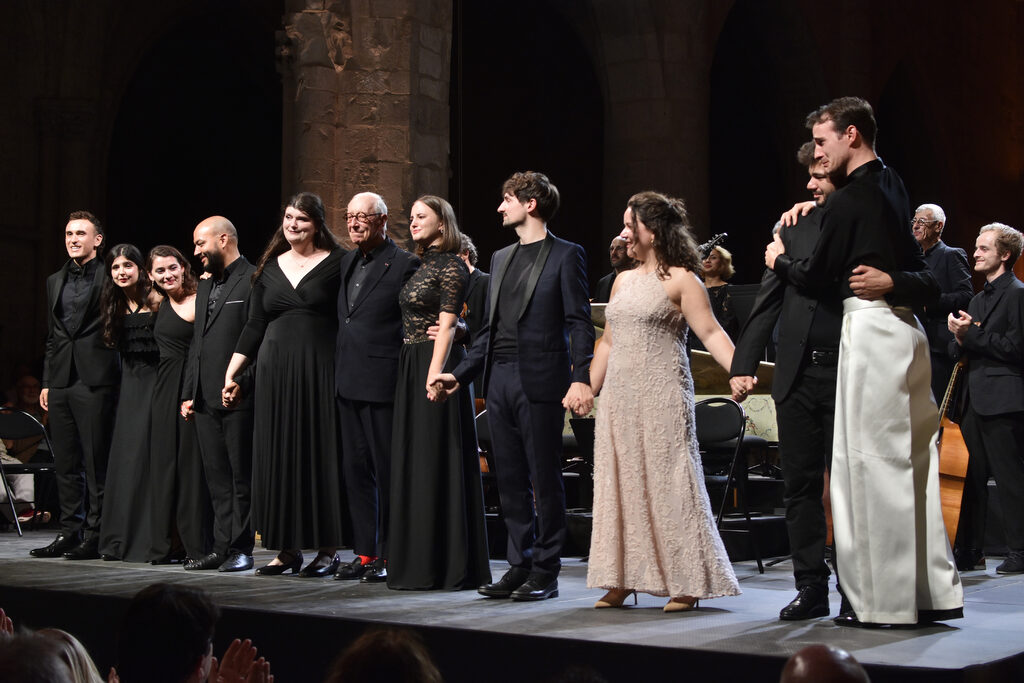
In Ambronay, Les Arts Florissants and Le Jardin des Voix return to Charpentier
During the first weekend of the Ambronay Festival, on 12 September, Les Arts Florissants, William Christie and the young singers of Le Jardin des Voix brought together two ‘pocket operas’ by Marc-Antoine Charpentier: Les Arts florissants and La Descente d’Orphée aux Enfers.
The first, an ‘idylle en musique’ in five scenes composed in 1685 for Marie de Lorraine, Duchess of Guise, is the work that gave its name to the ensemble founded by William Christie. La Descente d’Orphée aux Enfers, composed shortly afterwards in the same milieu, transforms the myth of Orpheus into a drama of remarkable concentration. The surviving score breaks off before the denouement: scholars still debate whether this open ending was intentional or whether part of the work has been lost.
This new production, staged by Marie Lambert-Le Bihan and Stéphane Facco and choreographed by Martin Chaix, brought together the young singers of Le Jardin des Voix around William Christie. It marked the conclusion of a long international journey for these two works, both at the very heart of Les Arts Florissants’ historic repertoire.
These two musical gems were performed with passion and joy by the young laureates of the 12th edition of the flourishing ‘Les Jardins des Voix’ academy, the biennial talent programme created by William Christie in 2002. At the end of the concert came a deeply emotional moment: during the final curtain call, William Christie’s voice broke as he announced the end of this academy, which had become a kind of artistic family and with which he had celebrated his 80th birthday the previous year.
With Les Arts Florissants and William Christie.

You must be logged in to be able to post comments.
Sign in