


 With Sacro Furore, Carlo Vistoli and the Akademie für Alte Musik Berlin (Akamus) take Vivaldi’s sacred music to new expressive heights, where faith, emotional intensity, and vocal flamboyance converge.
  By
By 


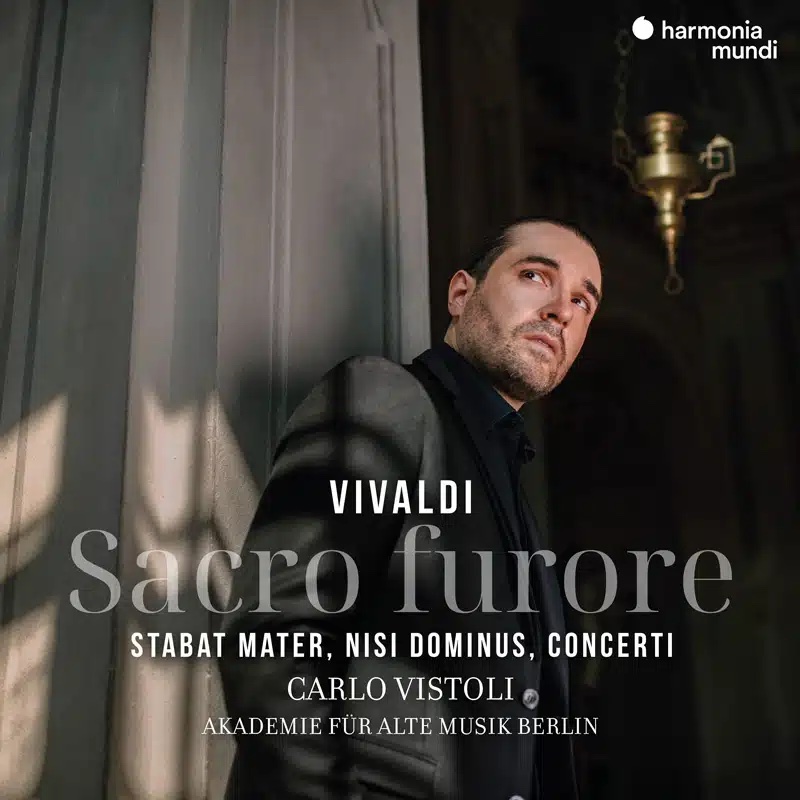
In Sacro Furore, Carlo Vistoli and Akademie für Alte Musik revisit Vivaldi’s sacred masterpieces, from the Nisi Dominus to the spectacular motet In furore iustissimae irae. Oscillating between expressive fury and intimate devotion, the programme highlights the theatrical dimension of sacred music, driven by a countertenor determined to convey the full emotional and dramatic force of the Venetian composer’s writing.
Sacro Furore unfolds as a journey through Vivaldi’s sacred works, navigating between contemplation and dramatic expressivity. How did you conceive this programme? What, in your view, does it reveal about the relationship between violence, faith, and theatre in Vivaldi’s sacred music?
With Akamus, we originally planned to record Nisi Dominus, after a tour in 2021 was almost entirely cancelled due to Covid restrictions (only one concert went ahead, in Essen). So, we began to consider what might pair well with that grand motet, remarkable in its expressive power and virtuosity. Stabat Mater quickly emerged as an obvious choice, as the two works are often compared—even on record. But we also wanted to offer something less conventional, which led us to In furore iustissimae irae, in a “new” version for contralto (originally written for soprano, but it suits this range extremely well). Once the works had been chosen, the idea behind the programme was to bring out the theatrical nature that runs through and nourishes Vivaldi’s sacred vocal music. In Stabat Mater, this comes through mainly in the highly expressive use of the voice. In a motet like In furore iustissimae irae, it’s found in the rhetorical forms and dazzling virtuosity—like a grand sacred scene of rage. Our goal was to propose an interpretation that is less “vertical” and more dramatic. This is indeed church music, but it tells powerful stories—sometimes even violent ones. After all, all religion is built on narrative, and these works resemble painted frescoes where striking scenes come to life, such as the Virgin weeping at the foot of the Cross.
The album alternates vocal motets with instrumental pieces, such as the G minor string concerto or the Madrigalesco Concerto in D minor. What kind of dialogue, in your opinion, emerges between these forms?
We wanted to give the selection of pieces a sense of unity and coherence, as though they were parts of a single organism or musical discourse. On the one hand, the instrumental concertos act as connective tissue between the three large-scale vocal works—almost like the interludes of a sacred drama. On the other hand, the interplay reveals fascinating parallels, particularly in Vivaldi’s use of instrumental colour, which mirrors his treatment of the voice and carries a similar dramatic weight.
The countertenor voice, historically tied to the castrati, has brought a fresh perspective to early and baroque music—especially sacred works. How does this unique timbre contribute, in your view, to the rediscovery of Vivaldi’s spiritual world?
The countertenor voice emerged historically with Renaissance church polyphony, before evolving into a solo voice in 18th-century England—sometimes used in oratorios. It was only in modern times that it became associated with the rediscovery of the Italian castrati opera repertoire. Although these works were sung by women in Vivaldi’s time, I believe that given the technical and expressive development the countertenor voice has undergone in recent decades—and the substantial reinvention it has undergone—it can now stand alongside female voices, offering a valid alternative in terms of colour. Especially in a repertoire like this, where there are no “genders”, and where the text can be delivered with the same dramatic force regardless of the singer’s gender. To me, what truly matters is expressiveness and the ability to convey the affetti through the inflections of both text and music. You need strength and energy for the fast passages, and tenderness in the more sorrowful ones—coloratura and legato, in other words. That’s what I strive to express with my voice.
 Press review
[Vistoli’s] coloratura is solid and exciting but never mechanical, and his ability to switch from anger to clemency […] is deeply impressive. […] In short, I think it’s safe to conclude that another new countertenor superstar has arrived, and he’s found just the right ensemble to work with.
Edward Breen, Gramophone
Cleverly assembled, sacred works and concertante pieces engage in dialogue throughout a disc where the encounter between Italian countertenor Carlo Vistoli and Berlin’s “Akamus” works wonders.
Télérama
The dizzying vocalises of the motet Nisi Dominus or the aria “In furore iustissimae irae” assign the countertenor an almost operatic role, while the sublime Stabat Mater makes him the voice of faltering emotion. In one register as in the other, Carlo Vistoli proves to be an absolute Vivaldian.
Pierre Gervasoni, Le Monde
In the sumptuous setting provided by the Akademie für Alte Musik Berlin’s accompaniment, these masterpieces by Vivaldi are elevated by Carlo Vistoli’s singing […] The countertenor stands at the peak of his artistry and mastery of a refined, delicate technique that serves a sincere expressiveness, capable of shaping exceptional musicality. […] Always attentive to the music, underlining Vivaldi’s extroverted character and theatrical writing, Carlo Vistoli succeeds in making this album a benchmark version—one to play on repeat.
Jean-Luc Izard, Baroquiades

You must be logged in to be able to post comments.
Sign in