


 At 80, Paul Van Nevel continues to view polyphony as an art of time: balancing rhythmic precision, the legacy of Gregorian chant, and an unwillingness to compromise, he looks back on fifty-five years of exploration with the Huelgas Ensemble, at the heart of a repertoire that is as essential as it is underappreciated.
  By
By 


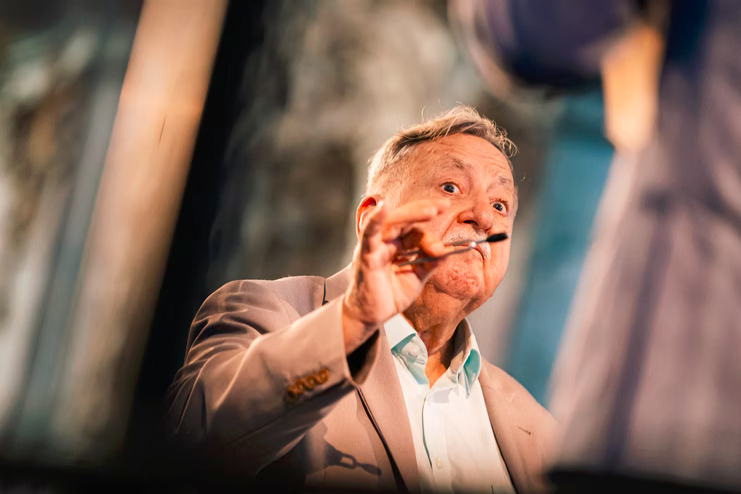
Based in Leuven, the Huelgas Ensemble is among the leading ensembles for the repertoire of the 14th to 16th centuries. This year, the ensemble celebrates its 55th anniversary, while its founder and director, Paul Van Nevel, turns 80. On this occasion, he reflects on his long-term work on early polyphony: the relationship to time and notation, rhythmic rigour, the training of singers, and the concrete conditions for performing a repertoire that is as vast as it is little known. First part of the interview.
You celebrated your 80th birthday on February 4, and you founded the Huelgas Ensemble 55 years ago, in 1971. What seems most important to you to celebrate?
Paul Van Nevel: The anniversary is undoubtedly the most important thing, and the whole project is, in a way, my reason for being. My own life is just taking its course, and we’ll see how it goes… so far, everything has gone very well (laughs). My health is excellent, so we’re just going to keep going. But of course, I do not know what I am going to do with myself; on the other hand, I know very well what I want to do with the ensemble, and that is what matters.
What do you mean when you say you don’t know what you’re going to do with yourself?
P. V. N.: Well, I could drop dead tomorrow. But an ensemble does not simply drop dead; it continues to exist. Or tomorrow, I might no longer feel like working with the ensemble, no longer have the drive; in that case, I would stop. But fortunately, for now, I still feel like it. Then it also depends on how I feel about travelling and life on tour: it is demanding, and if it becomes too much for me, I will stop. But that’s not the case at the moment. Right now, I still have an enormous number of projects prepared that I am absolutely determined to carry out!
Originally, Huelgas was not founded as a vocal ensemble, was it?
P. V. N.: Indeed, we began in 1971 as a quartet. The four of us were students in the class of Johannes Colette [Dutch recorder player and pedagogue (1918–1995), a pioneering figure in the rediscovery of the instrument in the 20th century and a professor at the Maastricht Conservatory], and it was thanks to him that we started Huelgas, at the time mainly with instruments in very varied combinations: all of us played the recorder, two also played the vielle, one also the crumhorn. This gave us many different ensemble options. It was only in the second or third year of our existence that I myself began to sing. I had, of course, sung for six years at the episcopal college and therefore had solid vocal experience. But after a year, I told myself: no, I don’t want to become a professional singer. So we brought in other singers, and it developed from there. In the 1980s, I finally came to understand that our repertoire, polyphony, belongs above all to the vocal domain, and so we gradually offered more and more a cappella programs. Today, we use instruments only when it is truly necessary or corresponds to the original context of the music. I am thinking, for example, of Claude Le Jeune, who set many psalms to music; in that case, instrumental participation is entirely possible. In contrast, in the Vatican repertoire in Rome, not at all: it is naturally a strictly a cappella repertoire. At present, around 80% of our programs are therefore a cappella.
Do you think that these instrumental beginnings, with the recorder and that consort sound, influenced the particular timbre you have cultivated for 55 years?
P. V. N.: No, it has nothing to do with it.
Not even with the sound you have in your head of that recorder ensemble?
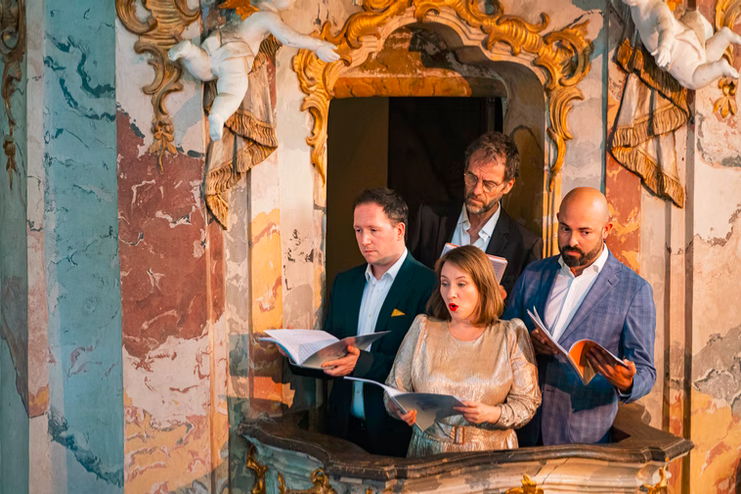
P. V. N.: No. The sound we’re interested in stems from something entirely different. It has to do with the way the text is set to the voice. I proceed from the idea that the singers and composers who performed this music primarily sang Gregorian chant. Around 70% of their repertoire was Gregorian chant, 30% polyphony, but they could not change their voices. And it is with that vocal aesthetic that we must work, an aesthetic founded on legato. A complete legato, nourished by the melismas of Gregorian chant.
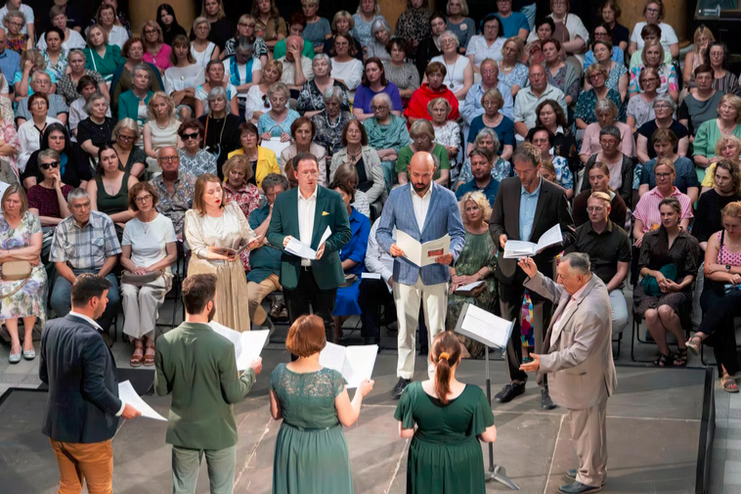
This is the style I wish to transmit to the singers of the Huelgas Ensemble. And so a unity is born—a harmony, if you will—a unity of sound and idea. What I do not want is a 19th-century choral sound, where everyone colours exactly like their neighbour! No: I want individual voices, distinct colours, identifiable, almost self-centred, one might say. But certain elements must be identical for everyone: intonation, the pronunciation of the text, and a precise, perfect rhythmic interpretation. Because the organization of time, the conception of time in these compositions—we are indeed speaking of mensural music [a system of notation used in Europe from the late 13th century until 1600 allowing precise durations to be fixed in music], this almost obsessive demand for rhythmic precision—that is what we seek to reproduce. And during the auditions I organize each year (this year, 86 candidates in three days!), the singers come from very far away, but most don’t know how to sing rhythms accurately. They sing approximately, slow down or speed up without realizing it. Paradoxically, at a time when life is entirely structured by rhythm from morning to evening, a solid sense of rhythm and precise rhythmic interpretation have become very difficult for younger generations.
Why do you think that is?
P. V. N.: Because their training confronts them less and less with the necessity of making autonomous decisions and of singing rhythm with the precision that was that of the time. And for that, one must be able to read the original notation, understand how to interpret dotted rhythms or other elements. What I hear today from certain baroque choirs, and also from instrumentalists, shows that they know little about this. I am taking only one detail here, but it shows how indispensable a perfect rhythmic interpretation is, because back then, singers were also composers, and vice versa. They knew exactly why they used a particular punctuation.
It is clear how much your repertoire remains exotic for a large part of society, even for a cultivated audience, and even in Belgium. How do you explain that your ensemble still exists and continues to give so many concerts after so many years?
P. V. N.: The notoriety of a repertoire has nothing to do with its quality, nor with its quantity. Certainly, an enormous amount of music was written, almost daily; a large part of it was neither very important nor particularly good. But there still remains a considerable quantity of very high-quality music, completely unknown. And when it is said that public interest is limited, I must disagree. Perhaps in Germany, but I can assure you that in Spain or Italy, as in Poland or the Balkans, we are unable to fulfill all ticket requests. The demand is enormous, and above all the public’s curiosity is great. As Umberto Eco said: curiosity is the beginning of wisdom! If we continue to exist, it’s because we bring to light an essential part of European culture of the 14th, 15th, and 16th centuries. That is a fundamental aspect. Of course, there are also many concerts that we turn down because the organizer insists on including Lassus or Palestrina in the program to ensure a full house. That, I do not accept.
When you look back over this long journey, is there anything you would do differently today?
P. V. N.: Oh, I already want to do what I recorded yesterday all over again today! Everything is evolution. Every rehearsal, every concert, every recording is a snapshot of a moment. We are constantly in motion; we are constantly reflecting on what we do. Experience cannot be measured, but one carries it within oneself. When I listen today to recordings made twenty or thirty years ago, I almost shudder, because I would want to redo everything differently, because I know more things today, or at least I believe I know more than I did then.
Can you share some of the most important discoveries you have made over these decades?
P. V. N.: An awareness of time. The way we convey an idea of time, a sense of time, and even the way we measure time. I wasn’t as aware of this in the past. Today, I’m much more conscious of the importance of time…
You mean time in the sense of tempo?
P. V. N.: Yes, in the sense of tempo, of the speed at which a work is performed. That is a central point. But also, the sense of time more generally. For me today, the choice of tempo depends not only on the music, but also on the text. I have a better sense of how people spoke in the past—when speech would speed up, and when it wouldn’t. The manipulation of time is crucial in the 16th century, and without it, the madrigal would never have existed. It rests on the absence of fixed time: one adapts time to the emotion of the text. In the 15th century, it was different: the tactus [regular pulse that organizes time in Renaissance music, serving as a reference for performance] was a constant. Think of the construction of a cathedral: if you remove the keystone, everything collapses. This symmetry, this sense of a fixed and immutable tempo, is essential to 15th-century music. In the 16th century, the perspective is reversed.
I also feel that these days, a lot of things are played too fast.
P. V. N.: Yes, often too fast. That comes from the desire to please the public. One wants to please, to be invited back, so one adapts. It is not only a musical problem, but a general cultural phenomenon: out of fear, one adapts. One should not. In politics, it is the same. In the past, a leader would say: here is my idea, it is right and good for the country, and I stand by it; if you do not agree, do not vote for me. Today, one asks what people want, and then adjusts the program. Instead, we should be honest and tell listeners: this is how we think this music might have sounded. If you don’t agree, you might not come back…
But clearly, this isn’t a problem for our audience; our concert halls are getting more and more crowded. Crossover projects are another example. Not only are the tempos getting faster, but instruments are being added that are neither necessary nor appropriate. For example, I’ve heard Brumel’s twelve-part polyphony performed with saxophones—no, thank you. That shows, in my view, a lack of respect for the past. The French philosopher Jean-Christophe Bailly once said that what frightened him most was the speed at which the current generation erases the past. It is a very broad idea, but it also concerns music. We do too many things too quickly, we think too little. And the pace of production is also very high. Rehearsing for seven days has almost become unaffordable today.

Next week…
- Paul Van Nevel: the importance of silence (2/2)
The octogenarian conductor will reflect on the importance of what he calls the “sense of silence,” his personal perception of sound, the dangers of the illusion of authenticity, and the passing of the torch, in the presence of his designated successor, tenor Achim Schulz.
You must be logged in to be able to post comments.
Sign in