


 Six years after releasing their recording of Cozzolani’s Vespers, Mathilde Étienne, Emiliano Gonzalez Toro, and I Gemelli take on a monumental work of the repertoire in the form of a book & CD set: Monteverdi’s Vespers of the Blessed Virgin.
  By Mathilde Étienne & Emiliano Gonzalez Toro


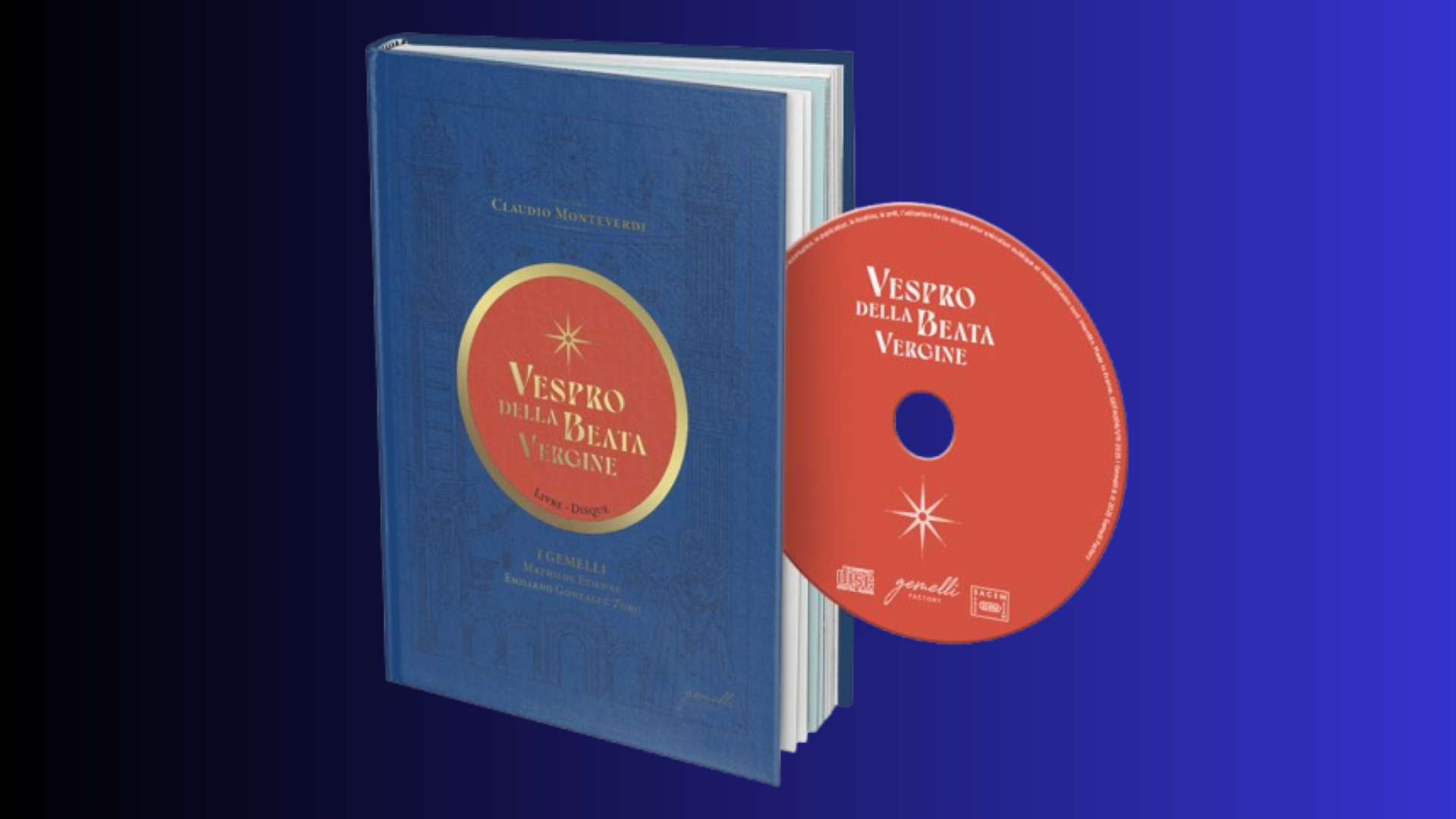
The CD-Book by I Gemelli breathes new life into the colours and rhythms of the score; the human voice and timbral dialogue lie at the heart of the process, highlighting the sacred texts and revealing their poetic splendour—both traditional and modern. While Orfeo displays all human emotions, the Vespers focus on a single one: joy. With sophisticated writing and jubilant effervescence, the Vespers appear as a love song, a hymn of praise to the Virgin Mary, a radiant figure who accompanied Claudio Monteverdi throughout his life. Total Baroque Magazine invites you to discover a few selected excerpts from this generous CD-book accompanied by a disc.
Emiliano Gonzalez Toro is a tenor and conductor. Mathilde Étienne is a soprano, dramaturge, and stage director. Together, they co-direct the ensemble I Gemelli, founded in 2018, and specialized in 17th-century vocal music.
Excerpts from the book & CD set Vespro della Beata Vergine, I Gemelly Factory, 283 pages, released February 28, 2025.
«
THE ROUND DANCE OF THE ANGELS
In 1572 in Paris, during the wedding of Marguerite de Valois and the future Henri IV, a sumptuous ballet was staged: La Défense du Paradis, with a set representing the heavens in the form of a large wheel featuring the signs of the Zodiac, seven planets, and an infinity of tiny stars.
The starry sky is a constant in court ballets across Renaissance Europe. As early as 1490, Leonardo da Vinci designed a Feast of Paradise where the seven Platonic planets emerged from the cosmic egg. In England, in 1607, Thomas Campion’s The Lords’ Masque conjured the Morning Star to make the celestial spheres appear in rhythm with the choir’s songs.
The courtly entertainments of the Medici between 1608 and 1615—including the famed Night of Love—played a decisive role in shaping this distinct genre. The starry night was not only a setting for evoking amorous longing, but also carried political meaning in courtly contexts. Such is the case for The Queen’s Comic Ballet at the court of Catherine de’ Medici, The Loves of Diana and Endymion, an interlude by Monteverdi for the wedding of Marguerite de Medici, or later, The Royal Ballet of the Night, where Louis XIV danced as the Sun King within a heliocentric set design inspired by Galileo’s discoveries.
(…)
At the end of the 16th century, attempts to revive ancient forms led to experimental styles that included in-depth reflection on poetic metre. Greek tragic poetry, indeed, possessed immense rhythmic variety due to its rich accentuation. In order to recreate the supposed effects of that music, French poets from the Pléiade and the Académie de Baïf sought to align poetry and music “in the ancient style,” using fixed metres composed of long and short syllables.
These experiments had a marked influence on Italian poetry (notably Chiabrera) and, consequently, on music. Zarlino’s Harmonic Institutions describe ballets composed on poetic metres. Metre is a central concern for Monteverdi, as indicated in the preface to his Eighth Book of Madrigals. Verses “measured in the ancient manner,” such as the Anacreontic metre, appear in L’Orfeo and the Scherzi Musicali of 1607.
There exists a proportional logic between musical structure and metrical style. Now, a Vespers service is composed of psalms with verses of unequal length: ensuring coherence between poetic rhythm and musical rhythm—necessary for overall harmony—presents a considerable challenge for any composer.
Monteverdi’s virtuosity is evident in his ability to make two seemingly opposed forms—psalms and dance patterns—coincide. The Dixit Dominus is a brilliant example: the psalm alternates unmeasured music (psalmodic verses in free rhythm) with dance rhythms (binary or ternary), punctuated by instrumental ritornellos. The text’s rhythm mirrors, by harmonic and spiritual analogy, the rhythm of the cosmos.
The main form in the Vespers is the pavane, in binary rhythm: a spondee (– –) alternating with a dactyl (– uu). The pavane is traditionally paired with the galliard, in trochaic metre; a long syllable followed by a short one (– u) creating ternary rhythm.
(…)
The Renaissance, steeped in Dante and Plato, often placed the Virgin Mary at the heart of choreographic representations, as seen in the Annunciations by Botticelli or Lorenzo di Credi. The bending of the knee, Gabriel’s crossed hands, the young girl’s bowed head form rhythmic, contrasting dance-like figures. In Botticelli’s Mystic Nativity, the Virgin and Child are crowned by a mystical round of twelve angels symbolizing the hours of the day, the months of the year, Mary’s privileges, and Christian invocations.
In Primavera, celestial Venus—symbol of harmony and concord in Neoplatonism—presides over the dance of the Graces, like the Virgin in a blooming garden. She embodies the highest level of spiritual love, one that elevates the soul to the heights of pure intellect.
(…)
SAPPHIRE AND PURPLE
In the Litanies of Loreto, Mary is called “mirror of justice” and “mirror of beauty”: the sweetness of dolce Maria, likened to the Moon, reflects the light of the Sun-God. Monteverdi dedicates his Vespers to the Virgin, a composition full of reflections and reverberations, mirroring the specular construction of the psalms.
Mary is immaculate, with a purity that makes her præclarissima (“most bright”). She is therefore exceedingly beautiful, for beauty, according to Thomas Aquinas, is born of three qualities: proportion, integrity, and clarity.
(…)
In painting, the Virgin is traditionally depicted in blue: only crushed lapis lazuli, a rare and luxurious stone, was deemed worthy of the Queen of Heaven. Pope Paul V even had a sumptuous lapis-lazuli altarpiece installed around the Virgin’s icon in the chapel of Santa Maria Maggiore.
In another of his chapels, at the Quirinal, the pope commissioned a fresco of the Virgin embroidering. In this episode from the apocryphal gospels, Mary—chosen by the elders to embroider the temple veil—drew the lot for purple and scarlet thread. These colours foreshadow Christ’s Passion: “They stripped Him and put a scarlet robe on Him” (or purple, according to the Gospel of Mark). Red, the colour of blood, symbolizes the human nature of Christ and His Mother.
(…)
In the 16th century, harmony—long conceived as the reduction of plurality to unity—came to be understood instead as the expression of plurality within unity, a concordance of differences. The influence of Venetian painting, with its chromaticism attentive to relief and balance, to the “tonality” of hues, made itself felt in musical conception. For Zarlino, the senses prefer complexity over simplicity; the ear delights in the composition of sounds as the eye delights in the composition of colours.
Monteverdi took this lesson to heart. He built his palette of sounds like a painter his pigments: voices, strings, woodwinds, brass, and organ are grouped in choruses or stand out individually to highlight the text through subtle plays of nuance, intensity, and tone. Like white highlights evoking light and reflection, musical ornamentation (the colour) enhances the disegno of the score with luminous, delicate touches. We are not yet in the Caravaggesque chiaroscuro of The Combat of Tancred and Clorinda; the chromaticism of the Vespers resembles rather that of Rubens: a tension between warm and cool, a mosaic of colours arranged around red and blue.
In 1608, two years before the Vespers were published, Rubens was in Rome completing the commission for the Oratory of the Chiesa Nuova, dedicated to the Madonna della Vallicella. The painter strove to reconcile the medieval icon and modern painting in a single, ingenious composition.
»

You must be logged in to be able to post comments.
Sign in