


 Recorded in the Basilica of St. Florian, Franz Joseph Aumann’s Missa Solemnis regains its original emotional resonance with Ars Antiqua Austria’s interpretation.
  By
By 


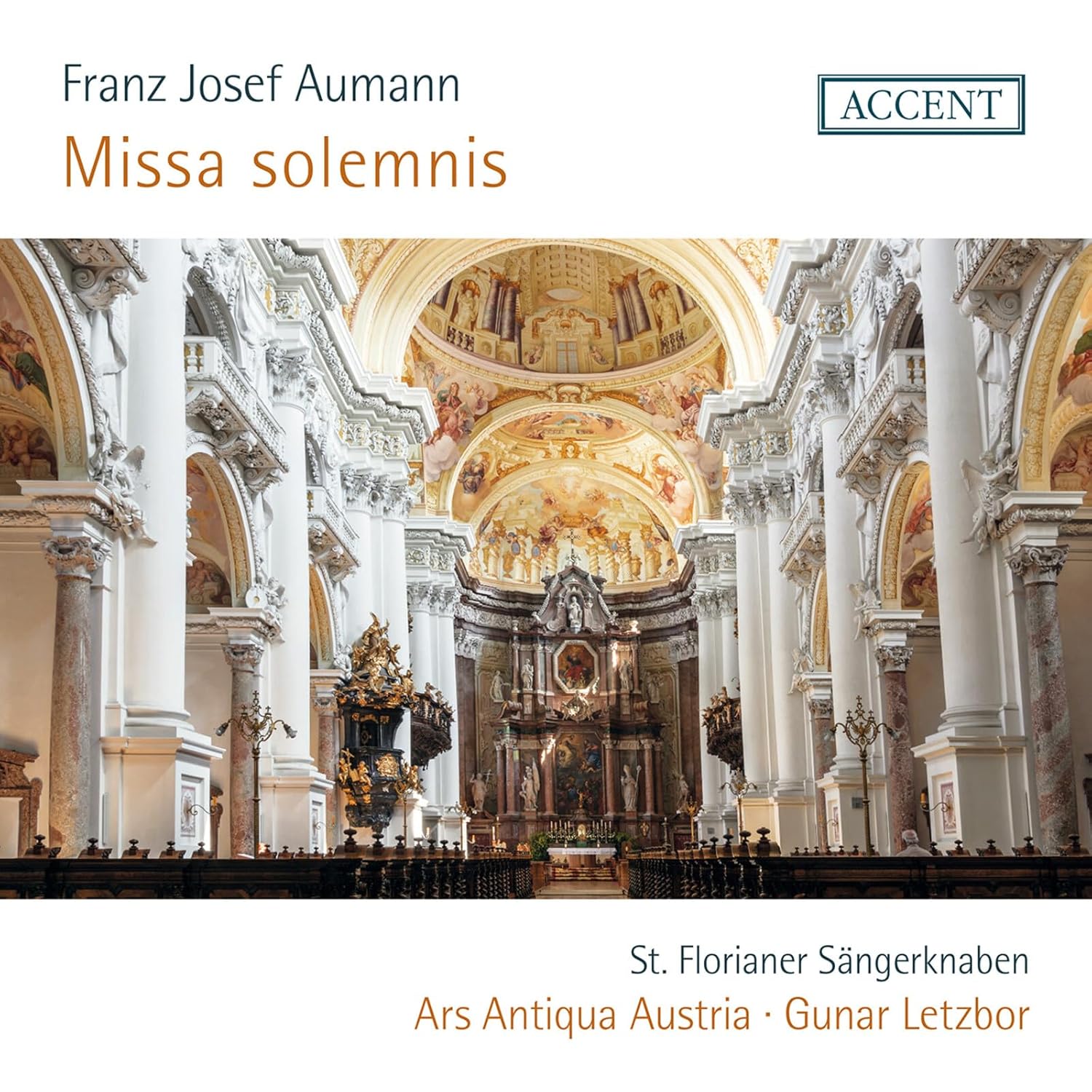
A little-known figure of late Austrian Baroque era, Franz Joseph Aumann is brought back into the light by Gunar Letzbor and his ensemble Ars Antiqua Austria, in close collaboration with the St. Florian Boys’ Choir. Captured in the very abbey where it was composed and first heard, this Missa Solemnis impresses with its sonic intensity, liturgical grounding, and refined writing. We met with a passionate conductor who is breathing new life into a forgotten tradition.
Franz Joseph Aumann remains a relatively unknown composer. What inspired you to choose his Missa Solemnis for a new recording?
Gunar Letzbor: I’ve been a regular guest at the Augustinian Abbey of St. Florian for nearly thirty years. With Ars Antiqua Austria, we organise a concert series there and frequently record albums. Our collaboration with the St. Florian Boys’ Choir has been a great source of inspiration we perform together regularly. Franz Joseph Aumann was an exceptional composer. As an Augustinian canon himself, he composed exclusively for the needs of the monastery. His sacred and chamber music was widely disseminated throughout Central Europe. The quality of his writing and the individuality of his style are truly remarkable. His works were still being performed regularly in the 19th century. Anton Bruckner, who was himself a chorister at St. Florian, drew some of his inspiration from Aumann’s music.
Did you encounter any particular challenges related to interpretation or historical performance practice as you were preparing this recording?
G. L.: Since the 1970s, efforts have been made to reconstruct historical instruments, but the focus has been on technical aspects of construction. Certain claims, although not always accurate, have become widely accepted as “characteristics” of these instruments. Yet one crucial aspect has been largely neglected: rediscovering the sound as it might have been heard in the Baroque era. And yet, it should be quite simple: the primary role of the violins was to play colla parte with the boys in the church. They had to blend perfectly with the choirboys’ voices and with the organ’s registers. Only when the violin timbre became truly soave (soft, mellow) was it permitted to take part in church music. It was only from that point on that string instruments began their ascent in instrumental music. Our task today is to rediscover that soave tone on modern instruments. Every opportunity to perform with the boys of St. Florian is a chance to get a little closer to it.
What do you hope listeners will take away from discovering this work? Is there a moment that particularly moves you?
G. L.: Aumann’s deeply Catholic sacred music is full of striking moments. What I find especially successful in this recording is that we’ve managed to capture the splendour of the basilica’s acoustics. You hear the music as it might have sounded in its original space. I’m also glad that the recording includes, alongside the magnificent mass, a chamber work that reveals another side of Aumann. One could hardly imagine a greater contrast! In his chamber music, Aumann is very much rooted in his land. He weaves in elements of folk music from the “land above the Enns” (present-day Upper Austria) while elevating them through charming and highly refined textures. In a way, Aumann’s music conveys both the architectural grandeur of the St. Florian monastery and the grounded yet cultured spirit of its inhabitants: the Augustinian canons.
 Press review
Letzbor creates strong dynamic contrasts, which underlines the festal character of this mass. The instrumental ensemble is outstanding, and the performances of the trumpeters deserve special praise. […] There is really never a dull moment in Aumann’s music, neither in his vocal nor in his instrumental works. Gunar Letzbor is an enthusiastic advocate of his oeuvre, and rightly so. It has resulted in some very fine recordings, and I hope that he continues his exploration of Aumann’s oeuvre.
Johan van Veen, MusicWeb
You must be logged in to be able to post comments.
Sign in