


 In “Duologues”, Rachel Podger turns counterpoint into an art of conversation. Joined by Lucie Horsch, Jane Rogers and Alex Rolton, the violinist sets the voices of Bach, Telemann, Carl Philipp Emanuel Bach and Boismortier in motion with exhilarating freedom and spontaneity.
 By
 3 minutes


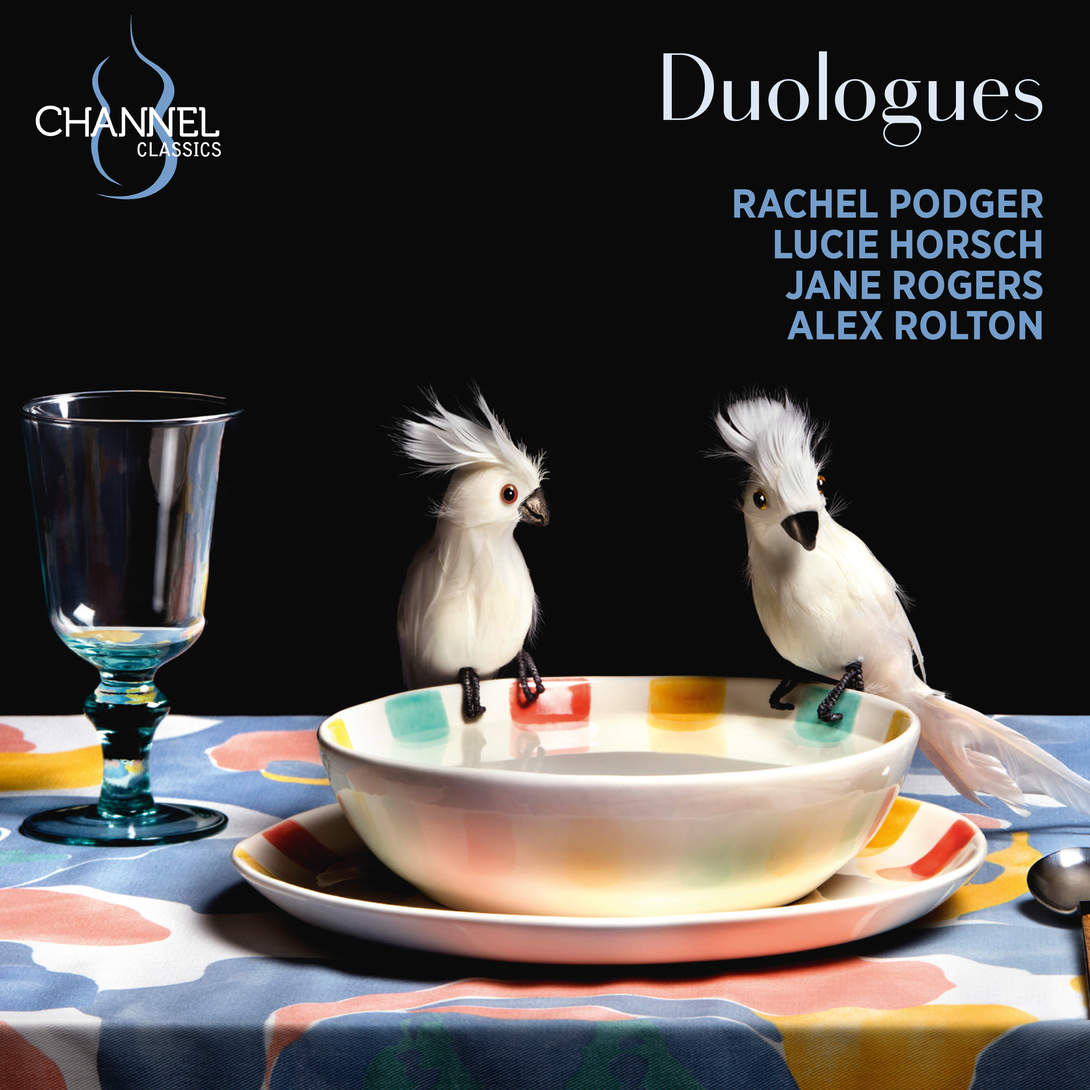
Released on October 16 by Channel Classics, Duologues places the violin of Rachel Podger at the centre of a deliberately stripped-back setting: no harpsichord and no permanent continuo, but a succession of one-to-one encounters with the recorder of Lucie Horsch, Jane Rogers’s viola and Alex Rolton’s cello. Bach provides the backbone of the programme, joined by Telemann, Carl Philipp Emanuel Bach and Boismortier, before a final excursion into traditional Irish music.
Bach finds new partners
The fifteen Inventions, BWV 772–786, form the album’s true common thread. Written to teach Bach’s pupils how to bring out two distinct voices clearly at the keyboard, they are divided here into several groups and arranged by Fred Thomas. Rachel Podger entrusts the second line in turn to viola or cello, while the three-part Sinfonias selected for the programme bring several partners together at once. The four Duettos, BWV 802–805, are meanwhile given to violin and cello.
The danger would be to hear these arrangements merely as an exercise in redistributing the different voices. Yet they work precisely because the musicians make no attempt to imitate a keyboard split between several instrumental parts. Instead, each line acquires its own weight, articulation and colour. With Jane Rogers, the darker grain of the viola gives the Inventions a warm foundation; with Alex Rolton, the distance between violin and cello makes the movement of the counterpoint more palpable still. The pieces cease to sound like miniature pedagogical exercises and recover what the booklet describes as their quality of “invention”: an idea taking shape and changing as it passes from one voice to another.
Two players, no safety net
It is with Lucie Horsch that the album’s principle becomes most immediately theatrical. The recorder player changes instruments according to the work – sixth flute, voice flute, alto in F or sopranino – allowing her sometimes to extend the violin’s colour and at other times to confront it with a distinctly different timbre. Telemann’s opening canon immediately sets the tone: one voice pursues the other, imitates it and provokes it. In Carl Philipp Emanuel Bach’s Duet, Wq. 140, the relationship becomes more fluid still, with the two performers continually exchanging the roles of melody, accompaniment and, at times, even bass line.
It is also here that the elegance of Podger’s playing meets Horsch’s vitality at its most compelling. In Carl Philipp Emanuel Bach, their mutual attentiveness gives the dialogue an almost improvisatory flexibility; in the Badinerie from the Suite in B minor, BWV 1067, virtuosity remains firmly at the service of the exchange and never slips into mere display. In Boismortier, whose Aria affettuoso from the Sonata Op. 51 No. 4 retains its original scoring, the dialogue breathes with an almost disarming simplicity.
The pleasure of the reply
An interesting detail in the booklet is its comparison between these musical exchanges and eighteenth-century correspondence: Bach’s letters, gifts sent to Telemann, and the circulation of scores and ideas. Something similar happens here: the voices overlap, imitate and sometimes contradict one another, each altering the other’s trajectory, to the point where an answer can itself become a new question, shaping the response that follows. It is through this interplay of listening and mutual transformation that the duo regains the vitality of its original purpose.
Ultimately, much of Duologues’ charm lies in this sense of lightness: thirty-four short tracks moving from Bach’s concentration to Telemann’s elegance, from Carl Philipp Emanuel Bach’s sensitivity to Boismortier’s grace. And when an Irish jig, The Kid on the Mountain, brings the album to a close, it feels anything but out of place. It simply reminds us of what has animated the recording from the outset: the very tangible pleasure of responding to one another, surprising one another and making music together.




You must be logged in to be able to post comments.
Sign in