


 At the Great Organ of Versailles, Thomas Ospital and l’ensemble Saint-Honoré pay tribute to composers, from Guilain to Marchand, Morel to Marais. A journey into the heart of the Grand Siècle’s legacy.
  By
By 


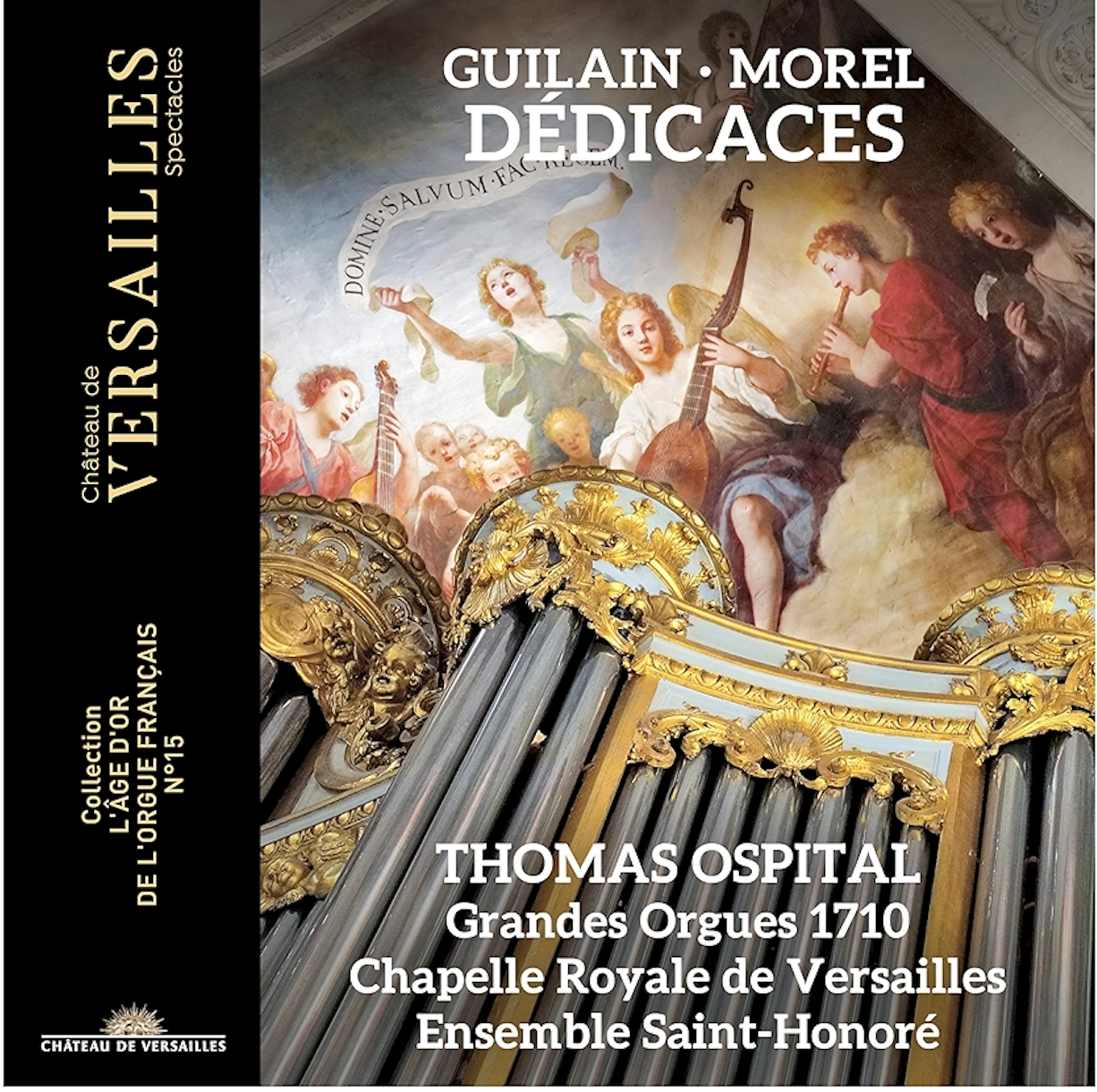
Jean-Adam Guilain and Jacques Morel are not familiar names, even for lovers of baroque music. The former, a pupil of Louis Marchand, published in 1706 his Pièces d’orgue pour le Magnificat; the latter, a disciple of Marin Marais, brought out his Premier Livre de pièces de violle in 1709. In Dédicaces, their worlds meet: the great organ of the Royal Chapel of Versailles, under the fingers of Thomas Ospital, engages in a play of alternation and dialogues with the Ensemble Saint-Honoré—two viola da gamba players (Sacha Lévy, Lukas Schneider), a harpsichord (Brice Sailly) and a chamber organ, directed by Valentin Rouget.
This album highlights works by Jean-Adam Guilain and Jean-Baptiste Morel, composers who are sometimes overlooked by the general public. What motivated you to bring these pieces together under the title Dédicaces, and what was the common thread that guided your selection?
Thomas Ospital: As the title of the work suggests, Guilain’s Magnificat pieces should alternate with Baroque plainchant. However, it would be liturgically absurd to take the Magnificat out of the context of the rest of the service and, moreover, to play the same hymn text four times in a row. We therefore wanted these works to alternate with pieces for gamba by his contemporary Jean-Baptiste Morel. The idea of alternating these suites with pieces for viola da gamba comes from the very structure of Guilain’s works. These highlight an attraction to the medium and low registers. This collection includes four pièces de basse and two récits en taille, compared to a single récit de dessus. The basses de trompette obviously borrow from viol writing. It was therefore the musical substance of these suites that convinced us to establish this link with Morel’s works.
Since 2015, you have been the titular organist of the great organ at Saint-Eustache Church in Paris. You recorded this program on the great organ at the Royal Chapel of Versailles, an instrument with which you are less familiar. How did the characteristics of this organ influence your interpretation of these French Baroque works?
T. O.: In fact, I have known the organ at the Royal Chapel of Versailles for a long time, because when I was a student, we had access to this instrument as part of a partnership between the CNSM and Versailles, a partnership which, fortunately, still exists today. Being able to record on this organ was therefore an opportunity to relive some very special emotions. Finding yourself in Versailles, in the silence of the night, is a striking experience. The instrument in the Chapel is perfectly suited to the venue and its acoustics. This type of organ, which has such character, suggests rather than dominates: it invites you to go along with it. There is no point in struggling with the organ: the performer must engage in dialogue with the instrument.
The title Dédicaces evokes a form of tribute. To whom or what does this album pay tribute, and how does this notion of dedication manifest itself in your musical approach?
T. O.: In their respective works, Guilain and Morel pay tribute to their masters by dedicating their work to them. For Guilain, it is Louis Marchand; for Morel, it is the illustrious Marin Marais. In both cases, there is an obvious stylistic connection, without ever falling into mimicry. Establishing this link allows us to better contextualize these works by highlighting the constants and particularities of each composer. This comparison also provides a better understanding of certain singularities, such as the exceptional range of the pedalboard required by the Trio du 4ᵉ ton: this was one of the characteristics of the organ at the Cordeliers, where Louis Marchand was organist and where Guilain was certainly a substitute, as was customary for disciples at the time.
 Press review
Thomas Ospital approaches these pieces with great nobility of playing, in harmony with the acoustics generously captured by François Eckert, where everything is revealed and unfolds with power and refinement.
Frédéric Muñoz, RESMUSICA
This disc is a good appetizer for Morel’s suites … the main attraction of this disc is the performance of the four suites by Guilain … Thomas Ospital … delivers stylish and entirely convincing interpretations
Johan van Veen, musica Dei donum


You must be logged in to be able to post comments.
Sign in