


 Marsyas Baroque goes back to the origins of its own name. From the satyr’s challenge to Apollo to his terrible punishment, the ensemble turns Ovid’s tale into instrumental theatre, bringing Vivaldi, Telemann, Gesualdo and Bach into dialogue with a new work by Alessandra Bellino.
 By
 2 minutes


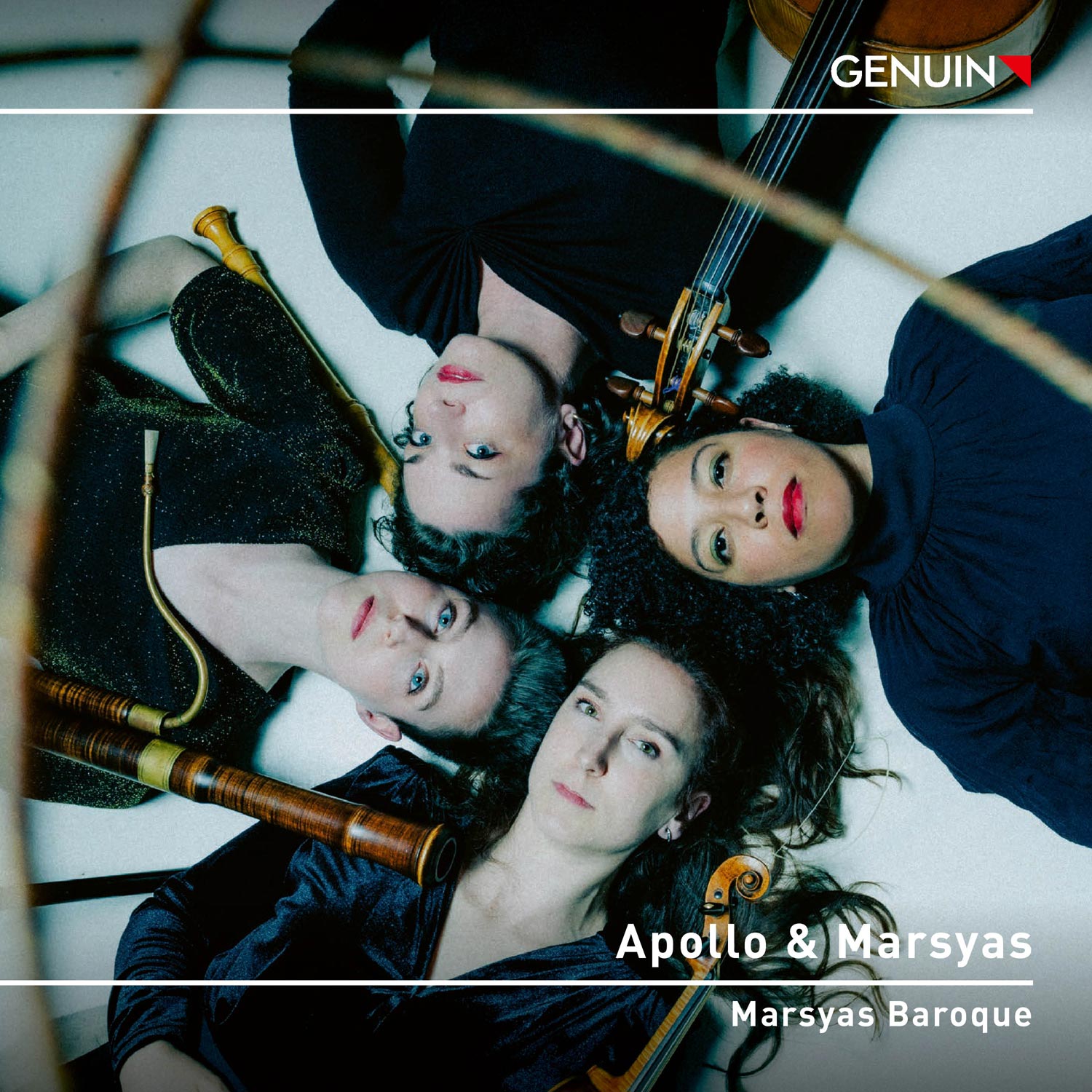
Released on October 2 by GENUIN, Apollo & Marsyas brings together the four musicians of Marsyas Baroque: Paula Pinn on recorders and Baroque bassoon, María Carrasco Gil on violin, Konstanze Waidosch on cello, violoncello piccolo and viola da gamba, and Sara Johnson Huidobro on harpsichord and organ. Across six scenes, punctuated by very short texts freely inspired by Ovid’s Metamorphoses and spoken by Timur Işık, they recount the musical contest between the satyr Marsyas and Apollo.
A myth as self-portrait
The choice is anything but incidental for an ensemble that has made Marsyas its emblem. In the ancient myth, the satyr discovers the aulos – a double-pipe reed instrument from ancient Greece – abandoned by Athena, and draws such striking music from it that he dares to challenge Apollo and his lyre. The contest proves fatal: defeated – or tricked, depending on the version – he is flayed alive by the god. Yet it is less Marsyas’s hubris – excessive pride – than his vulnerability that fascinates the four musicians: the idea of music that physically engages the performer, at the risk of exposure and self-revelation.
The programme embraces this opposition between two worlds. After Dario Castello’s Sonata Quarta à due Soprani, a true curtain-raiser in which the lines pursue and collide with one another, the two adversaries appear separately. Marsyas is represented by Quantz’s Vivace alla Francese and the unpredictable energy of Paula Pinn’s recorder; Apollo by Locatelli’s brilliant Capriccio, in which María Carrasco Gil’s solo violin embodies a very different approach to virtuosity. The contrast is immediate: breath against string, spontaneity against control, freedom against order.
From play to confrontation
Marsyas then enters the arena to Telemann’s light-footed, almost insolent Chaconne comique. Opposite him, Johann Caspar Ferdinand Fischer’s Toccata Uranie establishes a more hieratic gravity at the harpsichord. Vivaldi’s Concerto in D major, RV 92, finally brings the two protagonists together. Here the ensemble displays everything that makes the recording so successful: lively articulation without dryness, sharply differentiated timbres and, above all, remarkable cohesion between four musicians whose individual voices remain constantly recognisable without ever sounding detached from one another.
Timur Işık’s spoken interventions provide continuity between these episodes. Their brevity is welcome, preventing the recording from turning into melodrama and leaving the instruments themselves to carry the real narrative.
Music laid bare
The programme takes its boldest turn at the moment of Marsyas’s punishment. Commissioned especially for the project, Marsýas by Alessandra Bellino shifts the narrative onto different ground: a three-note motif returns insistently while gestures evoking the aulos and the lyre gradually merge, blurring the boundary between Marsyas and Apollo. The transition into Gesualdo’s Moro, lasso, al mio duolo is particularly striking, its extreme chromaticism extending Bellino’s tension and allowing the recording to cross several centuries without any real sense of rupture. The violence then recedes in Marais’s Plainte and Reichenauer’s Quartet in G minor, which turn the story into a collective lament.
Bach brings the journey to a close with Schmücke dich, o liebe Seele, BWV 654, the flute carrying the melody above the other voices in an understated moment of calm. Marsyas’s body has disappeared, but his breath remains. This is also what makes Apollo & Marsyas so compelling: a remarkably diverse repertoire held together by a strong dramatic arc and playing that remains agile throughout, ultimately turning the ensemble’s very name into an artistic manifesto.


You must be logged in to be able to post comments.
Sign in